Showing posts with label Pollock. Show all posts

Tuesday, September 16, 2025

Women of Abstract Expressionism

Image result for helen frankenthaler mountain storm
Untitled (1951), Frankenthaler
In February of 2017, the Palm Springs Art Museum (PSAM) held the "Women of Abstract Expressionism" (WoAE) exhibit. While still volunteering at the Seattle Art Museum (SAM), I created a MS PowerPoint presentation to give to my then committee of department volunteer chairs. I've blogged about several of the dozen artists in past posts, but not the entire group.

This untitled work by Helen Frankenthaler is reminiscent of a work by Spanish Surrealist, Joan Miró. I'm thinking of his Harlequin's Carnival (1925).


The Palm Springs area is rich in art, including multiple locations/venues​ (e.g. Palm  Desert), and events (e.g. Desert X)​. In 2017, Palm Desert was showcasing “Glass of the New Millennium”​ at Kaplan/Ostergard Glass Center​. Other attractions included: The Galen and the Faye Sarkowsky Sculpture Garden​; and Desert X – International Art Biennial in the Coachella Valley​. Lots of artsy things to do and see!

PSAM contains a mezzanine level overlooking a large atrium​. There is a wide variety of art on display, including a Chihuly in “Contemporary Glass”​.

The WoAE originated at Denver Art Museum, exhibited June – Sept 2016, and then on to the Mint Museum in Charlotte, North Carolina.​ It celebrates the “Divine 12”, often unknown or unrecognized female artists of the mid twentieth century. Many of these women were still alive when we visited.


Mountains and Sea (1952), Frankenthaler
Helen Frankenthaler (1928-2011) is famous for Color Field paintings and Lyrical Abstraction. I appreciate her pastel compositions the most, as opposed to some of her larger, more monochromatic (red) works. See Palm Springs 2020. Here, I see a portrait of a woman in a fancy hat! This is reminiscent of Kandinsky's (1913) Improvisation 31 (Sea Battle). See my post entitled, Our National Gallery of Art in DC. See also, Palm Springs Art -- Marilyn Monroe & Museum Exhibitions.


JFK (1963)


Elaine de Kooning (1918-89), wife of Willem de Kooning, is probably most famous for her figurative expressionism, and specifically her portrait of President John F. Kennedy. I included the portrait in My Art Journey.


The Eye is the First Circle (1960), Krasner

Lee Krasner (1908-84), wife of Jackson Pollock, was famous in her own right. Expressing her grief at the loss of her husband and mother in 1959, Krasner painted The Eye is the First Circle in 1960. Its title is a quote from Ralph Waldo Emerson's Circles, an essay about spiritual growth.


Inclement Weather (1970), Hartigan


Grace Haritgan (1922-2008) used vibrant colors and sometimes representational elements in her abstract compositions. It is currently on display at  the Smithsonian American Art Museum, Washington, D.C.


Antigone I (1958), Schwabacher


Ethel Schwabacher (1903-84) expressed anxiety and loss in her paintings following the death of her husband, Wolf in 1951. Wolf was a Jewish entertainment lawyer with clients such as the Marx Brothers. Studying under artist Arshile Gorky from 1934-36, she wrote his biography.


All Green (1954), Abbott


Mary Abbott's (1921-2019) work was inspired by nature and the jungles of the Caribbean. She was a descendant of President John Adams, a debutant and model in her youth, and a student of artist Mark Rothko. Although not representative of a jungle per-se, she's expressing how she feels by using the colors of the foliage and the sea.


Incision (1958-61), DeFeo


Jay DeFeo's (1929-89) Incision was both large and impressive when viewed in person at PSAM. Although it is largely shades of gray, the use of thickly applied oil paint and string seem to drip off the canvas. 


The Wave, Roaring, Breaking (1959), Fine


Russia-born artist, Perle Fine (1905-88) was a protégé of Dutch artist, Piet Mondrian and a student of Hans Hofmann. She used hard-edged pure abstraction as her trademark method. This is yet another example of oil and collage. Bristling (1946) uses oil and sand, and shows the influence of Mondrian.


The Beginning (1960), Gechtoff


Ukrainian-American artist, Sonia Gechtoff (1926-2018) was inspired by Giotto’s Arena Chapel in Padua, Italy where she spent time viewing frescos of the early Renaissance artist. It is intended to be a Genesis story and heavily influenced by Giotto.


Harlem (1981), Godwin


Lyrical abstract expressionist, Judith Godwin's (1930-2021) work has been displayed in over thirty-five art galleries. It's characterized by large organic shapes and sweeping brushstrokes. She was also a student of Hans Hofmann, who became her mentor.


Exodus (1960), Remington
Finally, Deborah Remington (1930-2010) also used hard-edged abstraction in her early works, then transformed into a machine-age abstraction, reflecting machines and industrial design during the era between the World Wars. Her work typically includes red and blue lines with black in the background.

Many of these expressionists were inspired by writers and poets whose works themselves are subject to interpretation.


Sunday, April 30, 2023

My Favorite Landscapes with Trees

Landscape with Trees (1881), Van Gogh

Vincent Van Gogh is known for his post-Impressionist works that used bright, bold colors and emotionally expressive brushstrokes. Sometimes we stumble upon paintings that seem less characteristic of a very familiar artist. Here, in Landscape with Trees (1881), Van Gogh captures this autumn scene using a more monochromatic palette than usual. Such uncharacteristic Van Gogh paintings using charcoal and watercolor wash are from 1881-86 while he was in Holland.


Cypresses (1889), Van Gogh


Perhaps more popular are Van Gogh's paintings of cypress, olive, and almond trees. I love his Starry Night and Wheat Field series painted from 1889-90, showing compositions that included pairs of iconic cypress trees. I love the familiar swirling brushstrokes in Cypresses (1889). I featured one of his very last paintings, entitled (olive) Tree Roots (July 1890), in my April 2021 post Artists Who Died Young (like Van Gogh).


Almond Blossom (1890), Van Gogh


Van Gogh often took inspiration from other artists (e.g., Millet), copying their works and making them his own. He studied Japanese art and gifted his Almond Blossom to his brother Theo and sister-in-law Jo on the birth of their son, Vincent Willem. The early Spring flowers symbolized new life. His nephew founded the Van Gogh Museum (The Rijksmuseum) in Amsterdam in 1973, five years prior to his death.


Jean-François Millet's The Gleaners (1857) inspired my Layered Landscapes art project used to teach fifth graders about perspective. In it, students drew three trees ranging in size and emanating from three hills. We chose a color scheme of analogous colors using blended oil pastels.


Two Trees (1907-8), Picasso


Perhaps I could have shown my students Picasso's Two Trees as a way of encouraging their own abilities to draw trees. Though not one of my favorites, it depicts trees using watercolors and in Picasso's Cubist style.


Blue Poles (No. 11),
(1952), Pollock
Four Trees (1891), Monet
In 1891, Claude Monet painted a series of poplar trees. His Four Trees reminds me of Jackson Pollock's Blue Poles due to the repeated shapes resembling Monet's poplars.


Chestnut Trees at Louveciennes
(1870), Pissarro
Chestnut Trees at Louveciennes
(1872), Pissarro
Camille Pissarro painted apple, walnut, and chestnut trees in his impressionistic style. Which one do you like best? I think the one on the right may have inspired one of Dali's later surrealistic works.


Swans Reflecting Elephants (1937), Dali


When teaching about Surrealism and Salvador Dali, I use his Swans Reflecting Elephants (1937) as a warm up challenge for my fifth graders. Of course, I keep the title hidden. I wonder what kind of trees Dali was thinking about when he dreamt up this scene.


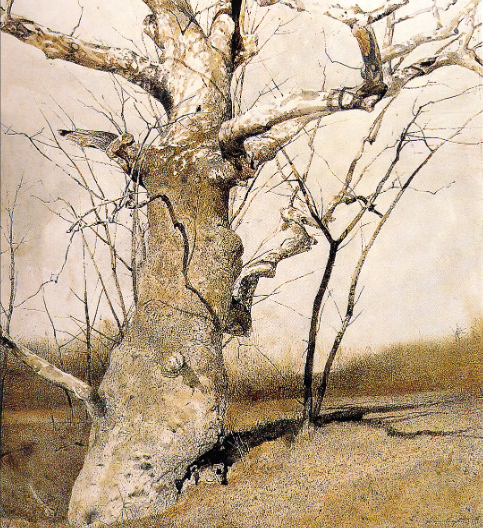
Sycamore (1982), Andrew Wyeth


This barren sycamore tree is recognizably the work of Andrew Wyeth. Wouldn't it be awesome to encounter such a magnificent and quirky tree on a walk through the Pennsylvania countryside of the Brandywine Battlefield?


Cairn in the Snow (1807), Friedrich


I also love 19th century German painter Caspar David Friedrich's (1774-1840) romantic landscape, Cairn in the Snow (1807). The subject is a pile of rocks (cairn) which is also known as a dolmen or a giant's grave (in the snow).


Capri Girl (1878), Sargent


My all-time favorite tree painting is by American portrait painter John Singer Sargent (1856-1925). It's a portrait of a favorite subject, Rosina Ferrara (a.k.a. Capri Girl), leaning on a birch tree. My daughter and I saw it on display at the Seattle Art Museum and couldn't stop looking at it. 

Friday, April 7, 2023

April Flowers in Art -- Daisies & Sweet Peas

Red April (1970), Sam Gilliam

In honor of my wife's birthday, let's pay tribute to April flowers in art. We can all appreciate the lively Spring colors in Red April (1970) by African American color field painter and abstract expressionist, Sam Gilliam (1933-2022). Often compared to Rothko and Pollock, Gilliam experimented with sculptural 3D elements in his paintings by using stretched, draped, and wrapped canvases. Another of my favorite abstract expressionists and color field painters is Helen Frankenthaler. Both Frankenthaler and Gilliam are known as lyrical abstractionists.


Daisies (1919), Matisse


Going back to the early 20th century, French artist and Fauvist, Henri Matisse painted Daisies (1919). Considered to be a double flower, the daisy is our first April flower. Matisse's vaseful of flowers contains Shasta daisies. His later 1939 version, The Daisies, depicts the more traditional wild white and yellow flowers, and there's a nude in the upper left corner, but you are free to access the link.


Girl with a Bouquet of Daisies (1897),
Jules-Cyrille Cavé


Girl with a Bouquet of Daisies (1897) by Jules-Cyrille Cavé (1859-1949) shows a young girl holding a bunch of wild daisies. I'm not sure but the floral wreath on her head may contain sweet peas, which also represent April flowers.


Vase with Daisies and Anemones
(1887), Van Gogh


While Vincent Van Gogh is famous for his paintings of sunflowers and irises, he also painted daisies and anemones. The daisies are in Vincent's favorite color yellow and prominently displayed in a beautiful turquoise vase. The textured background has Van Gogh's characteristic brushstrokes.


Drawing, Sweet Peas (1875),
Henrietta Benson Homer


Daisies are naturally resistant to many plant diseases and pests. Like daisies, sweet pea leaves contain antifungal properties. Here's a drawing of sweet peas by Henrietta Benson Homer (mother to Winslow Homer). I wonder if Mamma Homer ever tried doing embroidery or cross stitch. 

My brother and I used to draw wildflowers using pen-and-ink and watercolors. As a kid, I remember watching Popeye and occasionally seeing him follow around his troublemaker foundling son, Swee' pea. Like other characters (Wimpy, Poopdeck Pappy, and Sea Hag) in E.C. Segar's comic strip Thimble Theater, he only made rare appearances.


Freya (November 2022)


In Norse mythology, the daisy is considered to be the sacred flower of Freya, the goddess of beauty, love, and fertility. My wife's sister has a beautiful dog named Freya. Here's a photo of her that I captured this past Thanksgiving. I love how the beautiful pattern in her fur repeats in the striped fabric of the sofa.

Symbolizing innocence and purity, an old Celtic legend says that God sprinkled daisies over the earth to cheer the parents up, after the death of an infant.

Daisy, from the comic strip Blondie, was the Bumstead's Cocker Spaniel/Poodle/Terrier.


The Madonna of the Carnation
(1478), Leonardo da Vinci


In the 19th century, parents would encourage their children to get up after a fall by saying, “ups-a-daisy”. My Nana would have said, “oopsy daisy” or “whoops-a-daisy”. My wife has received lots of encouragement from family and friends during her recent illness. Her favorite flower is the carnation, which has become a symbol of motherly love. Christians believe that they grew from the Virgin Mary’s tears as she watched Jesus carry the cross.

I hope you've enjoyed this tribute to my wife, April flowers, and the artists and artworks that celebrate them.

Thursday, December 8, 2022

Our National Gallery of Art in DC

Majorcan Fisherman (1908), Sargent

John Singer Sargent in Spain

Recently, my daughter attended a professional conference in Washington D.C. and took the opportunity to visit several museums. She shared her photos of famous works on exhibit at the National Gallery of Art. Curiously enough, there were two exhibits of one of our mutual favorite artists, John Singer Sargent, while on one of his seven trips to Spain (1879-1912) to study Velázquez. His painting of a Majorcan Fisherman is particularly captivating and unlike many of his other portraits, usually of women, and typically with a darker color palette. It reminds me of Renoir's Luncheon of the Boating Party (1888) with its canopy and view through to the water in the background. I love the shadows and the sharp contrast of the dominant orange tones with the striking blue of the water.


Newly Discovered Art & Artists

Blue Morning (1909), George Bellows
Another American artist, George Wesley Bellows (1882-1925), painted a similarly framed landscape looking out over water. He is famous for painting urban life in New York City. His Blue Morning scene is reminiscent of Edvard Munch's sad depictions of mine workers returning home in the snow. Here, the column, fence, and shadows frame a silhouetted portrait on a foggy morning. The 'blue' may represent either the color of the water or the sadness of the workers. This is the last of four paintings Bellows made from 1907-1909.


Street of Barns (1914), Feininger


German American painter, caricaturist, and comic strip artist, Lyonel Feininger grew up in New York City. He was a proponent of Expressionism, painting buildings, street scenes, and barns. His figures are elongated much like those painted by fellow German Expressionist, Ernst Ludwig Kirchner. At first blush, I thought this painting was one of the works by Cubist George Braque. I guess I need to practice guessing artists using Artle - the daily art exploration game created by the National Gallery of Art (it's free!).


Still Life (1918), Picasso
Peonies (1901), Picasso
Speaking of Cubists and other Expressionists, The National Gallery of Art was also showing several works by Pablo Picasso. Besides his recognizable Harlequin Musician and The Lovers, also on exhibit were Still Life and Peonies. I hadn't realized that Picasso painted these flowers. Normally, Manet and Monet are the artists whom I associate with them.


Impressionists

Children Playing on the Beach
(1884), Mary Cassatt


Many of the French Impressionists' works are also on display at the National Gallery of Art in Washington D.C. My daughter took photos of the works of Mary Cassatt, Édouard Manet, Henri Matisse, Claude Monet, Camille Pissarro, Georges Seurat, and Pierre Auguste Renoir. I love the innocence of Cassatt's Children Playing on the Beach (1884). Her portraits are some of my favorites -- they are timeless.


The Railway (1873), Manet


Édouard Manet preferred painting portraits, and I'd call him a French Realist. Here in The Railway we see a portrait of a mother and child waiting at the train station. I am distracted by the bars of the iron gate as well as the stitching in the mother's coat. Perhaps the daughter is dressed up to receive her father from the train. Did you notice the puppy cuddling in the woman's lap?


Still Life with Pineapple (1924), Matisse


Fauvist Henri Matisse is responsible for many colorful still lifes, and I especially like this one with a pineapple. We were lucky enough to visit his museum while in Nice, France in 2011. Like contemporary artist, Kehinde Wiley, Matisse backgrounds are always very interesting.


Woman with a Parasol - Madame
Monet and Her Son
(1875), Monet
The Artist's Garden at
Vétheuil
(1881), Monet


Like Manet, Claude Monet used members of his own family as his subjects. We also visited his garden at Giverny in 2011. Quite impressive!


Landscape, Ile-de-France (1873), Pissarro


My daughter knows how much I appreciate the works of Camille Pissarro, His works transcend all of the various Impressionist movements, although he is often referred to as a Neo-Impressionist. His version of Monet's haystacks is equally impressive.


Seurat Retrospective, Georges Seurat


The exhibition also featured a sort of retrospective wall showing the work of French Post-Impressionist and Pointillist, Georges Seurat. Of course, A Sunday Afternoon on the Island of La Grande Jatte (1884-86) is probably his best-known Pointillist works, made famous by the play starring Mandy Patinkin.


A Girl with a Watering Can (1876),
Pierre Auguste Renoir


It's always fun to find familiar artwork at the museum you're visiting. Here's probably the most famous Renoir, A Girl with a Watering Can (1876). I seem to focus on the girl's upper half with the red bow and the blue and white dress, but I never really noticed the watering can. And I consider myself very observant!


More 20th Century Artists

Ground Swell (1939), Edward Hopper
So, luckily my daughter took photos of four more of my favorites, who are more modern and contemporary than those of the French painters you usually spot at art museums. These artists are Edward Hopper, Wassily Kandinsky, Joan Miró, and Lee Krasner (wife of Jackson Pollock).

I love Hopper's clean and confident style. His paintings have no frills, little shading, and calming areas of color that capture a moment and illicit relaxation for the viewer. 


Head of a Catalan Peasant
(1934), Joan Miró
Improvisation 31 (Sea Battle)
(1913), Kandinsky

I love Abstract Expressionism and the playful compositions of Kandinsky and Miró. Whether I am teaching kids or seniors to make colorful Kandinsky concentric circles or cutting out shapes to make Miró balanced compositions, it is always fun to find new masterpieces to share with them as examples for our projects.


Cobalt Night (1962), Krasner

It's surprising how many of Jackson Pollock's work I've seen at various art museums. Like Kandinsky, his compositions are usually numbered and mention the dominant color used in the painting. While vacationing in Palm Springs, I saw the exhibit of the 12 Women of Abstract Expressionism, including some works by Lee Krasner.


I hope you enjoyed this post about some of the 'most important' works currently on display at the National Gallery of Art in D.C. While in St. Petersburg, Russia in June 2019, our tour guide only showed us the 'most important' artwork because of the vast number of pieces at the Hermitage Museum. While I certainly appreciate seeing those, I still enjoy stumbling upon those diamonds in the rough, lesser known or seldom seen works, and even those by artists I've only recently discovered. This is how we learn and grow in our ability to appreciate visual art! 

Wednesday, July 27, 2022

Inspirations in Visual Art

What if a light bulb and a soft-serve
ice cream cone had a baby?

You'd get a CFL
(Compact Fluorescent Lamp)
[From the JoyReactor Website]

I'm always looking for inspiration for art projects, lesson plans, and especially what to blog about. Now that I have 136 posts, it is becoming increasingly more challenging to come up with ideas. I had hoped that my readers would comment, asking me to include topics of interest to them. After posting seven Baltics posts of June 2019, I received a request from one of my most avid readers for another in-depth series which resulted in six Art of the Pacific Northwest posts of July 2020.  I continued with Artist Interviews in September of 2020. That suggestion came from a website listing art blog ideas.


Smudgy the Cat from
PawsWithCause

Of late, my inspiration comes from baseball, shelter animals, teaching art to multiple age groups, art museums, and travel. When I visit new cities, I keep an eye out for local art such as sculptures and murals. Movies and other media also provide interest when I see art displayed in scenery, actors playing famous artists, or stolen artwork in the newspaper. It's fun to include Art in the News as part of my monthly elementary school lessons.


Vase of Peonies on a
Small Pedestal
(1864),
Édouard Manet


Following the art docent model of the Interurban Center for the Arts, I always include an inspirational work by a famous artist from which to pull an art concept, element, or principle of art. For example, I would use Jackson Pollock for a lesson about LINE. And for Positive-Negative Space I will always turn to Édouard Manet.


Two Crabs (1889), Vincent Van Gogh

My family, friends, and colleagues encourage me to do more art. Museums are always stimulating, especially when I discover another Van Gogh painting or see a Rembrandt in person! Flemish artist, Peter Paul Rubens heavily influenced both artists. Van Gogh was also influenced by his friend, Paul Gauguin, who encouraged him to paint from his imagination, French realist Jean-François Millet, other Impressionists, and Japanese art. Van Gogh painted Two Crabs in 1889 as an experiment in complementary colors inspired by the color theory of Eugène Delacroix.
In May of 2017, I saw it hanging in The National Gallery in London's Trafalgar Square.


Emily's Chicken


I wonder if PawsWithCause resident artist, Emily, was inspired by Van Gogh's crabs. Here is her portrait of a chicken in a very similar contrasting color scheme. Amazing! And I love the brushstrokes!!


My Charcuterie Board (2022)

Taking art classes and exploring new mediums and techniques instigates new hobbies and adds to your toolbox. I especially enjoyed learning the art of wood burning when my daughter and I took a class to decorate charcuterie boards. The recent COVID pandemic prompted me to engage in teaching online classes with Heart Art Healing and their Circle of Love. I've also been moved by family members requesting me to teach art to homeschoolers. And while looking for classroom spaces to teach such groups I was asked to teach art at a city-sponsored Summer camp.


Judy's Family Portrait Collage (2019)

I think the students that inspire me the most are other seniors. While I am amazed at the existing talent of senior citizens, I am happy to see the less confident ones discover talent they weren't aware they had. This is why I teach at Franke Tobey Jones Senior University in Tacoma. It's almost always the same group of 12-15 artists, some who are painters, a quilter, and several novices, all of whom bring their enthusiasm to my classes. My Collage Portraits with Seniors class was particularly successful!


PushMePullYou from Dr. Dolittle (1967)
Inspiration
is different than motivation. Some say that inspiration is a 'pull' while motivation is a 'push'. Inspiration is typically an internal, mental or emotional influence to do something creative. Motivation is more of a process of external stimulation with definite actions designed to achieve a goal. For example, weight loss could be a goal motivated or prescribed by a doctor to make a person healthier. The inspiration could be imagining yourself in a bathing suit or noticing the successful weight loss journey of another person. It may inspire you to think of creative ways to cook meals and make healthier choices.

My own motivation to do art is to inspire others to do it. My goal is to write in my blog every two weeks, to keep it interesting, and to get comments as a way of improving it or gauging its success. My hope is that my writing inspires others to be more creative, recognize and appreciate creativity in themselves and others, and feel good looking at, doing, or talking about art.


So, what inspires you? Creativity comes from the inside although it is often sparked by an outside stimulus.


Observation gives us the opportunity to realize and gain creative insight. Hopefully, this blog will inspire you to put forth the effort and provide you with the means, energy and enthusiasm needed to dedicate yourself to reaping your own artistic rewards.