Showing posts with label Artists. Show all posts

Thursday, April 10, 2025

Praising Budding Artists for Their Work

Words of encouragement go a long way to inspiring young artists. “Creativity is so delicate a flower that praise tends to make it bloom, while discouragement often nips it in the bud. Any of us will put out more and better ideas if our efforts are appreciated.” - Alexander Osborn

For example, "I love the way you...", or "Your style amazes me." is a great starting point. Get people talking about their art and have them practice talking about the work of other artists. "What do you like about it?" "Why did you choose this color combination?" Use art vocabulary, explaining how their choice of complementary or contrasting colors added interest. Besides praising an artist for their own unique style, it might be helpful to compare their work to that of other more famous artists. It also helps to take a picture of your art on your phone. Seeing a photo can change one's point of view away from the canvas you've been staring at for an hour and a half, and that which you've become overly critical.


Making connections with other artists and even the subject matter -- "Your brushstrokes remind me of Van Gogh" or "That reminds me of MY dog" -- are inspiring comments for an artist to hear. Their work is being thoughtfully acknowledged for its content, execution, style, or the feelings it invokes in the viewer.


Two Crabs (1889), Vincent Van Gogh
My family, friends, and colleagues encourage me to do more art. Museums are always stimulating, especially when I discover another Van Gogh painting or see a Rembrandt in person! Flemish artist, Peter Paul Rubens was heavily influenced both artists. Van Gogh was also influenced by his friend, Paul Gauguin, who encouraged him to paint from his imagination, French realist Jean-François Millet, other Impressionists, and Japanese art. Van Gogh painted Two Crabs in 1889 as an experiment in complementary colors inspired by the color theory of Eugène Delacroix.


In May of 2017, I saw it hanging in The National Gallery in London's Trafalgar Square.


Emily's Chicken


I wonder if PawsWithCause resident artist, Emily, was inspired by Van Gogh's crabs. Here is her portrait of a chicken in a very similar contrasting color scheme. Amazing! And I love the brushstrokes!!


An art docent needs to understand and become familiar with the elements and principles of visual art.


As time is often limited to an hour and a half, it is important to monitor the progress of the artist's portrait. They need to decide where to start, then begin to lay down paint. If they have a favorite color and are unfamiliar with brushes and the medium, you may suggest starting with the background. Help the novices mix their color in the large space in the center of the palette, making enough to cover the surrounding area. Often, with Seniors especially, the background is left blank. If the body of the subject animal is grey, that too may require mixing lots of that color in the middle of the palette.


One of our seniors spent most of her time outlining the features of her white cat and chose to limit her palette. She simply used black paint to suggest texture on the cat's coat. She carried on and used black for the front paws in shadow. The cat's tail saw the beginnings of Pointillism that had time permitted would have been an awesome technique to finish with. Because there was no paint applied to the background it made for a harmonious somewhat linear composition.


White Angora Cat (1761), Bachelier


Another favorite of mine is this portrait of a white angora cat beautifully (oil) painted by French artist, Jean-Jacques Bachelier. Here we see a cat chasing a butterfly. The cat's fur is well-executed. Though I wouldn't want to have to brush that coat!


All one-color animals, such as white or black cats, or white, brown, or black dogs, are particularly challenging to paint. It may take time to execute the subtle shading (primarily shades of grey). As an art docent I'd recommend doing small areas at a time while the paint is still wet; this is when blending is most successful. Maybe work on the head, then body and legs. Highlights may be added later, as with the back and tail in Bachelier's painting.


Two Cats Blue and Yellow
(1912), Franz Marc
Cats on a Red Cloth (1909),
Franz Marc

20th century German Expressionist Franz Marc captured some cats sleeping or grooming themselves. The first painting is more realistic than his second more expressive Cubist work. Can you find the mouse?


18th century English artist Thomas Gainsborough also studied feline positions of the Great Cat. According to the referenced link, his black-and-white chalk drawing is similar to that of another famous artist from the 15th century.

Apparently, I missed Paul Gauguin's Flowers and Cats (1899) while visiting the Ny Carlsberg Glyptotek museum in Copenhagen, Denmark on our cruise to the Baltics in June 2019.

Another recent post, entitled Making Connections with Artists & Animals features the cats of French Fauvist Henri Matisse.

Many of the world's most famous artists kept cats as pets. Here's a list:

Henri Matisse (Minouche, Coussi, and Le Puce); Pierre Bonnard (Cat);
Salvador Dali (Babou); Gustav Klimt (Katze); Georgia O’Keeffe (Siamese); 
Pablo Picasso (Minou); Louis Wain (Peter); Andy Warhol (Sam); and
        Wassily Kandinsky (Vaske)


We lost American artist Laurel Burch in 2007. She was famous for her bold cat designs such as those featured in one of her books, Fantastic Felines (1997). I believe we've done a jigsaw puzzle like this.


by Bill


Many of the artists who paint the shelter animal portraits are seniors who hang out at senior centers or assisted living establishments. One such artist is Bill, whose work is reminiscent of German Expressionist, Max Beckmann. See my post entitled, 'Egyptian Art, Sculpture, and Tombs'.


Another PawsWithCause patron painted this portrait of Cai with a light green tennis ball in its mouth. The artist's style is also like Beckmann, but with more of a Surrealist vibe. The background continues with the lime green color, adding little wispy shapes much like Henri Matisse decorated his red wallpaper in his Fauvist works. The touches of blue add interest to the composition.


You may also appreciate Medford the dog, who is sporting a Dio de Los Muertos mask on his face, reminiscent of the art of Frida Kahlo or Diego Rivera. Spanish Catalan painter Joan Miró often used a black background and Whimsical shapes (like spirals) to create his abstract art with Surrealist fantasy. Notice how the brushstrokes in his blonde fur add a realism that adds an anthropomorphic touch as if the animal is celebrating a human holiday. See Pepe the Dog in my post entitled, Making Connections with Artists & Animals.


Marlee is a good example of Realism. I especially like the artist's use of small, jagged brushstrokes, lending texture to the dog's coat. Happy accidents, like allowing the marker outline (from the original sketch) to show through, accentuate subtle features. I love the impressionistic background which further softens the overall painting. Check out the eyes with different color irises!


This portrait of Emma shows a good example of well-executed shading. The blue-gray color that the artist chose is a beautiful complement to her orangish-brown coat. Her sad eyes and overall color scheme make me think of the melancholy paintings (like "The Scream") of Norwegian Expressionist, Edvard Munch.


Many of our painting sessions, as with many of the art classes I've taught, are often too short for seniors or even younger students to complete a portrait in the allotted time. Although not common for established painters and master artists, some works are intentionally unfinished.


Gilbert Stuart created the Athenaeum Portrait of George Washington that currently hangs in the Smithsonian's National Portrait Gallery. The unfinished work was used to paint 130 copies sold for $100 each and for the engraving of GW on the US $1 bill.


The only other unfinished painting I've ever seen is “An Allegory of Virtue”, attributed to Corregio (~1489-1534), which hangs in the Scottish National Gallery in Edinburgh. 


Friday, April 19, 2024

Owls in Art & Photography

Photo (2024),
McDonald


In May of 2021, I posted about Birds in Contemporary Art and Photography. Today, I am inspired by a photograph taken by my nephew while stationed in Kuwait. It is a Pallid Scops Owl, one of six species found there.


My Michigan sister-in-law professionally photographed this Snowy owl. It migrates from Canada to Michigan in the Winter. There are at least seven other kinds of owls found in Michigan: Barred owl, Great Horned owl, Northern Hawk owl, Eastern Screech owl, Long-eared owl, Northern saw-whet owl, and the Burrowing owl.


I've researched artists famous for painting owls and here's what I found:


Detail from Garden of
Earthly Delights,
Bosch

Perhaps the earliest and creepiest paintings of owls were done by Dutch artist, Hieronymus Bosch, famous for his tryptic Garden of Earthly Delights (1503-15). His tiny owl peers out from a log hidden amidst an otherwise busy menagerie of fantastical creatures and figures.

"Owls were generally associated with menace and death and had an emblematic, moralistic significance."


A Snowy Owl, Tunnicliffe


British Naturalist painter and etcher, Charles Frederick Tunnicliffe (1901-1979) is famous for painting birds and other wildlife. I like the white and black bird against the background's subdued color palette.

See  Royal Academy link to copyrighted Tunnicliffe paintings and etchings.


Wood Owl (1968),
Picasso 


Fun fact: Pablo Picasso rescued an injured owl and kept it as a pet that became the inspiration for a series of Picasso's whimsical painted ceramics.


See British wildlife artist, Robert Fuller's (1972) My Collection of Barn Owl Paintings. What I appreciate about owls is their ability to blend into their surroundings. Note the amber color highlighting its wings and repeating in the tree trunk's moss. It's like they camouflage during the daytime, and except for their eyes (and hoot) are pretty much invisible at night.


Barn Owls, Immature, Jamie Wyeth


Jamie Wyeth (1946-), son of Andrew Wyethpainted Immature Barn Owls in 2006. While the owls themselves are somewhat ghostly, the artist was successful at showing them hiding in the shadowy rafters of the barn.


AB Owl (2023), Patterson 


My 'owl' pumpkin was inspired by Angry Birds. I was going for eyes that got lighter and lighter with each concentric ring. Anyway, I'm happy with the final effect!


Friday, April 12, 2024

Sculptors

Sometimes, entire museums full of sculptures can be overwhelming and even repetitive. You can only stare at a few busts or nudes in various poses before moving on and walking quickly by. Some of the European museums are jam-packed with similar pieces, with only a few standouts (in my opinion).

I appreciated being ushered through a 2019 tour of the Hermitage Museum by a guide who planned to show us only the most important works of art in the vast collection. I always find myself hunting around for the Rembrandts!

I prefer a middle ground between classical marble statues and grand, ultra modern, abstract installations.

Penitent Magdalene
(1440), Donatello 


I recall learning about Donatello's (1386–1466) unusual wooden sculpture of the Penitent Magdalene (1440) in an Art History class in college. It rather reminds me of melting chocolate. More impressive is how he executed this 6-ft masterpiece without using a chainsaw; it wasn't invented yet!

Unfortunately, we missed the Museo dell 'Opéra del Duomo, where she resides, during our 2011 trip to Florence, Italy.


The Pieta (1498-99),
Michelangelo 


We did get to see Michelangelo's (1475–1564) David while visiting Florence. And, although we splined through the Vatican museums and the Sistine Chapel, the lines to get into St. Peter's Basilica were too long, so we didn't get to see the Pieta. Which one is your favorite?


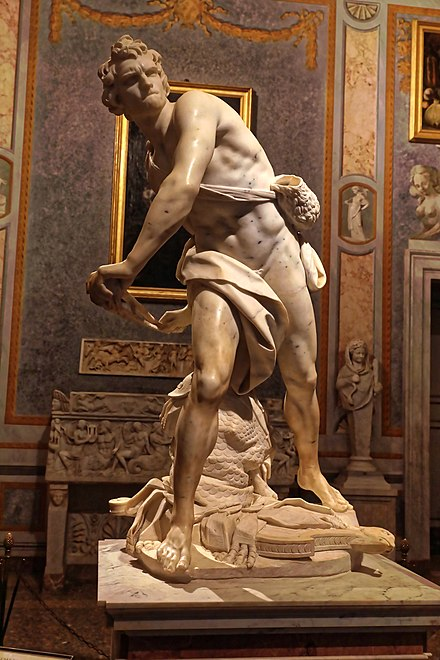
David (1623-24),
Bernini


We missed Bernini's (1598–1680) marble David while in Rome. He's on display at Galleria Borghese. We also missed Donatello's David, which I studied in my art history class. Although Bernini's is more of an action  (sling) shot. I think I prefer Donatello's bronze version.


Degas (1834–1917), although best known for painting ballet dancers and racehorses, he also sculpted them. We saw examples of them at the Ny Carlsberg Glyptotek museum while in Copenhagen, Denmark in June 2019. See my May 2020 post, entitled Sculpture - Another Dimension of Art.


The Kiss (1882),
Rodin
While in Copenhagen, we also saw Rodin (1840–1917) sculptures, though I struggle to remember any. He never actually carved any of his sculptures, instead merely directing other artisans to create them, probably due to poor eyesight. Famous for The Kiss and The Thinker, it was so realistic that he was suspected of surmoulage --  casting directly on the model's body.

More impressive is the Palm Garden and Kai Nielsen's (1882–1924) Mother of Water  (1918-20) as its centerpiece.

Unfortunately, we missed the Auguste Rodin - Displacements exhibit in 2021.


The only Brancusi (1876–1957) sculpture that speaks to me is Suffering (1907), which currently resides at the Art Institute of Chicago. It's an expressive bronze bust of a child. Unfortunately, the image is copyrighted. The Institute is on my bucket list to visit.


King and Queen (1952),
Moore


Henry Moore's (1898–1986) bronze sculpture once resided in Glenkiln Sculpture Park, located in Dumfries, Scotland. While I'd been to Edinburgh, Scotland in 2017, we didn't visit its park either. Lots of sculpture to see all over the UK! My favorite park is Vigeland Sculpture Park in Oslo, Norway, where we visited in June 2019.


Spider (1996), Bourgeois


Surrealist & Feminist artist, Louise Bourgeois (1911–2010) created this creepy Spider sculpture in 1996. I wonder if she was consulted for creating Ron Weasley's nemeses in the Harry Potter movies?

Friday, April 5, 2024

Alexander Calder - In Motion Exhibit

Untitled, Calder
Three-dimensional art is seldom taught in school, which is a shame. Alexander Calder (1898-1976) spent his early years drawing in space using wire to create 3D artworks. He was always building things using whatever he could find, perhaps because his parents were both artists who moved around to follow their commissions and exhibitions. Born in 1898, he created his first kinetic sculpture in 1931.


Figure, Dog, Birds (1946), Joan Miro


Calder was part of a group of avant-garde artists including Joan Miro, whose 2D drawings curiously resemble Calder's wire sculptures.


Yellow Circle

My daughter got me tickets to see the Alexander Calder - In Motion exhibit at the Seattle Art Museum. I once discovered a painting by Calder, which was hung rather obscurely near the information desk at the Palm Springs Art Museum. This 2D painting from the In Motion exhibit is similar to the one I found in Palm Springs.


I hope to eventually encounter some of Calder's grand-scale steel sculptures, like this one, that have been installed around the world. I believe there is at least one here locally in the Olympic Sculpture Park!

I believe this one is a stabile, rather than a mobile that would be in motion, and called a kinetic sculpture.


The In Motion exhibit is worth visiting, especially when witnessing the scale and breadth of Calder's work. In-person viewing allows one to appreciate the size and spatial quality. Even the shadows are impressive!

In Paris, Calder became inspired by the effect light had on the colored rectangles tacked on the wall of Piet Mondrian’s studio. Apparently, this image led to his working with mobiles.


Other Innovative Artists

For more kinetic sculptures, see 7 Artist Who Created Innovative Mobiles -- Beyond Alexander Calder. I've placed these artists in chronological order by birth year, and selected specific images.

1. Marcel Duchamp (1887–1968):


Bicycle Wheel (1951),
Duchamp


While I prefer Duchamp's futuristic Nude Descending a Staircase (No. 2) from 1912, some of his other works are pretty puzzling.


2. Man Ray (1890–1976):

Le Violon d'Ingres
(1924), Ray


Ray used everyday objects, such as hangers (Obstruction, 1920), in his kinetic art, though he's more famous for his photographs that were considered works of art.


3. Alberto Giacometti (1901–1966):


The Nose (1949),
Giacometti


Giacometti was obsessed with human heads and tall, slender figurines. They remind me of something an art teacher would use as a first project for students to study posing human figures. He had an interesting face, but his sculptures were repetitive and rather primitive.


4. Bruno Munari (1907–1998) 

My Multi-faceted Jacks (2015)


Boo! My multi-faced jack-o-lantern from 2015 has creatively designed mini carvings on a single pumpkin. Munari designed human faces in his graphical drawings made up of shapes. See Multiple Identities of a Face.


5. Roy Lichtenstein (1923–1997)


Barcelona Head (1992),
Lichtenstein


The father of pop art, his sculptures in his brushstroke series are 3D representations of movement in the style of his 2D Op Art images. He used benday dots to make his art look machine-made. He apparently designed Five Brushstrokes sculpture in 1984, but it wasn't fabricated until 2010, long after his death.


6. Swiss artist, Jean Tinguely (1925–1991)

The Métamatic, Tinguely


Tinguely is famous for using motor-powered automation, for his 'Métamatic' machines that produce artwork.


7. Julio Le Parc (1928–)


Blue Sphere (2001/13),
Le Parc


Much of his art is more like Op Artist, Victor Vasarely than Calder. Again, it is perhaps the 3D representation of 2D Op Art.


Friday, March 29, 2024

Watercolor Artists/Teachers

...We Three Meet Again... (2003), Birdsall
I am inspired by the artwork around me, especially when I encounter multiple works by the same artist all in one place. At Fred Hutch's South Lake Union House, where we've been staying while my wife recovers from a stem cell transplant, I saw two watercolor works by Byron Birdsall.

The first of two paintings is of three birds in a snowy scene (probably Alaska). It's my favorite.


Giorno di Shopping in 
Monterosso
, Birdsall
The second is a scene in a popular market on the Italian Riviera, and it looks like a photograph, until you get up close to it. 

Both were painted by Alaskan Watercolorist, Byron Birdsall (1937-2016). In a career that spanned 50 years, Birdsall painted thousands of watercolors/oils, including Alaskan scenes, panoramic landscapes, and even some portraits. I keep discovering more sprinkled around the apartment building.

Born in Buckeye, Arizona, he taught history for 6 years in California, then moved to Alaska to work in advertising, eventually taking up painting part time. Many professional artists, like Norman Rockwell, whose paintings were published in the Saturday Evening Post, worked in advertising.


Other artists who were also teachers:

White Bird of Paradise (1939)
O'Keeffe
American modernist painter, Georgia O'Keeffe (1887-1986), a student of Arthur Wesley Dowalso earned money for her own education working as a commercial illustrator and teacher.

She taught and continued her studies at the Teachers College, Columbia University. BTW, my mother grew up in NYC and lived in an apartment near the university. And my grandfather owned and operated a flower shop nearby.

O'Keeffe decided to become an artist at age 10, and received art instruction from local watercolorist Sara Mann.

O'Keeffe also taught and headed the art department at West Texas State Normal College.


Dead Rabbit with Copper Pot (1908)
O'Keeffe


This early O'Keeffe painting is reminiscent of Andrew Wyeth's Road Kill (squirrel). Both chose somewhat disturbing or unusual subjects. I apologize for the 'dark' image. I much prefer her modern colorful takes on closeups of flowers.


I and the Village (1911)
Chagall
Russian/French Artist, Marc Chagall (1887-1985) was also an early Modernist like O'Keeffe, although he is more commonly associated with movements: Surrealism, Cubism, Expressionism, Fauvism. Over 75 years, he produced more than 10,000 works. Probably his most famous painting is I and the Village (1911). In 2011, my family and I visited the Chagall Museum in Nice, France. His large artworks literally filled the walls!

He studied painting under realist, Jehuda Pen, and then in 1907 he went to St. Petersburg, Russia and studied art for three years with stage designer Léon Bakst.

Following WWI, at a war shelter in Malakhovka, Russia, Chagall taught art to Jewish boys. The school was once an orphanage for refugees.


The Blue Bird (1968),
Chagall


Chagall often included birds such as chickens and roosters in his dreamlike, symbolic, religious-themed surrealistic works.


Le Havre, The Port (1884). Boudin


I'm super thankful for Eugène Boudin, who taught Claude Monet and encouraged him to switch from drawing to painting outdoors. Check out Beach Scenes & Women with Parasols/Umbrellas, a post from June of last year, including some of my favorite Monet paintings.


Fishing Boats at Étretat (1885). Monet
I also appreciated the opportunity to visit Seattle Art Museum's Monet at Étretat exhibit in 2021. See my SAM Visit - Monet at Étretat post from August 2021 for more of Monet's beach paintings. Going to a museum is a great way to see multiple works by the same artist, especially at an exhibit in their honor.

My next tour will be the Alexander Calder exhibit at SAM next Thursday. I know, like me, he studied mechanical engineering but I'm unable to find evidence that he ever taught art. I'll continue researching for my next blog post.