Showing posts with label Sargent. Show all posts

Sunday, September 28, 2025

Famous Portraits of Children

The Age of Innocence (1788),
Reynolds

Now that I've been blogging for over six years, many of my favorite artworks have appeared in multiple posts. I apologize if you've already read about these common subjects. My love of portraits began with Rembrandt, who famously painted 75 self-portraits. As I became an art docent in my daughter's elementary school classrooms, I was exposed to many more talented portraitists, including Sir Joshua Reynolds, Principal Painter to the King. This painting may be of the artist's great niece. It was featured in my November 2022 post entitled, Famous Artists & Paintings -- By Century.


Lady Caroline Howard (1778),
Reynolds


Ten years earlier, Reynolds painted the portrait of Lady Caroline Howard, which was used early on in the art docent program in which I taught. See Artists With July Birthdays. The background and position of the subject figures are very similar, although you can easily see their stations and style of dress are quite different.


National Gallery, London


In Portrait Artists, my post from March 2020, I included a sweet portrait by John Singer Sargent. Although I'm a huge fan of the Impressionists, always gravitating to Van Gogh in particular, Sargent is my favorite portrait artist. Like Rembrandt, I am pleasantly surprised when I encounter one of Sargent's works at an art museum. 


A Girl with a Watering Can
(1876), Renoir


In Pierre Auguste Renoir's painting of A Girl with a Watering Can, the subject green watering can seems to get lost among the foliage and the dark blue of the girl's dress. If it wasn't for the lace trim on the dress it might be invisible. He has divided the composition in half, with the green grass in the background and the light dirt path in the foreground, balancing the girl's face color.


Young Girl with Doll (1884), Morisot


Much creepier is this portrait by Berthe Morisot. The black dress and the unusual and complicated background make it even more so. I am confused by the background. It feels like the girl is outside in a garden, but then the 'window' in the top right corner seems to depict a distant scene. Considering the upholstered chair, now that far off lighter area could be a bed. The large pot is also a distraction for me.


Little Girl in a Blue Armchair (1878), Cassatt

Perhaps the best known painter of children (and mothers) is Mary Cassatt. While I appreciate the cyan blue color of the fabric in the four chairs, I am less pleased with the clothing and pose of the young child. She seems to be relaxing, focusing on the dog resting nearby, and (maybe) waiting to be dressed. Apparently, Edgar Degas helped Cassatt rework this and ten other entries for her debut exhibition in 1879.


Mother and Child (1914),
Cassatt


My favorite is this pastel painting with its soft coloring and subtle blue shading. I like the child's little pink feet emerging from the mother's supporting left arm. The background is comprised of many colors, reminding me of one you'd see in a photographer's studio.


The Railway (1873), Manet


Édouard Manet's painting of a well-dressed child waiting for a train features his favorite model, Victorine Meurent. You may recognize her from his famous Luncheon on the Grass, although here she is clothed in a rather drab blue suit and matching hat. The model may not actually be related to the child. She may be portraying a nanny, who curiously is also caring for the girl's puppy.


Buttercups and Daisies (1881),
Hugh Cameron


I much prefer the portrayal of youths in the 19th century to those depicted as miniature adults in the earlier 18th century. Although this subject is shown without adult figures, she is realistically proportioned. Perhaps being related to the subject allows Cameron to capture the sweet personality of the little red-haired girl.

Sunday, September 14, 2025

Boats in Art History

Breezing Up (A Fair Wind) (1873-76), Homer

September marks the end of Summer, boating season, near end of major league baseball, the start of Fall and the school year. Sailing and sailboats have always fascinated me, though not enough to purchase one. Instead, I'll stick to rowboats and canoes, fishing on lakes rather than the open seas. My first, and probably my favorite, sailing painting is by Winslow Homer, an artist whom I studied in Art History in college. The man and three boys makes me nostalgic for my dad and two brothers.


Impression Sunrise (1872), Monet


Around the same time, French Impressionist Claude Monet painted his iconic Impression Sunrise. Blues dominate this seascape with contrasting orange punctuating an amazing sunrise. The only other colors are dark green and purple suggesting the silhouetted shapes of small watercraft against a background of larger ships.


Boating (1874), Manet
Édouard Manet's Boating captures a young couple sailing in the Summer. The man is Manet's brother-in-law, Rodolphe Leenhoff, and it is only assumed that the woman is Manet's wife, Camille. While the boom is meant to frame the scene, I am bothered by the corner and the dark-shadowed interior behind the woman's back. And her pose seems unsteady, awkwardly leaning into an empty space. Luckily, Leenhoff's white clothing takes contrasting focus away from the darker parts of the boat.


The Boating Party (1893/94), Cassatt
In contrast to the Manet painting (above), Mary Cassatt's portrait (with child) is darker, but includes a thin sliver of horizon not present in Manet's. Cassatt has rendered a Gauguin-like ~post-impressionist work using solid, decorative, almost geometric shapes that flatten the picture. The rigging of the sail cuts off the shadowed portion of the female figures. The sail and the woman's hat shade the woman's face and the top half of the child's face. Cassatt has used a light green (citron) and black to divide the scene from the expanse of blue water, helped by the diagonal lines of the rigging and oar.


Fishing Boats on the Beach (1888), Van Gogh


I love Van Gogh's paintings of fishing boats. The masts, spars, and rigging seem to complicate the composition to me. Especially the reddish orange diagonal line (boom?)! As always, I appreciate Vincent's use of yellow. His trip to Saintes-Maries-de-la-Mer lasted one week in June 1888, approximately two years before the artist's death in July 1890.


Sunrise (Mane) (1872-73), Monet


Another of Monet's sunrise paintings is on exhibit at the Getty Museum in Los Angeles, California, where my daughter recently visited. She knows of my passion for art and particularly impressionists. Just as atmospheric as the one above, but softer and less bright, I think I actually prefer this version to the other more famous sunrise painting.


Boats at Anchor (1917), Sargent
My favorite portrait artist, John Singer Sargent, also painted landscapes and seascapes. I love this watercolor of Boats at Anchor (1917). Sometimes I wish artists would edit out the somewhat repetitive reflections in favor of simplifying their compositions. Using watercolor though, Sargent merely suggests, rather than duplicates, the reflected images. His quick brushstrokes and squiggly masts make the water come alive with light and shadow. I'm not sure about the white blob in the bottom left corner (another boat?).


The Boat (1953), Matisse


As far as reflections, Henri Matisse created a rather simple paper-cut composition of a sailboat. In 1961, his work was mistakenly hung upside-down at MOMA in New York for 47 days before a museum patron alerted a guard about it. I love showing this one to my young art students! 


Vernazza Harbor (2024), Patterson
My last example of boats is my own acrylic painting of the harbor at Vernazza, Italy. I painted it for my daughter and her husband last year for Christmas, after promising it as their wedding present almost two years prior. The hardest part was the windows and the mooring pier to the right. I like the smaller reflections of the boats in the middle ground and how the reflection of the water shimmers on the wall of the pier. This would make an excellent jigsaw puzzle! Maybe I'll submit it for another Xmas gift.


Friday, June 9, 2023

Beach Scenes & Women with Parasols/Umbrellas

On the Beach (1873), Édouard Manet

Beach scenes were popular subjects in the paintings of the late 19th and early 20th centuries. As you can see here, Édouard Manet and his wife are fully dressed and seated on the beach to watch the big ships sail by. Both subjects are well-covered as if they needed protection from the sun, suspiciously absent from their surroundings. The gray and black figures stand out against the pale-yellow sand. Curiously, Madame Manet's bonnet and shoe get the most detail.


Woman with a Parasol (1875), Monet


Continuing with three paintings by Claude Monet, I must include Woman with a Parasol (1875) even though it may not be a beach scene like the other two paintings. I love the atmospheric effects that Monet has achieved in this painting of his wife and child. Monet reflected the green ground in the underside of Madame Monet's parasol. Her white dress is like a canvas reflecting the colors of her surroundings, making it seem like we're looking through and beyond her. I love this painting!


The Beach at Trouville (1870), Monet


Earlier, in 1870, Monet depicted this scene of The Beach at Trouville. It may have well been people walking on a city street instead of a boardwalk and sandy beach. This northernmost coastal city of France is over 700 miles from southernmost Nice, where we visited in May 2011, yet it looks quite similar. 


Beach in Pourville (1882), Monet


Monet painted a series of more impressionistic beach scenes in 1882. The shadows of the cliffs in the bottom corner distract me almost to the point of drawing a 'line of tension'. Fortunately, the sandy curved shoreline directs me eye toward the muted building in the background.


By the Seashore (1883), Renoir


Pierre-Auguste Renoir painted lots of portraits of women, including this one where the subject is posing in a wicker chair in the artist's studio. He added the beach scene in the background based on studies he did en plein air (outside).


A Sunday Afternoon on the Island of
La Grande Jatte
(1884-6), Seurat

The classic A Sunday Afternoon on the Island of La Grande Jatte was painted by Georges Seurat and depicts Parisians relaxing in a park on an island in the Seine River. It's probably the most famous Pointillist work of Neo-Impressionism. And also a very large painting measuring 6.6 ft × 9.8 ft. I usually try to tell my students the size of the painting that inspired my art lesson.


Fishing Boats at Sainte-Marie (1888), Van Gogh

Vincent Van Gogh's beach scenes typically contain brightly colored fishing boats. This one resembles Renoir's By the Seashore in that the subject boats stand out vividly against the more pastel background. The distant sailboats on the water almost disappear at the horizon.


Idle Hours (1894), Chase


I'm less familiar with American Impressionists such as William Merritt Chase. When I saw this scene of his family relaxing on a grassy knoll, it instantly reminded me of Port Townsend, Washington (sans Pt. Wilson lighthouse). Chase was also an art teacher who taught two of my favorite painters: Georgia O'Keeffe and Edward Hopper.


Lady with a Parasol (1900-1), Sargent

My favorite portrait painter has to be John Singer Sargent. His Capri Girl (my favorite) and other more formal portraits are unlike this one of a reclining Lady with a Parasol. Though in an awkward position, the shapes and swirling lines make for an almost abstract composition. I enjoy stumbling upon these gems whether I'm researching for my blog or visiting an art museum.


Women Walking on a Beach (1909), Sorolla


Our final artist is Spanish painter, Joaquín Sorolla. He has successfully captured his wife and eldest daughter taking a stroll along a beautiful beach. I love the movement and his ability to create a subtle value range using whites and grays. I'm assuming the daughter is on the right, carrying only her straw hat, while her mother is burdened with a coat and umbrella. Sorolla has cut off his wife's head and interrupts the wave crest with her hat and his daughter's hair.

Sunday, April 30, 2023

My Favorite Landscapes with Trees

Landscape with Trees (1881), Van Gogh

Vincent Van Gogh is known for his post-Impressionist works that used bright, bold colors and emotionally expressive brushstrokes. Sometimes we stumble upon paintings that seem less characteristic of a very familiar artist. Here, in Landscape with Trees (1881), Van Gogh captures this autumn scene using a more monochromatic palette than usual. Such uncharacteristic Van Gogh paintings using charcoal and watercolor wash are from 1881-86 while he was in Holland.


Cypresses (1889), Van Gogh


Perhaps more popular are Van Gogh's paintings of cypress, olive, and almond trees. I love his Starry Night and Wheat Field series painted from 1889-90, showing compositions that included pairs of iconic cypress trees. I love the familiar swirling brushstrokes in Cypresses (1889). I featured one of his very last paintings, entitled (olive) Tree Roots (July 1890), in my April 2021 post Artists Who Died Young (like Van Gogh).


Almond Blossom (1890), Van Gogh


Van Gogh often took inspiration from other artists (e.g., Millet), copying their works and making them his own. He studied Japanese art and gifted his Almond Blossom to his brother Theo and sister-in-law Jo on the birth of their son, Vincent Willem. The early Spring flowers symbolized new life. His nephew founded the Van Gogh Museum (The Rijksmuseum) in Amsterdam in 1973, five years prior to his death.


Jean-François Millet's The Gleaners (1857) inspired my Layered Landscapes art project used to teach fifth graders about perspective. In it, students drew three trees ranging in size and emanating from three hills. We chose a color scheme of analogous colors using blended oil pastels.


Two Trees (1907-8), Picasso


Perhaps I could have shown my students Picasso's Two Trees as a way of encouraging their own abilities to draw trees. Though not one of my favorites, it depicts trees using watercolors and in Picasso's Cubist style.


Blue Poles (No. 11),
(1952), Pollock
Four Trees (1891), Monet
In 1891, Claude Monet painted a series of poplar trees. His Four Trees reminds me of Jackson Pollock's Blue Poles due to the repeated shapes resembling Monet's poplars.


Chestnut Trees at Louveciennes
(1870), Pissarro
Chestnut Trees at Louveciennes
(1872), Pissarro
Camille Pissarro painted apple, walnut, and chestnut trees in his impressionistic style. Which one do you like best? I think the one on the right may have inspired one of Dali's later surrealistic works.


Swans Reflecting Elephants (1937), Dali


When teaching about Surrealism and Salvador Dali, I use his Swans Reflecting Elephants (1937) as a warm up challenge for my fifth graders. Of course, I keep the title hidden. I wonder what kind of trees Dali was thinking about when he dreamt up this scene.


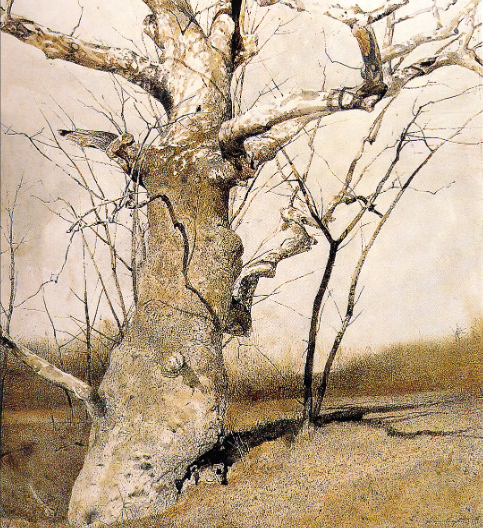
Sycamore (1982), Andrew Wyeth


This barren sycamore tree is recognizably the work of Andrew Wyeth. Wouldn't it be awesome to encounter such a magnificent and quirky tree on a walk through the Pennsylvania countryside of the Brandywine Battlefield?


Cairn in the Snow (1807), Friedrich


I also love 19th century German painter Caspar David Friedrich's (1774-1840) romantic landscape, Cairn in the Snow (1807). The subject is a pile of rocks (cairn) which is also known as a dolmen or a giant's grave (in the snow).


Capri Girl (1878), Sargent


My all-time favorite tree painting is by American portrait painter John Singer Sargent (1856-1925). It's a portrait of a favorite subject, Rosina Ferrara (a.k.a. Capri Girl), leaning on a birch tree. My daughter and I saw it on display at the Seattle Art Museum and couldn't stop looking at it. 

Saturday, December 24, 2022

The Art of Illustration -- Rockwell, Wyeth, and Others

Daybreak (1922), Maxfield Parrish

This is a continuation of my April 2020 post entitled, Illustration in Children's Literature & the Wyeths. It is inspired by my last post Blue Morning by George Wesley Bellows that is currently on exhibit in the National Gallery of Art in Washington D.C. While investigating similar paintings framed by columns, I found Daybreak (1922) by American Illustrator Maxfield Parrish (1870-1966). 


Baseball Scene of Batter, Catcher and Umpire
(1915), Joseph Christian Leyendecker


Parrish is among the most famous American painters and was once the highest paid illustrator in the country. You've no doubt heard of Norman Rockwell (1894-1978) and maybe J.C. Leyendecker (1874-1951), both known for their covers on The Saturday Evening Post. Both were featured in my December 2020 post, Saint Nicholas and Father Christmas in Art. J.C.'s baseball illustrations may inspire me to write another post about the art of baseball!


Tough Call (1948), Norman Rockwell


Rockwell is probably the most recognizable illustrator of his time. As one of his iconic baseball illustrations depicts, it's a Tough Call as to which artist captured the spirit of baseball better -- Rockwell or Leyendecker. It was fun visiting the Baseball HOF in Cooperstown, NY in 2019 and seeing the art up close and personal. I also like Rockwell's The Dugout (1948) and Leyendecker's Boys Playing Baseball (1915).


Blue Lock the Queen (1916), N.C. Wyeth
A great place to view the works of these artists is the National Museum of American Illustration in Newport, Rhode Island. Here's a link to the N.C. Wyeth exhibit at NMAI. Wyeth (1882-1945) was one of the most famous and successful literary illustrators, helping readers visualize heroic characters in adventure books such as Treasure Island. His first cover for the Saturday Evening Post was published in 1903. I was introduced to his work while I was an art docent in my daughter's elementary school. This illustration accompanied a story published in Collier's magazine.


Mermaid (1910), Howard Pyle


Wyeth's mentor was American painter, Howard Pyle (1853-1911). His Mermaid painting is quite impressive and acclaimed for being the best depiction of a mermaid by an artist. The man being saved by the sea nymph is all blue, as if he became frozen in the frigid water, all expect for his red cap! Its movement reminds me of Wyeth's 'Blue Lock', even down to the red detail on the horse rider's head (bandana). While there is already tension in the mermaid's struggle, the red cap draws my attention even more. Also interesting is Pyle's treatment of the sea foam, reminding me of how Bob Ross teaches us to paint watery seascapes in his Joy of Painting TV series.


Battle at Sea (1947), Fischer


A student of Pyle, German-born American artist, Anton Otto Fischer (1882-1962) was also featured in the Post magazine. His illustrations often depicted maritime or marine war scenes such as Battle at Sea, published in a book about his sailing days. Curiously, there is a red flame in the center of the top third of the composition, much like the red cap in Pyle's Mermaid painting. While Pyle's seascape could be used to show movement, Fischer's would be perfect for teaching about perspective.


Violin Studies, Wistehuff


Revere Wistehuff (1900-1971) was part of the New Rochelle Art Colony in the 1920's, '30s and '40s, along with colleagues Rockwell and Leyendecker. His Violin Studies shows a boy who would rather be playing baseball than practicing his music. The kid reminds me of Buffalo Bob Smith's Howdy Doody character!


Grandma Catches Fly-ball,
Richard Sargent


Finally, we have another baseball illustration entitled, Marmont Hill Grandma Catches Fly-ball by Richard Sargent (1911-1979). It reminds me of Rockwell's The Dugout. It's surprising that she could see the ball with her eyes closed and her handbag hanging in the way. Isn't that Superman's Lois Lane standing next to her?

Thursday, December 8, 2022

Our National Gallery of Art in DC

Majorcan Fisherman (1908), Sargent

John Singer Sargent in Spain

Recently, my daughter attended a professional conference in Washington D.C. and took the opportunity to visit several museums. She shared her photos of famous works on exhibit at the National Gallery of Art. Curiously enough, there were two exhibits of one of our mutual favorite artists, John Singer Sargent, while on one of his seven trips to Spain (1879-1912) to study Velázquez. His painting of a Majorcan Fisherman is particularly captivating and unlike many of his other portraits, usually of women, and typically with a darker color palette. It reminds me of Renoir's Luncheon of the Boating Party (1888) with its canopy and view through to the water in the background. I love the shadows and the sharp contrast of the dominant orange tones with the striking blue of the water.


Newly Discovered Art & Artists

Blue Morning (1909), George Bellows
Another American artist, George Wesley Bellows (1882-1925), painted a similarly framed landscape looking out over water. He is famous for painting urban life in New York City. His Blue Morning scene is reminiscent of Edvard Munch's sad depictions of mine workers returning home in the snow. Here, the column, fence, and shadows frame a silhouetted portrait on a foggy morning. The 'blue' may represent either the color of the water or the sadness of the workers. This is the last of four paintings Bellows made from 1907-1909.


Street of Barns (1914), Feininger


German American painter, caricaturist, and comic strip artist, Lyonel Feininger grew up in New York City. He was a proponent of Expressionism, painting buildings, street scenes, and barns. His figures are elongated much like those painted by fellow German Expressionist, Ernst Ludwig Kirchner. At first blush, I thought this painting was one of the works by Cubist George Braque. I guess I need to practice guessing artists using Artle - the daily art exploration game created by the National Gallery of Art (it's free!).


Still Life (1918), Picasso
Peonies (1901), Picasso
Speaking of Cubists and other Expressionists, The National Gallery of Art was also showing several works by Pablo Picasso. Besides his recognizable Harlequin Musician and The Lovers, also on exhibit were Still Life and Peonies. I hadn't realized that Picasso painted these flowers. Normally, Manet and Monet are the artists whom I associate with them.


Impressionists

Children Playing on the Beach
(1884), Mary Cassatt


Many of the French Impressionists' works are also on display at the National Gallery of Art in Washington D.C. My daughter took photos of the works of Mary Cassatt, Édouard Manet, Henri Matisse, Claude Monet, Camille Pissarro, Georges Seurat, and Pierre Auguste Renoir. I love the innocence of Cassatt's Children Playing on the Beach (1884). Her portraits are some of my favorites -- they are timeless.


The Railway (1873), Manet


Édouard Manet preferred painting portraits, and I'd call him a French Realist. Here in The Railway we see a portrait of a mother and child waiting at the train station. I am distracted by the bars of the iron gate as well as the stitching in the mother's coat. Perhaps the daughter is dressed up to receive her father from the train. Did you notice the puppy cuddling in the woman's lap?


Still Life with Pineapple (1924), Matisse


Fauvist Henri Matisse is responsible for many colorful still lifes, and I especially like this one with a pineapple. We were lucky enough to visit his museum while in Nice, France in 2011. Like contemporary artist, Kehinde Wiley, Matisse backgrounds are always very interesting.


Woman with a Parasol - Madame
Monet and Her Son
(1875), Monet
The Artist's Garden at
Vétheuil
(1881), Monet


Like Manet, Claude Monet used members of his own family as his subjects. We also visited his garden at Giverny in 2011. Quite impressive!


Landscape, Ile-de-France (1873), Pissarro


My daughter knows how much I appreciate the works of Camille Pissarro, His works transcend all of the various Impressionist movements, although he is often referred to as a Neo-Impressionist. His version of Monet's haystacks is equally impressive.


Seurat Retrospective, Georges Seurat


The exhibition also featured a sort of retrospective wall showing the work of French Post-Impressionist and Pointillist, Georges Seurat. Of course, A Sunday Afternoon on the Island of La Grande Jatte (1884-86) is probably his best-known Pointillist works, made famous by the play starring Mandy Patinkin.


A Girl with a Watering Can (1876),
Pierre Auguste Renoir


It's always fun to find familiar artwork at the museum you're visiting. Here's probably the most famous Renoir, A Girl with a Watering Can (1876). I seem to focus on the girl's upper half with the red bow and the blue and white dress, but I never really noticed the watering can. And I consider myself very observant!


More 20th Century Artists

Ground Swell (1939), Edward Hopper
So, luckily my daughter took photos of four more of my favorites, who are more modern and contemporary than those of the French painters you usually spot at art museums. These artists are Edward Hopper, Wassily Kandinsky, Joan Miró, and Lee Krasner (wife of Jackson Pollock).

I love Hopper's clean and confident style. His paintings have no frills, little shading, and calming areas of color that capture a moment and illicit relaxation for the viewer. 


Head of a Catalan Peasant
(1934), Joan Miró
Improvisation 31 (Sea Battle)
(1913), Kandinsky

I love Abstract Expressionism and the playful compositions of Kandinsky and Miró. Whether I am teaching kids or seniors to make colorful Kandinsky concentric circles or cutting out shapes to make Miró balanced compositions, it is always fun to find new masterpieces to share with them as examples for our projects.


Cobalt Night (1962), Krasner

It's surprising how many of Jackson Pollock's work I've seen at various art museums. Like Kandinsky, his compositions are usually numbered and mention the dominant color used in the painting. While vacationing in Palm Springs, I saw the exhibit of the 12 Women of Abstract Expressionism, including some works by Lee Krasner.


I hope you enjoyed this post about some of the 'most important' works currently on display at the National Gallery of Art in D.C. While in St. Petersburg, Russia in June 2019, our tour guide only showed us the 'most important' artwork because of the vast number of pieces at the Hermitage Museum. While I certainly appreciate seeing those, I still enjoy stumbling upon those diamonds in the rough, lesser known or seldom seen works, and even those by artists I've only recently discovered. This is how we learn and grow in our ability to appreciate visual art!