Sunday, August 29, 2021

Edgar Statue, HOFers Murals, and Other Ballpark Art

HOFers Mural (2020), 'Weirdo'


Walter Jones, Jack Sikma and Edgar Martinez have been immortalized in a SOHO mural located on 1st Ave South in Seattle, about a block south of T-Mobile Park, and painted by local artist, Jeff Jacobson, a.k.a. 'Weirdo'. On our way to a Mariners baseball game we spotted the spectacular Edgar mural painted on a textured wall covered with small stones. What a surface to paint on! I love the colors and the faint outline of #11 in the middle layer.


Kyle Seager portrait (2018), 'Weirdo'


Weirdo also painted a portrait of 3rd baseman Kyle Seager during Mariners Care Charity Night in June 2018 that sold for a final bid of $2,600.


New Statue at T-Mobile Park (2021)


Then we walked to T-Mobile Park and took plenty of pictures of the new statue of slugger and Baseball HOFer Martinez, sculpted by Chicago-based artist Lou Cella,  and just down the street from his Ken Griffey Jr. statue.


Ken Griffey Jr. Statue (2017)


Dave Niehaus Statue (2011), Lou Cella


Cella is also the artist responsible for the tribute to late sportscaster, Dave Niehaus that sits inside the ballpark. Fans can sit next to Dave for a photo op and take home a great souvenir of their ballpark experience.


The Mitt (1999), Gerry Tsutakawa


On the left field (north) side of T-Mobile Park (once Safeco Field) is The Mitt, a bronze sculpture by Gerry Tsutakawa, son of local fountain artist George Tsutakawa. It's a great example of positive-negative space with its cutout representing the baseball.


The Ascent (1950), George Tsutakawa


While at SAM the morning of the baseball game we spotted two of George Tsutakawa's early paintings. Though known for his sculptures, George Tsutakawa was initially trained as a painter. Here, in these two paintings, he combines Japanese calligraphy with American Modernism. 


The Descent (1950), G. Tsutakawa


I am always pleased to find such gems on my visits to the art museum. The compositions are very much the same, like many abstract works often are, although more representational than most. I like the color scheme and his playful use of line. Diagonal lines create the switchbacks characteristic of mountain trails. The smaller details are reminiscent of embellishments that Joan Miró would have added to his paintings.

Thursday, August 19, 2021

SAM Visit -- Monet at Étretat

The Cliffs At Étretat (1885), Monet


My daughter and I had tickets to an afternoon Mariners baseball game at T-Mobile Park. We spent the morning visiting the Seattle Art Museum and its Monet at Étretat exhibit. As you know, Monet often became fixated on a particular motif such as is evident by his many paintings of haystacks. In July of this year I posted about Impressionists' use of The Color Purple, Violet or Lilac in Art. Monet appears in >10 of my blog posts.


Fishing Boats (1885), Monet


Prior to his 1890 haystacks series, and in two separate visits to the Normandy Coast, he spent his time painting seaside landscapes along the English Channel. His main subjects were Manne-Porte arch and the cliffs at Étretat (above) and fishing boats. 


Boats on the Beach at Étretat (1885), Monet


I like how this painting of boats shows outbuildings (cabanas?) shaped like haystacks. It makes me wonder if they left an impression on his mind that lead to his later fascination with that shape.


Cliffs of the Porte d'Aval (1885), Monet


This popular vacation spot in France reminds me of our March 2019 trip to the Channel Islands off the coast of California and our boat trip and hike on Santa Cruz Island.


Santa Cruz Island off Ventura, CA

Coastal Location of Étretat


Santa Cruz Island (inbound from boat), March 2019


Luckily I had my cellphone and captured many beautiful shots. Too bad I didn't have my portable easel to paint en plein air. Notice the small slit (arch) in the rock (lower right).


One of my friends also pointed out the arch at Cabo San Lucas, which was one of the stops on our cruise to Mexico. Here is a great picture courtesy of Mike Raabe and fineartamerica.com.


La Falaise et la Porte d'Aval (1883), Monet

All of the above Monet landscapes are from his second trip to Normandy in 1885. Here is one from his first trip there in 1883. While I enjoy the atmospheric effects of the surrounding water and sky, the cliff (la falaise) seems rather flat and unaffected (maybe in silhouette?). The dark outline of the cliff creates a line of tension for me. The texture of Monet's cliff also seems more impressionistic in color and texture than the rest of his painting. Up close you can see bits of red.


Washerwomen on the Beach of Étretat (1894), Boudin


Also on display were paintings by Monet's first teacher, Eugène Boudin. The subject figures in the foreground accentuate the relative height of the cliff. Apparently, the artist was capturing a common occurrence while painting en plein air. It's almost like two paintings.


Scratch Paintings with Seniors at Old Friends Club
There was so much to see at the art museum besides the works of Monet and others. The paper cutouts  in The Geography of Innocence exhibit by Barbara Earl Thomas are amazing! Her use of light, colored glass, and intricate paper cutouts creates unusual portraits in both color and black-and-white. Her work also fills entire rooms and walls of gallery areas. The multicolor portraits overlay black paper with cutouts that allow the backlit painted glass to shine through. It reminds me of the scratch paper we used as kids where we used a wooden stylus to etch designs and reveal the colors beneath.

Walkabout Exhibit at SAM


Australian Aboriginal artist Dorothy Napangardi uses dots to create beautiful abstract paintings that will blow you away. Her Walkabout: The Work of Dorothy Napangardi is a new and ongoing exhibit at SAM.


One final note: these Kwottenal Kanye earrings, worn by the women of Fulani, captured our eyes because we made our own fortune cookie versions for one of my daughter's second-grade projects about African women's jewelry. I recall that we also used Sugar Corn Pops cereal for a necklace. We both get excited when we see something that sparks old memories. I remember back in 2011 during our France/Italy trip when she found a Rembrandt painting hidden in one of the museum hallways. And I still get jazzed when I find an obscure Van Gogh painting that I haven't seen before.


Wednesday, August 11, 2021

Art Activities You Can Do at Home

Bo the Cat, Purrfect Pals

I've started volunteering again and engaging in 60-90 minute art projects. One such project involves painting small animal portraits that support 45 local animal shelters. Paws with Cause provides 8X10 canvases and (water-based) acrylic paint kits, along with sketches of a cat, dog, or farm animal that is up for adoption. The shelters or rescue organizations supply a photo and bio of potential adoptees. At first, I thought it was going to be paint-by-number but it allows a wide range of creativity for a variety of age groups. PwC hosts painting parties at the Everett Mall, local senior centers, mans booths at local farmers markets and fairs and offers custom paintings of your pet.


by Bill


Many of the artists who paint the shelter animal portraits are seniors who hang out at senior centers or assisted living establishment. One such artist is Bill, whose work is reminiscent of German Expressionist, Max Beckmann. See my post entitled, 'Egyptian Art, Sculpture, and Tombs'.


Avisha by Tracie Olsen


My friend, Tracie Olsen, and PwC volunteer painted a dog portrait as a demonstration during our recent Black Diamond Labor Days event.


Power Plants Collage

Another organization where we do art at Issaquah Senior Center and online at Circle of Love is Heart Art Healing. In my first artwork, I did a collage about resolving to eat right and exercise more. I found this happy picture of an older gentleman celebrating while hula-hooping. I placed a mother bear and her cub in the background encouraging him/me to get moving! I added a dog (not my own) to symbolize walking as another form of exercise. My collage is decorated with plenty of fruits and vegetables. I even used salmon filets for the hands and a healthy fat for the tie. There are asparagus trees and a head of broccoli (another tree or my brain?).

This activity requires a collection of assorted magazines with pictures (or words) that may be torn or cut out, then arranged and stuck down with a glue stick. You may also want to use Washi tape, which is kids' masking tape that has been decorated with fun patterns. Acrylic paints and markers may also be used.


Spice Girl portrait

I'm still getting set up in my He-Shed and have now proved that WiFi works on my laptop outdoors from inside my studio. I attended Heart Art Healing's Circle of Love online Zoom session painting with spices such as cloves, garlic, ginger, cayenne pepper, paprika, and turmeric. The experiment not only worked but it also provided a sort of aromatherapy experience. I admit that I had to supplement my earth tone colors with some more saturated watercolor accents such as black, blue, and red.

When I teach a class online, I will need to log in on my laptop and also join the Zoom meeting as a guest on my cellphone. I purchased a flexible gooseneck phone mount to attach to my table for displaying my own work surface while teaching. Pretty cool!

My instructor chose to paint a simple bowl to teach the concept of shading, which works well for beginners or getting to know new media. A facial portrait also works for shading using earthy tones.


Color Wheel Sky inspired by Kandinsky's
Color Study. Squares with Concentric Circles
Apparently, there are certain spices that some people may be allergic to, so when teaching art to elementary school kids I am going to stick to using salt. While it doesn't add color to a painting it does add texture. The difference is that it reacts with the paint, pushing away some of the color and leaving areas of lighter or darker value behind.


The topic was COLOR and the project was called, "Color Wheel Sky". Some of the results were quite unexpected, though pretty remarkable, especially with non-rainbow color schemes. Two of my students went outside the box and managed to get some really interesting effects. I use laminated placemats to protect the working surface and remind the students of the elements and principles of art right there on the mat. Simply access the link, print out pages #4 & #16, make copies, then arrange side-by-side on a 12"X18" piece of construction paper and laminate. Most schools will have a laminator.


'Tim Burton' Trees

Another variation of the above salt painting project is to create a simple landscape with a moon, inspired by Tim Burton's "The Nightmare Before Christmas". Using either warm or cool colors of watercolor paint my seniors created a sky with lots of movement. Then we added trees to create repetition and interest.

You can see the results in my post entitled, Salt Painting with Seniors. You may choose to use black paint, markers, or construction paper strips for the branches.

Circles cut from contact paper work are great for preserving the white space for the moon when painting the sky. It resists the paint and leaves an unpainted shape when the sticker is peeled off. Amazing!


This month has been about giving back to my community. Although I haven't been teaching in a traditional classroom setting I am getting exposed to new ways of sharing and encouraging art. Participating in the farmers market and planning my own community event is making use of my skills in different ways and allowing access to all kinds of artists at all levels.

Monday, July 26, 2021

12 Flag Designers in Honor of Our Independence Day

Since July is the month when we celebrate our country’s independence, and the Summer Olympics have started in Japan, I thought the subject of flags and their designers would be interesting. Recall my inclusion of the 5-ring design of the Olympics that symbolizes the continents. See my October 2020 post entitled, What's in a Logo? Recognizable and Memorable Company Logos.


While Betsy Ross (1752-1836) is often credited for making the first American flag, it is actually Francis Hopkinson (1737-1791) who designed its two earliest versions (above). You just can’t trust the History you learn in school (or can you?). This proposed design for the Arkansas state flag was created by state historian, teacher, principal, and poet Willie Kavanaugh Hocker (1862-1944) in 1912. According to Wikipedia, a fourth star and the state name were added later in the final version.


The current American flag made #4 on The Ringer’s Which Country Has the Best Flag? list. However, the author apparently prefers the simplicity of the Japanese flag, ranking it 2nd; he believes that the Canadian flag is the worst (205th). Both flags use red and white, where white is considered to be solely a background color. I actually like the maple leaf on Canada's flag!


Let’s study the various types of flags from countries around the world based on aspects such as color scheme, contrast, patterns, and themes. Wikipedia does a nice job of listing Flags by Design.


I appreciate how effectively the Scandinavian countries divide the rectangular space into sections creating a cross pattern, often with white costarring with another color.


Some countries prefer to go the simple route and fly flags of a single color, like green for Libya (1977-2011), red for North Yemen (1918-1923), and black for Afghanistan (1709-1738 and 1880-1901). In Robert Rauschenberg’s White Painting (1951), he went so far as to create six variations, each with a different number of panels. Purely white flags are typically used for signifying surrender or symbolizing peace or calling for a truce.


Then there are the countries that choose to venture out into two colors (bicolor or duotone), the really wild ones choosing high-contrast or adding some sort of small symbol. My favorites are the simple vertical tricolor stripes of European flags observing the rule of thirds. These are often the most recognizable and memorable in my opinion. 


World’s Ugliest Flags: British Columbia, Belize, Virginia, Turkmenistan, and Morocco, according to one author. As with paintings and other artwork, it is really up to the viewer to decide what appeals to their own artistic senses.


A vexillologist is someone who designs flags. A vexillographer is someone who studies flags. Here is a list of 10 countries, their flags, and the vexillologists credited for designing them:


1. Argentina Manual Belgrano (1770-1820). The Sun is a common theme on many countries' flags.


2. BrazilRaimundo Teixeira Mendez (1855-1927). This flag includes the diamond shape, while the circle is much more commonly used. Inscriptions often include the National Motto; Brazil's reads:
"Ordem E Progresso" (Portuguese for "Order and Progress"). The stars represent Brazil's 26 states and the federal district.


3. CanadaGeorge Stanley (1907-2002). While Canada's flag now sports a maple leaf on its flag, I find it funny that Ireland doesn't have a shamrock on its flag.


4. ChinaZeng Liansong (1917-1999). Stars are the most common symbols found on many of the world's flags. At one point there was a hammer and sickle inscribed in the larger star, but it was removed because it was too similar to that of the Soviet Union.


5. CyprusIsmet Güney (1932-2009). This flag uses the shape of its island and an olive branch to symbolize peace and the unity between the Greek and Turkish Cypriots on a white background (also for peace).


6. India Pingali Venkayya (1876-1963). Although many may mistake the central symbol for a sun or flower, it is actually the Ashoka Chakra, and signifies signifies peaceful change (for there is "life in movement and death in stagnation").


7. NigeriaMichael Taiwo AkinKummi (1936-present). As usual, white means peace and unity, and in this case green represents natural wealth.


8. NorwayFredrik Meltzer (1779-1855). Used throughout Scandinavia, the cross symbolizes Christianity. The other colors, found on the American and French flags, represent freedom.


9. PakistanSyed Amir-uddin Kedwaii (1901-1973). Just as Scandinavian flags use a cross to symbolize their religion, Pakistan uses a crescent and star to represent theirs -- Islam.


10. UruguayJoaquin Suárez (1781-1868). It's hard to tell in the picture but there are actually nine stripes representing Uruguay's departments. It's common to represent established (original) divisions within a country by repeating stripes or stars. The upper left 'canton' once again includes the sun.


Other less often used symbols add uniqueness and interest to a flag but can make such detail difficult to interpret from far away. They are: animals, boats (anchor or ship), books, buildings, headgear, hills (mountains or rocks), a map, machine (tool or instrument), person (body part), shield (or weapon), spirals, square, or triangle. Hopefully the citizens of each country have learned what the elements symbolize.

Which country's flag is your favorite?

Flags Depicted in Famous Paintings


Declaration of Independence (1817), Trumbull
Many artists have depicted flags in their artwork (Jasper Johns (1930-), Howard Pyle (1853-1911), and John Trumbull (1756-1843)). Around 1817, Trumbull used this painting to create the etching that appeared on the back of the $2 bill. The captured British flags in the background served as trophies hung during the presentation of the document to the Second Continental Congress 28 June 1776. It was later adopted July 4th and eventually signed August 2nd. His portrait of Alexander Hamilton appears on the $10 bill. 


Nation Makers (1903), Pyle


American Illustrator, Howard Pyle, famous for teaching composition to N.C. Wyeth, created The Nation Makers in 1903 to depict the recently declared national flag carried during the Battle of Brandywine (1777).


Liberty Leading the People (1830), Delacroix

French artist, Eugène Delacroix's Liberty Leading the People, commemorates the July Revolution in Paris that removed Charles X and created a constitutional monarchy. In May 2011, I was lucky enough to see this huge painting in-person at the Louvre Museum. The one I show here has been somewhat modestly truncated.


Terrace at the Seaside, Sainte-Adresse (1867), Monet


Probably my favorite painting with flags is Claude Monet's (1840-1926) Terrace at the Seaside, Sainte-Adresse. It's a relaxed portrait of his family. The red and yellow flag may have been used as a ship-to-shore signaling device, although its colors are also present in the flag of the Sainte-Adresse municipality.

Wednesday, July 14, 2021

Egyptian Art, Sculpture, and Tombs

The way my mind works, visuals like the one in this ad often jar memories for me. For example, the positive space reminds me of the Egyptian Queen Nefertiti (bust shown below in painted limestone), but I can't tell you what's being advertised! I know it's a stretch, but the ad sparked a memory and inspired this post about Egyptian art.


Nefertiti Sculpture (1350 BC),
Thutmose


It amazes me what I can remember from my childhood and what we studied in grade school. When I was in 6th grade, we had to give a presentation and report in Social Studies and I chose the topic of Egyptian Culture. Back then we didn't have MS-PowerPoint as a visual aid. I was, however, able to use a photocopier and was pretty good at drawing.


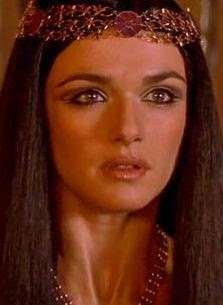
I also remember The Mummy movie (1999) starring Brendan Frasier, with Rachel Weisz as the reincarnation of a young Nefertiti.


The Mummy (1932), Grosz


The original 1932 film, The Mummy, starring Boris Karloff, was advertised on this poster by artist Karoly Grosz. It was expected to fetch $1M-1.5M at auction in 2018.


One of my wife's favorite movies is the epic 1963's Cleopatra starring Elizabeth Taylor as the Queen of the Nile. Check out this list of 11 movies filmed in Egypt as compiled by Trafalgar's The Real World. I bet you didn't know that Bond Movie, The Spy Who Loved Me, was filmed in Egypt in 1977. Can you guess which other Bond movie was partially filmed in Cairo? Hints: Connery, casino.


William (c. 1961 BC – c. 1878 BC)
So, what else do I remember about Egyptian art? I recall an Egyptian blue (turquoise) hippo that is now on display at the Metropolitan Museum of Art in New York City. Frankly, I didn't know him as William the Faience Hippopotamus. Faience refers to the sintered-quartz ceramic material from Ancient Egypt. The black lotus flower designs resemble Zentangles (organized doodling). I think I just came up with another art project for studying Line. It would be fun to decorate animal shapes cut out from brightly colored neon oaktag using black Sharpies.


The lotus flower represents reincarnation; after it closes at night, and disappears below the water surface, it emerges again in the morning. See the Top Important 35 Ancient Egyptian Symbols.


Tutankhamun & Ankhsenamun
(c. 1336-c.1327 BCE)


Much of Egyptian art was never meant to be viewed by the living but was created to be enjoyed by the entombed in the afterlife. Statuettes were placed in the tomb as eventual servants of its noble occupants. Its walls were painted with scenes of life activities and to show the path to the afterlife. This relief painting is from the golden throne of King Tutankhamun. The primary colors of yellow, red, and blue make the figures stand out against the golden background.


Sarcophagus Interior

San Jose, California houses one of the largest museums of Egyptian artifacts -- The Rosicrucian Egyptian Museum -- including this sarcophagus of the Chantress of Amun-Re Dynasty 22. I am impressed by the artisan's ability to paint the interior surface of this wooden coffin with so many colorful details that have survived millenniums.


Death Mask of Tutankhamun

Probably the most recognizable work of ancient Egyptian art is the death mask of Tutankhamun. Housed in the Egyptian Museum in Cairo, this golden treasure has traveled the world's museums. Such items are collectively known as Pharaonic antiquities.


Bastet (664–30 BC)


Many of the Egyptian deities were depicted with the head of a cat. The goddess Bastet had the power to transform herself into a cat. So respected and valued were cats that they were treated like royalty and even mummified when they died. The Sphinx has a human head and a lion's body.


Artists


Sphinx, Night (1925), Hiroshi Yoshida

Japanese artist, Yoshida Hiroshi, painted the Sphinx in watercolor in both daytime and night. The Great Sphinx of Giza is located on the west bank of the Nile River. Long ago, the limestone carving lost its nose and beard. Archaeologists have claimed that its likeness is of a Middle Kingdom pharaoh, Amenemhet II. From this angle, I see a profile of George Washington!


The Egyptians (c. 1893), Bernard

French Post-Impressionist, Émile Bernard (1868-1941), developer of Cloisonnism, painted The Egyptians during the decade when he lived in the Middle East beginning in 1893. He was friends with fellow artists Van Gogh and Gauguin. Gauguin's paintings of Tahitian women were much more colorful. This particular image reminds me of the work of German Expressionist, Max Beckmann. Both expressionists used simplified forms and flat areas of 'unnatural' colors separated by dark outlines.


Self-Portrait with a
Cigarette (1947),
Beckmann
Self-Portrait with a Cigarette
(1923), Beckmann
Somehow these three self-portraits of Beckmann resemble the figures in the above portrait of the three Egyptian women. The colors that Bernard chose and the highlighting of the faces, arms, and hands against the darker tones clinches it for me. Perhaps I'm simply recalling the hand next to the face. Or the torch burning (incense) like Beckmann's cigarette.

 
Self-Portrait in Tuxedo (1927),
Max Beckmann


Ta Matete (1892), Paul Gauguin

Finally, I'd like to finish with a painting by Paul Gauguin that shows five Tahitian women seated on a park bench. It is reminiscent of the ancient Egyptian two-dimensional paintings seen on the walls of tombs. Most of the figures are also shown in profile view, much like those painted in ancient times.