I'd like to base this post on the compositional element of unity or harmony or things that belong together in art. Here, we will be looking at the subjects of paintings, the components of landscapes, seascapes, and still lifes, and famous art couples. A subject is usually the main focus of a painting, the idea or essence that the artist wants to communicate. It can be a portrait, a landscape, or a still life that depicts something natural or imagined or even an abstract expression or feeling.
Portraiture
Let's start with my favorite -- portraiture. Portraits may be composed of a single person or animal or any group thereof. Some portraits focus on just the face or body, while others are accompanied by familiar surroundings, costumes, pets, etc. that tell a story. Sometimes they are abstracted using unexpected shapes and colors or something from nature made to look unnatural. Whatever technique, style, or color scheme you choose allows your subject to be more interesting.
I couldn't resist using this black-and-white photograph as my portrait example. It's simple, harmonious, repetitious, and balanced.
Landscapes
Perhaps one of the easiest subjects to portray or imagine is a landscape. This photograph of a person feeding swans in the snow adjacent to a lake is both a portrait and a landscape. The large rectangular-shaped areas of the snow and water and the somewhat similar organic shapes of the person and the pair of swans provide both value and texture contrast and a dramatic focal point for the scene.
Occasionally even portraits, such as the Mona Lisa, will have a landscape as a background or secondary focus.
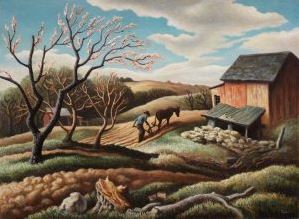 |
Spring Ploughing (1940), Thomas Hart Benton
|
In 2017, the Seattle Art Museum displayed 39 landscapes (like this one) from Paul Allen's private collection in its exhibit called, "Seeing Nature". Trees can be your focus or may be used to frame your view. Maybe you want to create depth and include mountains or hills in the distance. You can add buildings, barns, bales of hay, fences, roads, rivers, etc. to create interest in your composition. You can even change the environment or set the time of day. Maybe the focus in your landscape is the sky. Clouds may be particularly challenging. What's more difficult is creating atmospheric effects.
Probably the best example of
atmospheric paintings are those accomplished by J. M. W. Turner. His
Depositing of John Bellini's Three Pictures in La Chiesa Redentore, Venice (1841) is one of the more spectacular pieces in Allen's collection.
Still Lifes
 |
| Still Life With Skull (1898), Cezanne |
Arranging a collection of inanimate objects into a
still life is an excellent way of learning to draw and paint. Such subjects teach an artist what makes a good composition and may dictate what objects are chosen and how they relate. They also teach you how to create space and form using overlapping and shading.
While the skull in Cezanne's painting may seem out of place, its shape is similar to the pears arranged on the tabletop. The color palette of the skull, table and triangular background shape unifies the disparate objects. Even the skull's nasal area is highlighted in yellow and masquerades as another piece of fruit.
 |
| Still Life with Apples on Pink Cloth (1925), Matisse |
Artists who painted Still Lifes are Pierre Bonnard, Georges Braque, Paul Cézanne, Gustave Courbet, Eugène Delacroix, Édouard Manet, Henri Matisse, Claude Monet, Pablo Picasso, and Vincent van Gogh. I've bolded my favorites, both of who were not afraid of color, printed tablecloths, or elaborate wallpaper. I'd like to know what the brown and gold pillar-shaped objects are unless they're curtains or the hinged areas of a screen. I think the small white pitcher gets lost in the composition, except for the fact that the black and blue backdrop provides its emphasis.
 |
Viva La Vida (1954), Frida Kahlo
|
Both Frida Kahlo and her husband Diego Rivera painted still lifes of watermelons as their last paintings. Kahlo died in 1954 at age 47, apparently from a pulmonary embolism, within eight days of completing her final work. One of her legs had been amputated below the knee and she had been bedridden.
Curiously, Édouard Manet lost his foot and died in 1883, just a year after painting A Bar At The Folies-Bergère (1882), his final and probably most famous work.
 |
The Watermelons (1957), Diego Rivera
|
Rivera died three years after Kahlo at age 70. His painting was a commissioned work that he had initially refused because of his dislike for watermelon.
 |
Several Circles (1949), Kandinsky
|
Abstract Compositions
Abstract expressionists such as Wassily Kandinsky and Joan Miró used lines and circles as their subjects. Such compositions may or may not be representational though the arrangement of objects creates a feeling of harmony and uses colors that make us feel happy.
This is perhaps my favorite Miró painting. In an elementary school class I taught that focused on the art element,
Line, I made paper stick puppets out of all the figures that I found in
Figures and Dog In Front of the Sun (1944). Maybe you'd be surprised how many dogs are depicted here. You may also imagine a couple (a man and a woman) lying on the sand under a red sun. At least that's one interpretation!
Famous Art Couples
 |
Frida and Diego Rivera (1931), Kahlo
|
My original idea for this post was to find paintings of objects that go together or are often seen together in a painting. Of course, landscapes and still lifes have recognizable components that together form an outdoor scene or an indoor arrangement. It seemed only natural to make the leap to couples. At first, I found a painting of a couple of ducks (a drake and a hen) and a photograph of two puppies that I used to introduce the topic. I found pairings of gods and goddesses and even some double portraits. I've already posted about Grant Wood's American Gothic and The Two Fridas in earlier posts. Then I remembered that Frida Kahlo was married to Diego Rivera. They painted each other for 25 years, divorcing once and remarrying one year later. In Kahlo's painting, the relative sizes of the heads are mimicked in Miró's painting above, but instead of a dog, Rivera is holding a palette and brushes and there is a pigeon overhead instead of a red sun.
Rivera's feet are turned out and even Kahlo's feet are as small as the black dots in Miró's work.
I'm pretty sure that Miró did not have this couple in mind for his painting!
 |
| Murnau Landscape (1909?), Münter |
Wassily Kandinsky and Gabriele Münter were both expressionists and together with Franz Marc started the Blue Rider movement in Germany. Kandinsky, though married, met Münter in 1902 and lived together for many years, separating from his wife in 1904 and eventually divorcing in 1911. Münter painted several of these colorful landscapes, each with three lollipop trees.
 |
| Münter's Kandinsky |
She also painted this portrait of Kandinsky, looking a bit like a sepia-tone photograph with a more modern background. Curious that the only highlighting or shading is on his hair and beard, and nothing on the pipe or clothing. Also, it's as if she put herself behind him with the outlined areas of color.
 |
Taos Mountain New Mexico (1930), O'Keeffe
|
Painter Georgia O'Keeffe was the favorite portrait subject of photographer and husband, Alfred Stieglitz. He apparently photographed her for 331 portraits. Although most famous for her American Modernist closeups of flowers, you may have seen her southwestern landscapes and animal skull paintings. It's funny how colorful her paintings are when the artist herself wore strictly black and white.
Abstract Expressionists Willem and Elaine de Kooning were married in 1943, and her most famous subject was President John F. Kennedy, whose portrait she painted in 1963. I was lucky enough to see her work, along with 11 other female artists, as part of the 12 Women of Abstract Expressionism exhibit at the Palm Springs Art Museum in 2017.
 |
Gothic Landscape (1961), Krasner
|
Abstract Expressionists Jackson Pollock and Lee Krasner were married from 1945-56. When they met, Krasner was already active as a painter in New York and apparently was intrigued by Pollock's work. Her work was also on display in Palm Springs when I visited in 2017. This one from London's Tate Museum is similar to her work exhibited at PSAM. The thick black lines resemble trees.
 |
| Galatea of the Spheres (1952), Dali |
Surrealists Salvador and
Gala Dali married in 1958, though they lived together for 53 years. She was his muse, and for a time Dali signed both their names to his works, crediting her (blood) as his inspiration.
In 1972, Dali painted a double portrait of the artist and his muse (wife Gala). It reminds me of an interior, painted by Johannes Vermeer, with light streaming in from a window. Here, we get to see both figures from the front and the back with the aid of a mirror. If only we could see what's on his easel! Notice how Gala's chair is downplayed in both color and value so as not to compete with the artist's chair and mirror frame.
Everyone is familiar with Norman Rockwell's 1960 Triple Self-Portrait. It is also aided by a mirror, though in this case, we can see what he has drawn bigger than life. What an iconic image! Did he really draw himself without glasses? I like how he pinned several famous self-portraits to the top right-hand corner of his easel. Included are artists Albrecht Durer, Rembrandt, Picasso, and Van Gogh. Notice also how the mahlstick (or maulstick) that Rockwell is using to steady his hand points directly at the masters he acknowledges.
 |
| Las Meninas (1656), Velázquez |
My favorite classic group portrait is by Diego Velázquez. I challenge you to decide who is the subject of this painting. Entitled Ladies in Waiting, the central figure is 5-yr-old Princess Margaret Theresa, daughter of King Philip IV of Spain, surrounded by several strange figures, including the painter himself. The crazy thing is that you can actually see the King and Queen reflected in a distant mirror. I always thought that it was just another portrait hanging in the large room. Yet, as it turns out, Velázquez is painting their portrait as they sit for it out of our view. The man in the doorway is Don José Nieto Velázquez, the queen's chamberlain, who may be waiting for the royal couple's exit. So, is the royal couple the subject? Their little girl? Or is this simply another self-portrait?
Though difficult to see, Jan van Eyck sneaks a very small image of himself in the double portrait, The Arnolfini Portrait (1434). Even more obscure than the mirror in Velázquez's composition, the centrally located convex mirror discretely contains the artist's reflection. Check out those crazy shoes in the bottom left corner. They look like bones for the pet dog that is staring at the viewer.
The painting is fraught with symbolism of fidelity, love, marriage, opulence, and religion. The
Artstor Digital Library is a great source for highlighting such obscure details and answering questions surrounding such complicated works.