- Defining the specific period in history when the movement actually began and its popularity ended or morphed into something else
- Defining the Father of the movement (e.g. Cubism – Braque or Picasso or both)
- Finding a list of supporting members or practitioners of the movement
- Finding good examples of each movement
- Deciding whether to list them alphabetically or chronologically
- Deciding which movement to include/exclude from my list
I've decided to list them in chronological order.
1. Renaissance (from the 14th century to the 17th century) -- Giotto
 |
| Arena Chapel (1305), Giotto |
The Father of the Italian Renaissance and European painting is
Giotto di Bondone. Giotto is most famous for his decoration of the Arena (or Scrovegni) Chapel, in Padua, Italy around 1305. One site I visited claimed that he had ~40 artisans working on the paintings, working from sketches by the artist, as he directed them where to place the colors. If this is true, then I liken Giotto to glass artist,
Dale Chihuly, who also sketched and directed the creation of his glass pieces and their installations all over the world.
2. Baroque (late 16th and early 17th century until the 1740s) -- Caravaggio
 |
| The Adolescent Bacchus (1595-97), Caravaggio |
The Father of the Baroque movement is Michelangelo Merisi da Caravaggio. While visiting Florence, Italy in 2011 we saw one of his most famous paintings at the Uffizi Gallery. The Baroque style applies to many of the arts and may be characterized by drama, dynamism, emotional exuberance, grandeur, movement, richness, sensuosity, and tension. The chiaroscuro technique first used by Caravaggio and Leonardo da Vinci was later employed by Rembrandt in many of his most recognizable works, including The Man in the Golden Helmet. The light and shadow added contrast and dramatic effects.
3. Realism (1830 thru the end of the 19th century) -- Courbet
 |
| The Stone Breakers (1849), Gustave Courbet |
Gustave Courbet is known as the Father of Realism. His paintings of ordinary people doing ordinary tasks were unwelcomed by the rich of society who had been used to seeing paintings of wealthy people displaying their opulence.
 |
| The Gleaners (1857), Millet |
I also enjoy the paintings of Jean-François Millet, whose paintings of peasant life influenced Van Gogh and inspired other impressionists.
Which of these cat portraits looks the most realistic?
4. Impressionism (The early 1860s to 1880s) -- Monet
 |
| Poppy Fields Near Argenteuil (1875), Claude Monet |
Perhaps the most well-known and acclaimed painter of his time, Claude
Monet is often considered to be the Father of Impressionism. Some may argue that its paternity belongs to Pierre-Auguste
Renoir, Alfred
Sisley, or Frédéric
Bazille. Impressionism was a precursor to Neo-Impressionism (
Seurat or
Pissarro), Post-Impressionism (
Cezanne), Fauvism (
Matisse), and Cubism (
Braque or
Picasso).
 |
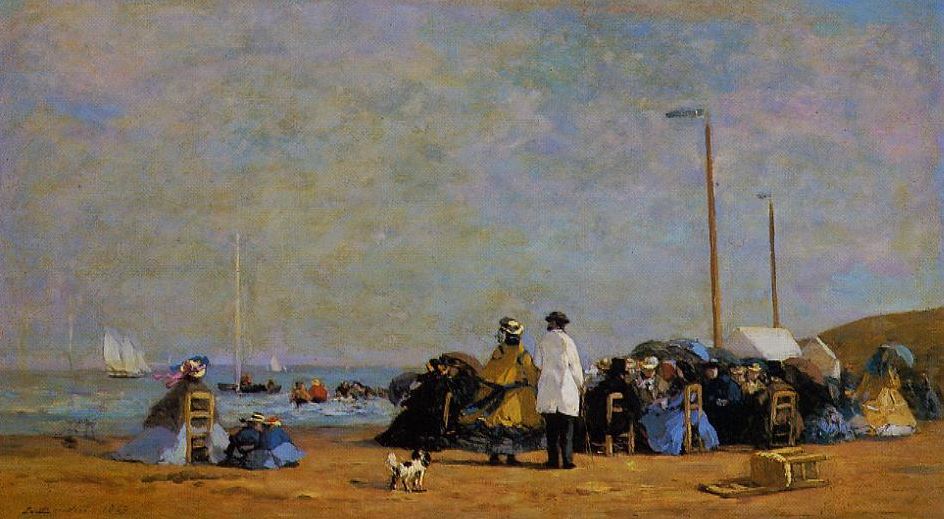
| Crinolines on the Beach (1863), Boudin |
Maybe the credit should be given to French landscape painter Eugène
Boudin, who met Monet in 1858 and taught him to paint landscapes
en plein-air and observe the effects of
light and tonal
value. Therefore, Boudin may have been the Grandfather of Impressionism. Check out that colorful sky!
This portrait of Denver the Cat exhibits a soft style, not unlike the skies in the above works by Boudin and Monet. These pastel colors may also be seen in works by Edgar Degas. The bottom of the painting may resemble a ballet dancer's tutu.
5. Pointillism/Divisionism/Neo-Impressionism (the late 1880s to the first decade of the 20th century) -- Seurat
 |
| Sunday Afternoon On The Island Of La Grande Jatte (1886), Seurat |
 |
| Picking Peas (1887), Pissarro |
Georges Seurat is credited as being the Father of Pointillism. However, my favorite Neo-Impressionist will always be Camille Pissarro. His compositions and color schemes are much more pleasing to me than Seurat's array of colored juxtaposed dots. While he still captures the lighting effects of Impressionism, his brushstrokes add texture without the obvious dots.
6. Modern Art/Post-Impressionism (1886-1905) -- Cézanne
 |
| Mont Sainte-Victoire (1895), Cézanne |
Post-Impressionism evolved from the saturated colors of Impressionism and sought to reduce objects to their basic forms. The Father of Post-Impressionism is Paul Cézanne. Notice the shaded areas of color forming a patchwork of shapes that resembles later Cubist compositions. The 20th-century compositions will become much more angular and geometric, often using contrasting bold colors as opposed to the more analogous colors of this landscape.
7. Fauvism (1904-1908)
 |
| The Dessert: Harmony in Red (1908), Matisse |
One of my all-time favorite artists,
Henri Matisse, is also the founding Father of Fauvism. Inspired by the works of Impressionists like Van Gogh, Matisse also infused emotion into his paintings but instead of using the pastel colors of Monet, he used vibrant right-out-of-the-tube colors creating tension and contrast between warm and cool colors. In May 2011, on our trip to France and Italy, we stopped in Nice to visit the Matisse museum. Last Fall, in my post entitled,
Top 15 Paintings that Use Primary Colors -- Red, Yellow, and Blue, I selected this Matisse work as #2 of my favorite Red paintings. Using unnatural colors was a way for the Fauvists to express emotion.
8. Expressionism (1905-1920)
 |
| The Scream (1893), Munch |
The
Chapman University blog about Expressionism describes the movement as "A group of artists that became associated with the Expressionism movement, tried to express or capture these feelings of uncertainty through swirling, exaggerated brushstrokes or jarring and violent lines and combinations of colors." Norwegian artist
Edvard Munch is known as the Father of Expressionism. While on our June 2019 Baltic Cruise, we visited the Munch Museum in Oslo, Norway. Munch has also been considered to be part of the Post-Impressionist movement.
 |
| From Thuringewald (1905), Munch |
In 1905, German architecture students Ernst Ludwig
Kirchner, Fritz Bleyl, Karl Schmidt-Rottluff, and Erich Heckel became artists and formed the group The Bridge (Die Brücke) in the city of Dresden. Like Munch, their work was an emotional and psychological response to the world around them. While Munch's colors in his earlier works were more somber, German Expressionists' colors were more akin to its French Fauvist counterparts like Matisse. Matisse's paintings were happier and less anxious or angst-filled.
Which one of these cat portraits of Cheeky Tom is more expressionistic? Impressionistic? What about the use of color?
9. Cubism (1908-14)
 |
(left) Ma Jolie, Picasso (1911-12) &
(right) The Portuguese, Braque (1911-12) |
Cubism is yet another style that evolved almost to abstraction from the Fauvist and Expressionist movements. While they share some elements in common, Cubists went even further away from representational figures and forms to angular and geometric shapes and areas of color. Many will argue whether
Georges Braque or
Pablo Picasso is the true Father of Cubism. Even their works are quite similar. Supporting members of the movement included: Robert Delaunay, Henri Le Fauconnier, Albert Gleizes, Juan Gris, Fernand Léger, and Jean Metzinger.
 |
Nude Descending a Staircase,
No. 2 (1912), Duchamp |
Dadaist Marcel Duchamp's Nude Descending a Staircase (No. 2) is a work that was rejected by member artists as being too futuristic. The Dadaism and Futurism movements (1909-13) were overlapped by the Cubist movement. While in high school, my older brother did some futuristic paintings. The one I remember most is of the Frazier/Ali fight.
10. Surrealism (1924-1966)
 |
| The Persistence of Memory (1931), Salvador Dali |
Although many consider Spanish artist
Salvador Dali to be the Father of Surrealism in art, French writer, poet, and artist
André Breton began the movement as a response to Dadaism (the 1860s-1970s) during World War I. Other notable Surrealist artists include Antonin Artaud, Francis
Bacon, Marc
Chagall, Marcel
Duchamp, Max
Ernst, Lucian Freud, Freda
Kahlo, Paul Klee, René Magritte, Joan
Miró, Pablo
Picasso, Man Ray, and Yves Tanguy. The irrationality of the images is said to unlock the creativity of the unconscious mind.
11. Abstraction/Abstract Expressionism/Action Painting (1943 thru the mid-1950s)
While the first real departure from Realism and toward Abstraction is said to have been fathered by Russian artist, Wassily Kandinsky, and other Expressionists in the early 1900s, the first generation of Abstract Expressionism didn't begin until 30 years later.
 |
| Still Life Interior (1941), Hofmann |
German-American artist, Hans Hofmann, is also thought to be the Father of Abstract Expressionism, although he was apparently influenced by the work of Kandinsky. His early paintings were more Fauvist, such as his stylized still lifes and interior paintings. It turns out that Lee Krasner, future wife of Jackson Pollock, and an Abstract Expressionist herself, enrolled in Hofmann's art school in 1937. Later, in 1940, Hofmann experimented with drip paintings. Jackson Pollock followed in Hofmann's footsteps by dedicating his later career to Action Painting.
 |
Fish Market (Seattle Market
Scene Sketch) (1943), Tobey |
 |
Water of the Flowery Mill (1944),
Arshile Gorky |
Some say that Armenian-American artist, Arshile Gorky (left) or even Mark Tobey (right) is the true Father of Abstract Expressionism.
12. Pop Art (the mid-1950s and the '60s)
 |
| The Marilyns, Andy Warhol |
Yet another controversy exists for Pop Art. Like Cubism, there are two artists -- Andy Warhol (1928-1987) and British collage artist Richard Hamilton (1922-2011) -- who get credited with starting the movement. We saw Warhol's exhibit at the Palm Springs Art Museum in the Spring of 2018. Let's not forget Roy Lichtenstein (1923-1997) and Robert Rauschenberg (1925-2008) both of whom are famous Pop Artists.
13. Op Art (the 1960s when JFK became President)
 |
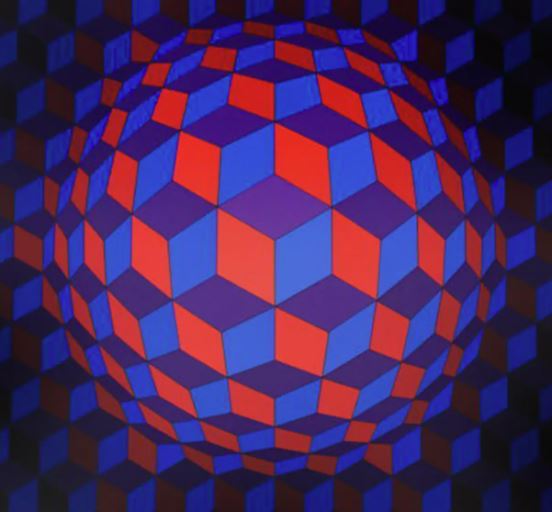
| Cheyt Rond (1974), Victor Vasarely |
Finally, the Founder of the Op Art movement is Hungarian-French artist Victor Vasarely (1906-1997), whom I've blogged about in several posts. Optical Art uses precise lines and contrasting colors often in geometric patterns to create optical illusions and even movement.
What style or art movement best describes the following two portraits of Buster-Baxter? How are they different? Which portrait looks the most realistic and why? What if anything makes you like one painting over the other?