Showing posts with label Cezanne. Show all posts

Friday, January 23, 2026

Artists' Portraits & Self-Portraits


Berthe Morisot with a bouquet
of violets
(1872), Manet

Self-Portrait (1885),
Morisot

French painter, Berthe Morisot was a young subject of Édouard Manet, here dressed in all black. Years later, Morisot painted this rather impressionistic self-portrait using more muted colors and perhaps showing her age.

Which portrait do you like better?


Self-Portrait with palette
(1878-9), Manet


Manet himself then painted himself holding a palette and paint brush, again using dark colors. Does it seem odd that he is dressed formally and with a black fedora, tie, and jacket?


Self-Portrait with a Beret
(1886), Monet


Claude Monet sported a beret in this early self-portrait. It surprises me how only a bit of blue accompanies a rather boring color palette for Monet's portrait. Note how as a much younger man Monet can paint with full focus and precision, as opposed to later in life when his eyesight began to fade.


Self-Portrait (1888), Gauguin
Paul Gauguin also painted several self-portraits. Here is the self-portrait that Van Gogh challenged him to paint, along with his painting of mutual friend, Émile Bernard (in the background). The reference to Les Misérables refers to Gauguin's insistence that his life was like that of the book's hero, Jean Valjean. The Post-Impressionist livened up his portrait with a yellow floral background in homage to its recipient, his friend Vincent.


Self-Portrait with palette (1890),
Cezanne


Paul Cezanne did his share of self-portraits, including this one 'with palette'. What I enjoy about this is how Cezanne, who has been identified as a Post-Impressionist, makes use of multiple colors in his palette, face and neck, and even as decoration (and balance) on the reverse side of the canvas he's painting.

So much livelier and more engaging than Manet's rather monochromatic composition in brown and black! 


Self-Portrait #1 (1894), Beaux


I actually prefer this realistic self-portrait by Cecilia Beaux to Morisot's impressionistic portrait. I enjoy the use of earthtones and the treatment of lights and darks, highlighting her face. While the golden-brown background is what one might see in a professional photograph, she has created offsetting visual interest with the striped pattern of her dress.


Somehow, I prefer the character of older self-portraits of Renoir to those of the younger man. Here, his palette is less colorful than a typical Renoir, though the facial highlights seem to be channeling Rembrandt. I like Renoir's choice of warmer tones for the face and background. I especially like his pork-pie style hat! No fedora or palette in this one though!!


After visiting a Travel and Adventure Expo in Seattle this month, I became interested in Kenya. Besides the attraction of a safari for viewing animals in the wild, I think a visit to Kenya would provide a window into the culture (and art) of Kikuyu, the Bantu people native to Central Kenya.

Kikuyu Man (1908-10),
Gallen-Kallela


This portrait of a Kenyan man is by Akseli Gallen-Kallela and was painted early in the 20th century. Here, the subject is dark with a golden yellow background, as if the sun is shining on the back of the figure. The foliage and subtle brushstrokes give the impression of a somewhat barren grassy field.

I show this portrait because it shows art at the tail end of the time period of the other portraits of the late 19th century. Though not a self-portrait, the artist has captured the personality of his subject without forcing a formal pose.


Self-Portrait (1943), le Doux


I include this self-portrait by Charles Picart le Doux in comparison the that of Édouard Manet. Like Manet, le Doux painted self-portraits, portraits of family and friends, still lifes, landscapes, and even murals. His work also reminds me of Impressionists Paul Cezanne and Paul Gauguin (above), obviously with a more limited palette!

With a simple diagonal line, he suggests that he's working on a canvas.


Please note that I purposely excluded the artists who are more well-known for painting self-portraits -- specifically Rembrandt, Van Gogh, and Frida Kahlo.

Sunday, June 12, 2022

Portraits of Artists' Fathers

Winter 1946 (1946), Andrew Wyeth

Last year, I posted Fathers of Art Movements in honor of Father's Day. This year, I thought I'd research artwork that honors the fathers of famous painters. A good example would be Andrew Wyeth's Winter 1946, a portrait of a young man running aimlessly down a hill, which, following the tragic death of his father, Newell Convers Wyeth (and grandson), became a sort of tribute. The boy may actually represent the artist himself trying to make sense of his father's tragic death.

Portrait of Camille Pissarro
(1893), Lucien Pissarro


I like Lucien Pissarro's rendering of this simple drawing of his father, Camille Pissarro, who is one of my favorite impressionist painters. It may be seen at Tate Britain in London, although I don't recall seeing it during our UK trip in June 2017.


Portrait of Alexander J. Cassatt
and His Son, Robert Kelso Cassatt

(1884), Mary Cassatt

We've all seen the iconic Whistler's Mother, a portrait of the artist's Mother, a subject common to many artists. Its title is actually, Arrangement in Grey and Black No. 1. More common are paintings of mother and child. French impressionist, Mary Cassatt, painted this portrait of her brother and her nephew. The father is reading a newspaper, offset by the boy's white collar. Their heads and hands stand out from the contrasting black shape of their suits.


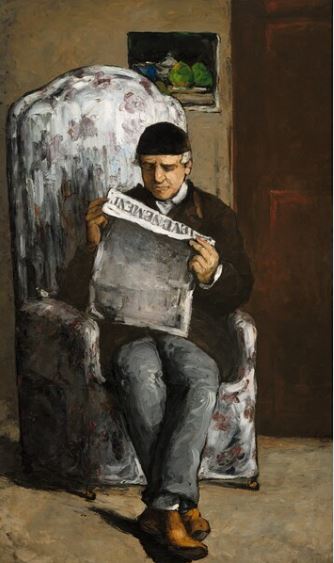
The Artist's Father, Reading
"L'Événement"
(1866),
Paul Cézanne


The perspective in Paul Cézanne's portrait of his father seems a bit off and his father's body twisted, making him look uncomfortable while reading his newspaper (~The Event). It also looks like the subject is wearing gray stone-washed Levi's.


The Return of the Prodigal Son
(1663 - 1665), Rembrandt


Although there's a category of painting known as Rembrandt's Father, such paintings have NOT been attributed to the artist. Instead, I'm including Rembrandt's The Return of the Prodigal Son, which hangs in the Hermitage Museum in St. Petersburg, Russia. I saw lots of dark portraits when I visited the museum during our Baltics cruise in June 2019. It would have taken days to see everything!


First Steps After Millet (1890), Van Gogh


My daughter recently visited the Metropolitan Museum of Art in NYC and saw Van Gogh's Starry Night hanging there. Also on display there is his painting of a child taking its first steps toward the farmer father. It is one of Van Gogh's final paintings inspired by a similar painting by Jean-François Millet.


Brita and me (1895),
Larsson


I love this watercolor portrait of Swedish artist Carl Larsson and his two-year-old daughter, Brita. It hangs in the National Museum in Stockholm. The colors and expressions indicate the happy childhood of Brita, unlike that of the artist, who himself had a rather contentious relationship with his own father. He and his wife went on to have eight children. Although we visited the Moderna Museet while in port on our Baltic Cruise in June2019, we did not get to see the National Museum


Portrait of My Father (1951), Kahlo


Frida Kahlo painted this portrait of her father, Wilhelm, in 1951. He has the same eyebrow(s) and a marvelous mustache. He was a Hungarian-German artist-photographer.


Escher's Father (1916),
M.C. Escher


Expressionist M. C. Escher produced this portrait of his father in 1916. It looks like a block print. I like the simplicity, probably for the same reason that I liked Pissarro's portrait (above).


Facts of Life (1956), Rockwell


I end this post with a dedication to my father, who in his own right was an artist that inspired all of us boys to explore our talents. Although Norman Rockwell did not pay tribute to his own father, I enjoy his Facts of Life illustration of a father giving advice to his son. Curiously, there is a maternal cameo silhouette hanging on the wall in the top left corner. The pair is also surrounded by what appears to be a mother cat and her kittens. I wonder what this father-son talk is about!

Thursday, December 2, 2021

Making Connections with Artists & Animals

The Old Guitarist (1903-4), Picasso

Many of my posts connect art elements and principles to the artists and movements that were inspired by them. Two websites that I recently visited argue that an artist's fame comes from the connections they made with other artists rather than from their own creativity:

Study Finds Artists Become Famous through Their Friends, Not the Originality of Their Work and

Artists Can Become Famous Through Connections and Not Their Creativity

I like to look for famous artwork in movies and on TV. Picasso's The Old Guitarist frequently appears in episodes of Bewitched, which I watch repeatedly in reruns. It was hung rotated 90 degrees to the right to fit over the Stephens' fireplace. The Cleavers' front door on Leave it to Beaver is flanked by Sir Thomas Lawrence's Pinkie (1794) and Thomas Gainsborough's The Blue Boy (1770). Officers Row on Fort Worden in Port Townsend, WA even displayed this pair (in needlepoint) in the dining room of one of the houses we rented there. I hadn't connected the two Thomas's.


Here are three Picasso-style animal portraits. The Lab on the left may actually resemble Cubist artwork by Georges Braque.


One of my posts identifies the Fathers of Art Movements and further mentions the social network of member artists who shared similar visions that inspired their own unique styles and interpretations. Picasso developed his style by admiring African sculpture, particularly traditional African masks and ancient Egyptian art, as well as Iberian sculpture. He was influenced by the art of Paul Klee, as well as French painters Paul Cézanne and Eugène Delacroix.


Las Meninas (1957), Picasso


In 10 Quotes from Famous Artists - My Own Interpretation, Picasso is quoted as saying, "Good artists copy, great artists steal." In 1957, Picasso rescued a dachshund named Lump who had been diagnosed with a spinal condition. He lived 10 years longer than expected and died 10 days before his master. Picasso featured Lump as the dog in his recreation of Diego Velázquez' Las Meninas (1656).


Self-Portrait with Bandaged Ear (1889), Van Gogh

Vincent Van Gogh, Edgar Degas, and Gustav Klimt were all influenced by Japanese art. Van Gogh's interpretations can be seen hanging on the walls of his bedroom in his own paintings. His "The Angelus (After Millet)" is almost a direct copy of Jean-François Millet's painting but with his own color scheme.


Head of a Dog (1882), Monet


Claude Monet's garden is famous for its Japanese footbridge, which is prominent in his Waterlilies series. We visited his garden in Giverny, France in May 2011 on our trip to France and Italy. Monet was influenced by Manet, Boudin, Hokusai and Jongkind. Monet also painted animals, such as the domesticated turkeys I mentioned in my recent Thanksgiving Artwork post. He even painted a dog's head.


Doge Andrea Gritti (c1545), Titian


Continuing with Japanese connections, there is an Internet meme called doge which first appeared in 2013 and is based on a Japanese Shiba Inu dog named Kabosu. The word doge actually refers to an Italian magistrate from Venice or Genoa, dating back to the 16th century. It is also a word that is popular in the game of Scrabble. My daughter recently returned from a visit to Italy that included Venice. Her Korean village dog is a rescue that she originally thought was a Shiba Inu. 


One of my colleagues at Paws with Cause creates whimsical portraits of shelter animals dressed in regal attire. I love this portrait of Pepe the Dog. Pepe would qualify as the Doge of his animal shelter. While my friend and fellow resident artist is not famous, she is certainly creative!


Lady with an Ermine (c1490), da Vinci


The next artist on the mindshare index of famous artists is Leonardo da Vinci. He was influenced by Lorenzo de Medici, John Argyropoulos and Andrea del Verrocchio. I like how his Mona Lisa (1503) has been called a counterpart to Vermeer's The Girl with a Pearl Earring (1665) -- a.k.a. "the Mona Lisa of the North." I like his unusual Lady with an Ermine (c1490). The ermine (similar to a ferret) is a member of the family Mustelidae. The Washington Ferret Rescue and Shelter in Kirkland, WA  has ~150 ferrets looking to be adopted as fur-ever pets. While they aren't currently supported by Paws with Cause, they certainly seem worthy of support. I wish I had a ferret portrait to show you!


Le Civilisateur (1946), Magritte
The next artist on the list is Surrealist Salvador Dali, who was influenced by Pablo Picasso, René Magritte and Joan Miró. Dali often included animals in his dreamlike paintings and has been photographed walking his anteater and petting his ocelot (See Surrealists and Their Pets.). Magritte's portrait of his pet Pomeranian-Spitz, fetched €489,000 in March 2018. Just think of the shelter pets we could support with that kind of Euro!


Kachina, le Chien de Peggy Guggenheim (1946), Ernst


Max Ernst's portrait of his Pekingese, Kachina looks more like a lioness of grand scale in this Hopi landscape. Apparently, he had lived with American art collector Peggy Guggenheim (her dog?) before marrying American artist Dorothea Tanning.


Valse bleue (1954), Tanning


Tanning also painted an oversized Kachina in her Blue Waltz later in 1954. The painting is certainly surreal and the color scheme reminds me of paintings of couples by Marc Chagall. Some websites defined Kachina as a Lhasa Apso Terrier, rather than a Pekingese, which suits the lion reference better.


Le chat aux poissons rouges
(1914), Henri Matisse


Henri Matisse was influenced by Asian and African art, Post-Impressionists Gauguin, Cézanne, and Van Gogh, and his Mentor, Camille Pissarro. He was also a lover of animals, mainly cats, dogs, and doves. See The Friday Art Cat for Matisse's Interior with Goldfish (1914) and a second Etsy version by Deborah Julian where she adds Matisse's two cats -- Minouche and Coussi, or a black cat named la Puce (the flea). Here is his The Cat with Red Fish. I love these happy paintings. This one is reminiscent of others painted in the same room with the red printed wallpaper and window to the outside.


In keeping with the theme, here is an animal portrait that was painted in an event I organized on behalf of PawsWithCause for the shelter, South County Cats. I'm likening it to paintings by Fauvist Henri Matisse for its straight-out-of-the-tube colors.


"The Sower" (1888), Van Gogh


The striped backside of the cat makes me think of the background of Van Gogh's painting, "The Sower".


You may also like to read about The Most Famous Arty Pet Lovers And Their Furry Friends. For example, Georgia O'Keeffe's first dog was a poodle named Pancho, and she also had a total of six Chows as pets over her lifetime. Like Picasso, Andy Warhol favored dachshunds and kept two as pets.

Wednesday, June 16, 2021

My Art Studio Workspace & Artists' Ateliers

Office Space

Now several years into my retirement, I am finally able to carve out a space to paint. Almost two years ago we moved into a new home with an extra bedroom that I use as an office. In our previous home, the spare room had a twin bed (for guests) and an ironing board and became the place for storing nick-nacks and other miscellaneous junk. My intention for my office was to use it for writing art lesson plans on the computer and for doing art projects. Unfortunately, my wife doesn't want me to paint inside the house! My art colleague recommended getting a portable easel so that I could paint outside en plein air. For Christmas 2020 I got my easel and took it with me to paint on our late Winter trip to Palm Springs. 


Shed/Studio Space

My new goal is to establish an outdoor, sheltered place to paint by this Summer. I purchased an 8'X11' resin shed and assembled it under our deck in the backyard. My daughter helped me and found an old used drafting table for my new workspace. I even bought another smaller shed to offload the lawnmower and gasoline. My next challenge is to provide the necessary lighting. There's a small window and a large doorway that will allow some light to stream into my space. There are steel rafters that would be perfect for hanging overhead lighting. The problem is how/where to hang the solar power source since the shed is situated under my deck.


Portable Bluetooth Radio
A neighbor of mine has built his own personal outdoor man cave, a pretty impressive place to hang out. Although he doesn't have a window or electrical wiring, he does have a rather expensive portable power source -- the Massimo MPS 500. He also has a heavy-duty ION Tailgater AM-FM lithium battery-operated radio with Bluetooth capability. And a battery-operated LED light switch for entry into the unlit space. A radio would be useful for listening to music while painting or to hear a baseball game while doing yardwork.


Artists' Studios

If you're a fan of the Wyeths like I am, then you have to check out the Gurney Journey blog post, N. C. Wyeth's Studio, from May 2010. Apparently, Wyeth didn't electrify his studio until 1923, so he was only able to paint during daylight hours. I may experience a similar restriction. James Gurney may have just inspired me to take a trip to Wyeth's home and studio in Chadd's Ford, Pennsylvania. 

The Artist in his Studio
(c. 1626-28), Rembrandt


Rembrandt's studio reminds me of my own small, dimly lit shed though even with his meager digs, he still couldn't afford to pay a model to sit for him so he painted over 75 self-portraits. I probably won't be making any self-portraits any time soon.


Claude Monet in Argenteuil (1874), Manet


Claude Monet had the luxury of painting on a small boat. Édouard Manet captured Monet while painting in his floating studio. I'm thinking about how difficult it would be to paint with the movement of the water. Perhaps a better vantage point would be the river bank.


Musée Atelier de Paul Cézanne,
Aix-en-Provence, France


In May 2011, we were fortunate enough to tour France and Italy. We visited Normandy and Monet's house and gardens in Giverny, France. You may also visit the homes and art studios of famous painters. One such studio is the atelier de Paul Cézanne. Notice the skulls and the bowl of fruit.


Still Life with Skull (1896-98), Cézanne


At first, I thought it could be that of New Mexico artist, Georgia O'Keeffe, because of the skulls, but then I remembered Cézanne's Still Life with Skull. Both artists also used walking sticks (canes). O'Keeffe used hers to fight off desert rattlesnakes.


Window in the Studio (1889), Van Gogh


When Vincent Van Gogh painted indoors, it was often with his friend, Paul Gauguin, in the yellow house where he wanted to establish a studio in which other artists could paint. During the final year of his life, he turned a small hospital room at a mental health facility in Saint-Rémy-de-Provence into an atelier. I am struggling to figure out the four paintings or sketches he has hung on his wall.


Dedication

George Pappas
(1919-2016)
I'm dedicating this post to my high school art teacher, Mr. George Pappas, who spoiled us by playing music while we created our art in his classroom. Each year, we looked forward to hearing the soundtrack of 1939's The Wizard of Oz, which probably contributed somewhat to my love of the movie. Although it was beaten out by Gone With the Wind for the Academy Award, it grew in popularity over years of being televised. Both films were produced and released by Metro-Goldwin-Mayer Studios, Oz in August, and GWTW in December. The book, written by L. Frank Baum (1856-1919) and first published in 1900, was originally illustrated by William Wallace Denslow (1856-1915). See The Lost Art of Oz for the complete list of illustrators of these wonderful stories.


Tuesday, June 8, 2021

Fathers of Art Movements

Recently, while researching this topic, I found The "Fathers" of Art article on the website of the Park West Gallery of Southfield, Michigan. It asks, "Do you agree or disagree with this list?  Can you think of any others?" So, I thought, this sounds like a challenge!

Here are some of the challenges I experienced in researching this topic:

  • Defining the specific period in history when the movement actually began and its popularity ended or morphed into something else
  • Defining the Father of the movement (e.g. Cubism – Braque or Picasso or both)
  • Finding a list of supporting members or practitioners of the movement
  • Finding good examples of each movement
  • Deciding whether to list them alphabetically or chronologically
  • Deciding which movement to include/exclude from my list
I've decided to list them in chronological order.


1. Renaissance (from the 14th century to the 17th century) -- Giotto

Arena Chapel (1305), Giotto
The Father of the Italian Renaissance and European painting is Giotto di Bondone. Giotto is most famous for his decoration of the Arena (or Scrovegni) Chapel, in Padua, Italy around 1305. One site I visited claimed that he had ~40 artisans working on the paintings, working from sketches by the artist, as he directed them where to place the colors. If this is true, then I liken Giotto to glass artist, Dale Chihuly, who also sketched and directed the creation of his glass pieces and their installations all over the world.


2. Baroque (late 16th and early 17th century until the 1740s) -- Caravaggio

The Adolescent Bacchus (1595-97), Caravaggio


The Father of the Baroque movement is Michelangelo Merisi da Caravaggio. While visiting Florence, Italy in 2011 we saw one of his most famous paintings at the Uffizi Gallery. The Baroque style applies to many of the arts and may be characterized by drama, dynamism, emotional exuberance, grandeur, movement, richness, sensuosity, and tension. The chiaroscuro technique first used by Caravaggio and Leonardo da Vinci was later employed by Rembrandt in many of his most recognizable works, including The Man in the Golden Helmet. The light and shadow added contrast and dramatic effects.


3. Realism (1830 thru the end of the 19th century) -- Courbet


The Stone Breakers (1849), Gustave Courbet


Gustave Courbet is known as the Father of Realism. His paintings of ordinary people doing ordinary tasks were unwelcomed by the rich of society who had been used to seeing paintings of wealthy people displaying their opulence.


The Gleaners (1857), Millet


I also enjoy the paintings of Jean-François Millet, whose paintings of peasant life influenced Van Gogh and inspired other impressionists.


Which of these cat portraits looks the most realistic?


4. Impressionism (The early 1860s to 1880s) -- Monet

Poppy Fields Near Argenteuil (1875), Claude Monet

Perhaps the most well-known and acclaimed painter of his time, Claude Monet is often considered to be the Father of Impressionism. Some may argue that its paternity belongs to Pierre-Auguste Renoir, Alfred Sisley, or Frédéric Bazille. Impressionism was a precursor to Neo-Impressionism (Seurat or Pissarro), Post-Impressionism (Cezanne), Fauvism (Matisse), and Cubism (Braque or Picasso).


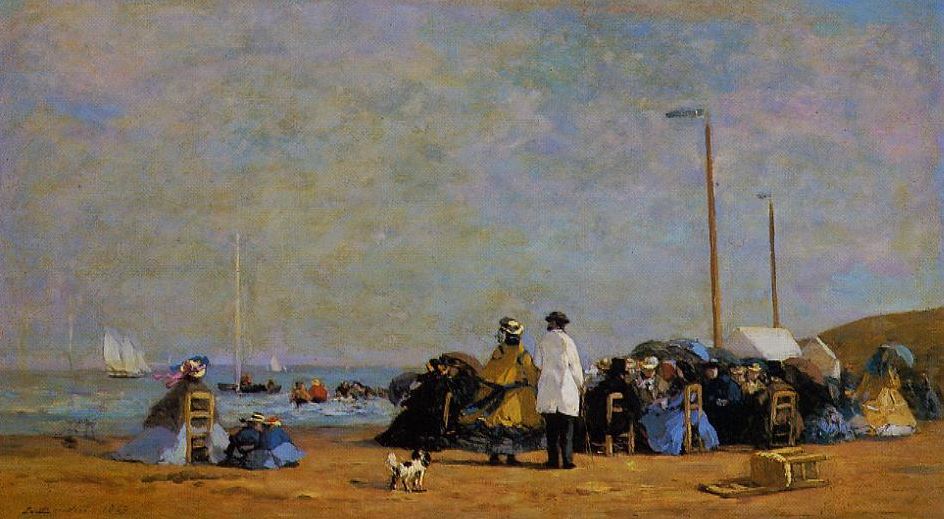
Crinolines on the Beach (1863), Boudin

Maybe the credit should be given to French landscape painter Eugène Boudin, who met Monet in 1858 and taught him to paint landscapes en plein-air and observe the effects of light and tonal value. Therefore, Boudin may have been the Grandfather of Impressionism. Check out that colorful sky!


This portrait of Denver the Cat exhibits a soft style, not unlike the skies in the above works by Boudin and Monet. These pastel colors may also be seen in works by Edgar Degas. The bottom of the painting may resemble a ballet dancer's tutu.


5. Pointillism/Divisionism/Neo-Impressionism (the late 1880s to the first decade of the 20th century) -- Seurat

Sunday Afternoon On The Island Of La Grande Jatte (1886), Seurat


Picking Peas (1887), Pissarro


Georges Seurat is credited as being the Father of Pointillism. However, my favorite Neo-Impressionist will always be Camille Pissarro. His compositions and color schemes are much more pleasing to me than Seurat's array of colored juxtaposed dots. While he still captures the lighting effects of Impressionism, his brushstrokes add texture without the obvious dots.


6. Modern Art/Post-Impressionism (1886-1905) -- Cézanne

Mont Sainte-Victoire (1895), Cézanne

Post-Impressionism evolved from the saturated colors of Impressionism and sought to reduce objects to their basic forms. The Father of Post-Impressionism is Paul Cézanne. Notice the shaded areas of color forming a patchwork of shapes that resembles later Cubist compositions. The 20th-century compositions will become much more angular and geometric, often using contrasting bold colors as opposed to the more analogous colors of this landscape.


7. Fauvism (1904-1908)

The Dessert: Harmony in Red (1908), Matisse
One of my all-time favorite artists, Henri Matisse, is also the founding Father of Fauvism. Inspired by the works of Impressionists like Van Gogh, Matisse also infused emotion into his paintings but instead of using the pastel colors of Monet, he used vibrant right-out-of-the-tube colors creating tension and contrast between warm and cool colors. In May 2011, on our trip to France and Italy, we stopped in Nice to visit the Matisse museum. Last Fall, in my post entitled, Top 15 Paintings that Use Primary Colors -- Red, Yellow, and Blue, I selected this Matisse work as #2 of my favorite Red paintings. Using unnatural colors was a way for the Fauvists to express emotion.


8. Expressionism (1905-1920)

The Scream (1893), Munch


The Chapman University blog about Expressionism describes the movement as "A group of artists that became associated with the Expressionism movement, tried to express or capture these feelings of uncertainty through swirling, exaggerated brushstrokes or jarring and violent lines and combinations of colors." Norwegian artist Edvard Munch is known as the Father of Expressionism. While on our June 2019 Baltic Cruise, we visited the Munch Museum in Oslo, Norway. Munch has also been considered to be part of the Post-Impressionist movement.


From Thuringewald (1905), Munch
In 1905, German architecture students Ernst Ludwig Kirchner, Fritz Bleyl, Karl Schmidt-Rottluff, and Erich Heckel became artists and formed the group The Bridge (Die Brücke) in the city of Dresden. Like Munch, their work was an emotional and psychological response to the world around them. While Munch's colors in his earlier works were more somber, German Expressionists' colors were more akin to its French Fauvist counterparts like Matisse. Matisse's paintings were happier and less anxious or angst-filled.


Which one of these cat portraits of Cheeky Tom is more expressionistic? Impressionistic? What about the use of color?


9. Cubism (1908-14)

(left) Ma Jolie, Picasso (1911-12) &
(right) The Portuguese, Braque (1911-12)
Cubism is yet another style that evolved almost to abstraction from the Fauvist and Expressionist movements. While they share some elements in common, Cubists went even further away from representational figures and forms to angular and geometric shapes and areas of color. Many will argue whether Georges Braque or Pablo Picasso is the true Father of Cubism. Even their works are quite similar. Supporting members of the movement included: Robert Delaunay, Henri Le Fauconnier, Albert Gleizes, Juan Gris, Fernand Léger, and  Jean Metzinger.


Nude Descending a Staircase,
No. 2
(1912), Duchamp


Dadaist Marcel Duchamp's Nude Descending a Staircase (No. 2) is a work that was rejected by member artists as being too futuristic. The Dadaism and Futurism movements (1909-13) were overlapped by the Cubist movement. While in high school, my older brother did some futuristic paintings. The one I remember most is of the Frazier/Ali fight.


10. Surrealism (1924-1966)

The Persistence of Memory (1931), Salvador Dali

Although many consider Spanish artist Salvador Dali to be the Father of Surrealism in art, French writer, poet, and artist André Breton began the movement as a response to Dadaism (the 1860s-1970s) during World War I. Other notable Surrealist artists include Antonin Artaud, Francis Bacon, Marc Chagall, Marcel Duchamp, Max Ernst, Lucian Freud, Freda Kahlo, Paul Klee, René Magritte, Joan Miró, Pablo Picasso, Man Ray, and Yves Tanguy. The irrationality of the images is said to unlock the creativity of the unconscious mind.


11. Abstraction/Abstract Expressionism/Action Painting (1943 thru the mid-1950s)


While the first real departure from Realism and toward Abstraction is said to have been fathered by Russian artist, Wassily Kandinsky, and other Expressionists in the early 1900s, the first generation of Abstract Expressionism didn't begin until 30 years later.


Still Life Interior (1941), Hofmann


German-American artist, Hans Hofmann, is also thought to be the Father of Abstract Expressionism, although he was apparently influenced by the work of Kandinsky. His early paintings were more Fauvist, such as his stylized still lifes and interior paintings. It turns out that Lee Krasner, future wife of Jackson Pollock, and an Abstract Expressionist herself, enrolled in Hofmann's art school in 1937. Later, in 1940, Hofmann experimented with drip paintings. Jackson Pollock followed in Hofmann's footsteps by dedicating his later career to Action Painting.


Fish Market (Seattle Market
Scene Sketch) (1943), Tobey


Water of the Flowery Mill (1944),
Arshile Gorky


Some say that Armenian-American artist, Arshile Gorky (left) or even Mark Tobey (right) is the true Father of Abstract Expressionism.


12. Pop Art (the mid-1950s and the '60s)

The Marilyns, Andy Warhol
Yet another controversy exists for Pop Art. Like Cubism, there are two artists -- Andy Warhol (1928-1987) and British collage artist Richard Hamilton (1922-2011) -- who get credited with starting the movement. We saw Warhol's exhibit at the Palm Springs Art Museum in the Spring of 2018. Let's not forget Roy Lichtenstein (1923-1997) and Robert Rauschenberg (1925-2008) both of whom are famous Pop Artists.


13. Op Art (the 1960s when JFK became President)

Cheyt Rond (1974), Victor Vasarely


Finally, the Founder of the Op Art movement is Hungarian-French artist Victor Vasarely (1906-1997), whom I've blogged about in several posts. Optical Art uses precise lines and contrasting colors often in geometric patterns to create optical illusions and even movement.


What style or art movement best describes the following two portraits of Buster-Baxter? How are they different? Which portrait looks the most realistic and why? What if anything makes you like one painting over the other?