Showing posts with label Whistler. Show all posts

Wednesday, June 28, 2023

Artists With July Birthdays

Still Life with Parrot and Fruit (1951), Kahlo


Many of my favorite visual artists were born in July. In fact, all of them have been featured in this blog. Most were born under the sign of Cancer (or the Crab). They are typically emotional, hypersensitive, competitive, and often isolated people. 

Frida Kahlo (1907-54), born  July 6th, is famous for her unusual and often creepy self-portraits. I much prefer her still life paintings. Do parrots like watermelon?


The Wolffish (2004), Jamie Wyeth


Jamie Wyeth (1946-), son of Andrew Wyeth and grandson of N.C. Wyeth, was also born on July 6th. I chose this painting of a fierce wolffish preying on seagulls because it's unusual. Wyeth crowded the birds on the left side of the painting perhaps to balance the dark fish emerging from the right. His sense of humor reminds me of his father's Roadkill painting of a dead squirrel on a road alongside of a plantation house.


The Bridal Pair with The Eiffel Tower
(1939), Marc Chagall


Marc Chagall (1887-1985), born July 7th, is famous for his very large Surrealistic paintings. We visited his museum in Nice, France in May of 2011. Weddings are a popular theme for Chagall's works. As well as oversized farm animals! His dreamlike paintings are more like collages.


Still Life with a Coffeepot (1900), Pissarro


French Neo-Impressionist, Camille Pissarro (1830-1903), born July 10th, is most famous for his pastoral landscapes and harbor scenes. I had to include this still life, which happens to have bird wallpaper. The copper coffeepot and green ceramic mug are the stars of this painting, while the china teacup, bowl, and lemon are secondary in his composition.


Soaring (c. 1950), Andrew Wyeth
I seem to be including birds in my selections, so here is a magnificent scene of ravens soaring high above a small white farmhouse below. Andrew Wyeth (1917-2009), born July 12th, and his son, Jamie used ravens as their subjects in several paintings. Andrew spent long hours, weeks, even months alone in a barn painting, and wouldn't show anyone his work until it was done.


Head of a Woman (1918),
Modigliani


Amedeo Modigliani (1884-1920), also born July 12th, painted portraits of women with elongated faces and necks. His subjects appear stretched in subtle 'S' shapes much like those of Marc Chagall.


James Abbott McNeill Whistler (1834-1903), also born July 12th, is most famous for his painting of his mother. His portraits, including his own self-portrait, have the subject facing in a left profile view. I feel like he was a one-hit wonder.

The Man With the Golden Helmet
(c. 1650-55), Rembrandt


Rembrandt (1606-69), famous for painting ~75 self-portraits in his lifetime, was born July 15th. In every museum I've visited, I've challenged myself to find at least one Rembrandt. My favorite is The Man With the Golden Helmet (1650). It has been attributed to Rembrandt, but may actually have been painted by a student of someone in his circle or artists. It has resided in Berlin's Kaiser Friedrich Museum, which we didn't get to visit during our Baltic cruise in June 2019.


Lady Caroline Howard (1778),
Reynolds


Sir Joshua Reynolds (1723-92), born July 16th, was Principal Painter in Ordinary to the King from 1767–1784. Thomas Gainsborough, painter of Blue Boy (1770), was his rival for the position, never attaining the prominent title. Thomas Lawrence, who painted Pinky (1794), did eventually receive the coveted title.


In Front of the Mirror (1889), Degas

Edgar Degas (1834-1917), born July 19th, remained a bachelor all his life. He presented himself as a loner and his demeanor drove people away, something he desired as an artist. He was known to be a misogynist and was also anti-Semitic. No wonder nobody wanted to marry him (or vice versa)!

Like Modigliani, Degas signed this painting at the top righthand corner. Unusual! Especially since Modigliani was born a Sephardic Jew!!


Nighthawks (1942), Hopper


Edward Hopper (1882-1967), born July 22, is most famous for his melancholy painting, Nighthawks, of a sad group of people hanging out in a diner, very late at night or perhaps in the wee hours of the morning.


Nude Descending a Staircase,
No. 2
(1912), Duchamp


Our last artist was born under the sign of Leo (the Lion). Leos are ambitious and creative. Marcel Duchamp (1887-1968), born July 28, is most famous for his Cubist painting of a Nude Descending a Staircase, No. 2. In the 1970s, my own brother was inspired to paint a futuristic version of the Frazier-Ali fight on a large canvas.

As I was researching and writing this post. I realized that most of my selections have either birds or hats in them. I guess this last painting doesn't fit the bill (Ha!)!

Sunday, May 14, 2023

Mothers of Famous Artists -- A New Dedication

The Artist's Mother: Head and Bust,
Three-Quarters Right
(1628), Rembrandt


In May of 2021, I posted Mother's Day Dedication and Artist Inspirations. It included artists: Mary Cassatt, Vincent Van Gogh, and James Whistler. For 2023, let's explore several other famous artists who memorialized moms with portraits. Happy Mother's Day!

Rembrandt captured his mother, Neeltgen Willemsdochter van Zuytbrouck, in several early etchings and painted portraits, since he was unable to afford to pay models to sit for his paintings. The squiggly lines figure well in showing the woman's age softly and with a subtly pleasant expression.


Mother's Day Off (1916), Rockwell


James Abbott McNeill Whistler's portrait of his mother, Anna Whistler, is yet another Portrait of the Artist's Mother (1871) and is famously known simply as Whistler's Mother. Van Gogh's mother, Anna Carbentus van Gogh, and Norman Rockwell's mother, Anne Mary (Hill) Rockwell share similar first names. See the link above for the Van Gogh and Whistler portraits. Norman Rockwell's dedication to mothers appeared in one of his first publications of the Saturday Evening Post in 1916's Mother's Day Off.


Mrs. Robert S. Cassatt,
the Artist's Mother

(1889), Cassatt
Portrait of the Artist's Mother
(1889), Mary Cassatt
Henrietta Benson Homer, an artist in her own right, was mother to Winslow Homer. I included her work in my recent April Flowers in Art post. I've also featured the works of Mary Cassatt in my posts. Here are portraits of her mother, Mrs. Robertt S. Cassatt (nee Katherine Kelso Johnston). Perhaps the portrait on the left is the final version and much truer to her impressionist style. The one on the right must have been a study. The flowers seem to be floating about her head.


Mother and Child (1938), Picasso
Portrait of the Artist's Mother
(1896), Picasso
Pablo Picasso did this portrait of his mother, Maria Ruiz Picasso, and has represented motherhood in many of his works. The portrait on the left shows his ability to paint in a realistic style. He has captured the softness of his mother's blouse and the light caressing her face. Contrast it with his painting of lover, Marie-Thérèse Walter, and their child Maya, long after he became a Cubist painter.


The Dead Mother (1902),
Edvard Munch

Dead Mother (1889), Munch
Edvard Munch was only five years old when his mother, Laura Much, died of tuberculosis following the birth of his sister, Inger. Death was a common subject for Munch. The child's pose is reminiscent of that of The Scream.


Portrait of Artist's Mother (1902),
by Franz Marc


German Expressionist, Franz Marc, painted this portrait of his mother Sophie in 1902. Its muted colors and natural realism are unlike his later more colorful abstract paintings of animals. I wonder if the 'postage stamp' picture in the top right corner is meant to be Franz as a toddler. Without it, my eye may have focused on the book. Its subtle presence in the background suggests that the woman is a mother. Although Franz was married twice during his short life, he never gave his mother any grandchildren.


The Artist's Mother (1916), Hopper


Edward Hopper is most famous for his melancholy painting, Nighthawks, showing patrons hanging out in a diner late at night. He also painted this portrait of his mother, Elizabeth Griffiths Smith Hopper. You can see the resemblance between mother and son. The richness of her vibrant purple dress is complemented by details of her face and right hand and contrasted by the pastel yellows in the background.


Portrait of the Artist's Mother
(1918), Salvador Dali

Portrait of the Artist's Mother
(1920), Salvador Dali

Salvador Dali's portraits of his mother, Felipa Domenech Ferrés differ dramatically. His 1918 Portrait of the Artist's Mother is in a realistic style, while his later version more impressionistic. Later, in 1929, he made a surrealist version entitled, The Enigma Of Desire, My Mother, My Mother.


Woman with Plant (1929), Grant Wood

Hattie Weaver Wood (mother of Grant Wood) is represented in Woman with Plant (1929). In Wood's later more famous American Gothic (1930), he used likenesses of his sister, Nan Wood Graham, and their dentist Dr. Byron McKeeby. The clothing on the woman is very similar to that of the farmer's daughter. Wood put a lot of detail in the woman's face, while the rest of the subject and background are flatter, simpler and more cartoonish.

American folk artist, Grandma (Anna Mary Robinson) Moses, painted her simple landscapes beginning in 1938 at the age of 78. See Artists Born Under Virgo or Libra.


Maga's Daughter (1966), Andrew Wyeth


Betsy Wyeth, wife of painter Andrew Wyeth, had two sons, Nicholas and James (artist Jamie). She was the model for Wyeth's 1966 painting Maga's Daughter. She likened her role as director and Andrew's career as that of an actor. One might also consider her his agent, collaborator, and muse.


Camille Monet and a Child in the Artist’s Garden
in Argenteuil
(1875), Claude Monet

I am a sucker for the Impressionists. Claude Monet painted this beautiful scene of his wife, Camille and their daughter relaxing in their garden at Argenteuil, where he lived from 1871-1878. While visiting Paris in 2011, my family and I drove to see Monet's garden in Giverny, where Monet lived from 1883-1926. The focus seems to be on his wife and the vivid blue and white brushstrokes in her dress. The child leaves more of an impression. I like how Monet has framed his composition with the path in the foreground and the flowers fading into the background.

Sunday, June 12, 2022

Portraits of Artists' Fathers

Winter 1946 (1946), Andrew Wyeth

Last year, I posted Fathers of Art Movements in honor of Father's Day. This year, I thought I'd research artwork that honors the fathers of famous painters. A good example would be Andrew Wyeth's Winter 1946, a portrait of a young man running aimlessly down a hill, which, following the tragic death of his father, Newell Convers Wyeth (and grandson), became a sort of tribute. The boy may actually represent the artist himself trying to make sense of his father's tragic death.

Portrait of Camille Pissarro
(1893), Lucien Pissarro


I like Lucien Pissarro's rendering of this simple drawing of his father, Camille Pissarro, who is one of my favorite impressionist painters. It may be seen at Tate Britain in London, although I don't recall seeing it during our UK trip in June 2017.


Portrait of Alexander J. Cassatt
and His Son, Robert Kelso Cassatt

(1884), Mary Cassatt

We've all seen the iconic Whistler's Mother, a portrait of the artist's Mother, a subject common to many artists. Its title is actually, Arrangement in Grey and Black No. 1. More common are paintings of mother and child. French impressionist, Mary Cassatt, painted this portrait of her brother and her nephew. The father is reading a newspaper, offset by the boy's white collar. Their heads and hands stand out from the contrasting black shape of their suits.


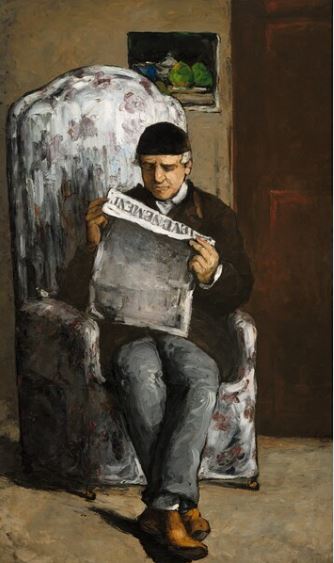
The Artist's Father, Reading
"L'Événement"
(1866),
Paul Cézanne


The perspective in Paul Cézanne's portrait of his father seems a bit off and his father's body twisted, making him look uncomfortable while reading his newspaper (~The Event). It also looks like the subject is wearing gray stone-washed Levi's.


The Return of the Prodigal Son
(1663 - 1665), Rembrandt


Although there's a category of painting known as Rembrandt's Father, such paintings have NOT been attributed to the artist. Instead, I'm including Rembrandt's The Return of the Prodigal Son, which hangs in the Hermitage Museum in St. Petersburg, Russia. I saw lots of dark portraits when I visited the museum during our Baltics cruise in June 2019. It would have taken days to see everything!


First Steps After Millet (1890), Van Gogh


My daughter recently visited the Metropolitan Museum of Art in NYC and saw Van Gogh's Starry Night hanging there. Also on display there is his painting of a child taking its first steps toward the farmer father. It is one of Van Gogh's final paintings inspired by a similar painting by Jean-François Millet.


Brita and me (1895),
Larsson


I love this watercolor portrait of Swedish artist Carl Larsson and his two-year-old daughter, Brita. It hangs in the National Museum in Stockholm. The colors and expressions indicate the happy childhood of Brita, unlike that of the artist, who himself had a rather contentious relationship with his own father. He and his wife went on to have eight children. Although we visited the Moderna Museet while in port on our Baltic Cruise in June2019, we did not get to see the National Museum


Portrait of My Father (1951), Kahlo


Frida Kahlo painted this portrait of her father, Wilhelm, in 1951. He has the same eyebrow(s) and a marvelous mustache. He was a Hungarian-German artist-photographer.


Escher's Father (1916),
M.C. Escher


Expressionist M. C. Escher produced this portrait of his father in 1916. It looks like a block print. I like the simplicity, probably for the same reason that I liked Pissarro's portrait (above).


Facts of Life (1956), Rockwell


I end this post with a dedication to my father, who in his own right was an artist that inspired all of us boys to explore our talents. Although Norman Rockwell did not pay tribute to his own father, I enjoy his Facts of Life illustration of a father giving advice to his son. Curiously, there is a maternal cameo silhouette hanging on the wall in the top left corner. The pair is also surrounded by what appears to be a mother cat and her kittens. I wonder what this father-son talk is about!

Sunday, May 16, 2021

Mother's Day Dedication and Artist Inspirations

Mom (ca. 1958)

I'm dedicating this post to my Mom, a very snappy dresser who expressed her artistic side through clothes, costume jewelry, handbags, and shoes; she was the Imelda Marcos of the U.S. My favorite photograph of her is a black-and-white portrait with me and my older brother. Her haircut is reminiscent of Elizabeth Taylor’s short 1950s hairstyle from Father of the Bride. Even Lucille Ball dons a new hairstyle during the Black Wig episode of I Love Lucy (1954) where she tries to fool Ricky into believing she is an Italian temptress.

Liz Taylor (1963-5), Andy Warhol

Andy Warhol famously silk-screened portraits of Liz, Lucy, Marilyn Monroe, among others. Warhol and Ball share August 6th birthdays and iconic hairstyles -- Andy with his white wig and Lucy with her red henna-dyed hair. We saw his Marilyn exhibit while visiting Palm Springs in 2018. His work is currently on display at the Tate Museum in London, the birthplace of Ms. Taylor. As a mother, she had three biological children and one adopted child.

Vue de l'asile et de la Chapelle de Saint-Rémy
(1889), Vincent Van Gogh


She once owned a rare Van Gogh painting. Apparently, her art dealer father paid $130,000 for it in 1963 on her behalf, and it later sold at auction at Christie's in May 2018 for $39,687,500.


Portrait of the Artist's Mother
(1888), Van Gogh


Vincent's mother, Anna Carbentus Van Gogh, an amateur artist herself, is credited as having introduced him to art. He colorized her portrait from a black-and-white photograph.


Green Acres (1965-71)

Mom sported many hairstyles. One day I came home from school and was shocked to find a blonde woman talking on the phone in the kitchen. It was my Mom, but she looked like Eva Gabor from the 1965 sitcom Green Acres. Her hair was in a French twist, the signature hairstyle of Ms. Gabor. Mom remained a blonde from then on and even wore her hair like that as the mother of the groom in my wedding.

I bet you recognize the couple's pose as that of Grant Wood's American Gothic (1930). You may see it hanging today in the Art Institute of Chicago.


We even compared Mom to actress Dina Merrill, who appeared as a brunette in 1963’s The Courtship of Eddie's Father opposite Glenn Ford with little Ronnie Howard as Eddie. Earlier in 1959, she starred with Tony Curtis in the Cary Grant movie Operation Petticoat as a blonde. We’d watch her in the 1970s on the game show Match Game.


Mom was also on TV as a 3-day winner on the game show Concentration, hosted by Hugh Downs. I remember watching her in my older brother’s 3rd-grade classroom where we made Christmas wreaths on paper plates. It felt like I was the Beaver, spending time with Wally and watching Mrs. Cleaver on a game show. The show inspired us to create our own rebus puzzles after we exhausted all the ones that came with the board game.


One of the most prominent game show stars was Betty White, who often appeared on her husband’s show Password. In Mom’s later years, she was definitely channeling this Golden Girl. Mom also caught the acting bug when she imitated Betty Hutton by lip-synching a song for a church variety show. 


The song, "How Could You Believe Me When I Said I Loved You When You Know I've Been a Liar All My Life?", was actually from a Fred Astaire movie and was sung by actress Jane Powell. Ms. Hutton was famous for her portrayal of sharpshooter Annie Oakley in Annie Get Your Gun (1950).


Mother and Child (1914), Mary Cassatt


Now let's look at some of the more famous artwork depicting mothers. I included this beautiful pastel painting by American portrait and figure artist Mary Cassatt (1844–1926) in my April Easter Eggs post.


Whistler's Mother (1871), James Whistler


One of the most iconic American paintings is James McNeill Whistler's portrait of his mother, Anna McNeill Whistler. Known simply as Whistler's Mother, its actual title is Arrangement in Grey and Black No. 1. Not the most flattering image, though it made it into the Musée d'Orsay in Paris.


Pietà (1498-99), Michelangelo,
St. Peter's Basilica

Michelangelo’s Pieta, a common subject in religious art, is certainly one of the most well-known sculptures in the world. Sorrowful Mother Mary is compassionately cradling her dead son. She seems so robust compared to the frail Christ. Even under the magnificent amount of folds of her garment and his shroud you can see her strong lower legs supporting his weight. 

When we visited the Vatican in May 2011, St. Peter's was unfortunately too crowded for us to visit. The lines were too long and we had just finished winding our way through the Vatican to see the Sistine Chapel. Maybe next time!