Showing posts with label Gainsborough. Show all posts

Thursday, May 22, 2025

Melancholy, Sadness, Grief, and Loneliness in Art

It's been almost one year since the passing of my wife of >40 years. Spring flowers, as discussed in my previous post, bring me joy and remind me of my lovely wife, whose birthday is in early April. On the flip side is the loneliness I'm experiencing, along with the sadness and grief of losing the love of my life.

The Honorable Mrs. Graham
(1777), Gainsborough


Thomas Gainsborough's portrait of The Honorable Mrs. Graham was commissioned by Mary's husband, Thomas, though she died a few years later of tuberculosis after he attentively cared for her throughout her illness. Sadly, he couldn't bring himself to look at her portrait after her death, and he lived for another 50 years. I may have seen this painting in the Scottish National Gallery when we visited Edinburgh in 2017.


Sorrowing Old Man (1890),
Van Gogh


Most of my favorite artists were Impressionists, with their soft, yet vibrant colors, peaceful landscapes, and portraits. Van Gogh's At Eternity's Gate (a.k.a. Sorrowing Old Man) shows a tired, worn-out man seated beside a warm hearth and possibly contemplating life after death in heaven. The chair resembles the one in the painting of Vincent's bedroom. I believe both men were residents of the asylum at St. Rémy, where Van Gogh spent the last two years of his life battling mental illness.


The Old Guitarist (1903), Picasso


In my post, Making Connections with Artists & Animals, I highlight Picasso's The Old Guitarist, which I like to use in my art lesson plans. It frequently appears in episodes of Bewitched, which I have watched repeatedly in reruns. It was hung rotated 90 degrees to the right to fit over the Stephens' fireplace. I like to ask my students which orientation is correct and which they like best. Picasso began to paint figures of the downtrodden (like this blind, poor guitarist) in response to the death of his close friend, Casagemas.


Christina's World (1948), Wyeth

Probably my favorite American Realist artist is Andrew Wyeth. In my post entitled, Farms and Barns by Famous Artists, he is described as "an actor being typecast for a specific role, who struggles to be recognized for his other works, and is forever remembered for a single character". Christina is a disabled young woman in a field of grass. You may recall his obsession with Helga, who was his most often painted model.


Nighthawks (1942), Hopper
In a repeated commercial for the Looney Tunes Sylvester & Tweety Mysteries series, the backgrounds that fly by remind me of the paintings of Edward Hopper. Nighthawks depicts a late-night diner with four lonely people. There's a takeoff painting with James Dean, Humphrey Bogart, Marilyn Monroe, and Elvis Presley as the soda jerk behind the counter. A Simpsons episode, "Homer and the 18th Amendment" also spoofs the famous painting.


Hotel Room (1931), Hopper
Automat (1927), Hopper

Many of Hopper's images are melancholic, especially Automat and the Hotel Room. In both paintings, a young woman is seated alone, one at a restaurant table at night, and the other in a small hotel room during the day. They share a similar color scheme, perspective, and strong contrast of light and dark.


The Scream (1895), Munch

Norwegian Expressionist Edvard Munch is often considered to be the melancholiest artist of all time. His paintings dealt primarily with death, as many of his family members suffered and died from lung disease such as tuberculosis and some of his subjects from polio and syphilis. He (like Van Gogh) also suffered from mental illness, probably from experiencing trauma early and throughout his life. The Scream is sometimes referred to as the Mona Lisa of its time and is clearly one of his most recognizable works. I didn't realize that it was pastel-on-board. Apparently, in 2012, it sold for $120M. It is also considered to be his self-portrait, that of a mad man, although he has painted the figure asexually and almost inhuman, like a space alien.


Pocket Poodles (1962), Keane


The final painting I want to share is by 'Big-Eye' artist Margaret Keane, whose second husband tried to take credit for her paintings (Can you believe that!?). Tim Burton's 2014 biopic, Big Eyes starred Amy Adams as the blonde artist. Pocket Poodles (1962) is a portrait of a sad young girl holding two small dogs. You may find such portraits cute, but I think they're a little creepy. In my grief journey, I am blessed to have the comfort of my own two Shih-Tzu fur babies, without whom I'd be lost!

Thursday, April 10, 2025

Praising Budding Artists for Their Work

Words of encouragement go a long way to inspiring young artists. “Creativity is so delicate a flower that praise tends to make it bloom, while discouragement often nips it in the bud. Any of us will put out more and better ideas if our efforts are appreciated.” - Alexander Osborn

For example, "I love the way you...", or "Your style amazes me." is a great starting point. Get people talking about their art and have them practice talking about the work of other artists. "What do you like about it?" "Why did you choose this color combination?" Use art vocabulary, explaining how their choice of complementary or contrasting colors added interest. Besides praising an artist for their own unique style, it might be helpful to compare their work to that of other more famous artists. It also helps to take a picture of your art on your phone. Seeing a photo can change one's point of view away from the canvas you've been staring at for an hour and a half, and that which you've become overly critical.


Making connections with other artists and even the subject matter -- "Your brushstrokes remind me of Van Gogh" or "That reminds me of MY dog" -- are inspiring comments for an artist to hear. Their work is being thoughtfully acknowledged for its content, execution, style, or the feelings it invokes in the viewer.


Two Crabs (1889), Vincent Van Gogh
My family, friends, and colleagues encourage me to do more art. Museums are always stimulating, especially when I discover another Van Gogh painting or see a Rembrandt in person! Flemish artist, Peter Paul Rubens was heavily influenced both artists. Van Gogh was also influenced by his friend, Paul Gauguin, who encouraged him to paint from his imagination, French realist Jean-François Millet, other Impressionists, and Japanese art. Van Gogh painted Two Crabs in 1889 as an experiment in complementary colors inspired by the color theory of Eugène Delacroix.


In May of 2017, I saw it hanging in The National Gallery in London's Trafalgar Square.


Emily's Chicken


I wonder if PawsWithCause resident artist, Emily, was inspired by Van Gogh's crabs. Here is her portrait of a chicken in a very similar contrasting color scheme. Amazing! And I love the brushstrokes!!


An art docent needs to understand and become familiar with the elements and principles of visual art.


As time is often limited to an hour and a half, it is important to monitor the progress of the artist's portrait. They need to decide where to start, then begin to lay down paint. If they have a favorite color and are unfamiliar with brushes and the medium, you may suggest starting with the background. Help the novices mix their color in the large space in the center of the palette, making enough to cover the surrounding area. Often, with Seniors especially, the background is left blank. If the body of the subject animal is grey, that too may require mixing lots of that color in the middle of the palette.


One of our seniors spent most of her time outlining the features of her white cat and chose to limit her palette. She simply used black paint to suggest texture on the cat's coat. She carried on and used black for the front paws in shadow. The cat's tail saw the beginnings of Pointillism that had time permitted would have been an awesome technique to finish with. Because there was no paint applied to the background it made for a harmonious somewhat linear composition.


White Angora Cat (1761), Bachelier


Another favorite of mine is this portrait of a white angora cat beautifully (oil) painted by French artist, Jean-Jacques Bachelier. Here we see a cat chasing a butterfly. The cat's fur is well-executed. Though I wouldn't want to have to brush that coat!


All one-color animals, such as white or black cats, or white, brown, or black dogs, are particularly challenging to paint. It may take time to execute the subtle shading (primarily shades of grey). As an art docent I'd recommend doing small areas at a time while the paint is still wet; this is when blending is most successful. Maybe work on the head, then body and legs. Highlights may be added later, as with the back and tail in Bachelier's painting.


Two Cats Blue and Yellow
(1912), Franz Marc
Cats on a Red Cloth (1909),
Franz Marc

20th century German Expressionist Franz Marc captured some cats sleeping or grooming themselves. The first painting is more realistic than his second more expressive Cubist work. Can you find the mouse?


18th century English artist Thomas Gainsborough also studied feline positions of the Great Cat. According to the referenced link, his black-and-white chalk drawing is similar to that of another famous artist from the 15th century.

Apparently, I missed Paul Gauguin's Flowers and Cats (1899) while visiting the Ny Carlsberg Glyptotek museum in Copenhagen, Denmark on our cruise to the Baltics in June 2019.

Another recent post, entitled Making Connections with Artists & Animals features the cats of French Fauvist Henri Matisse.

Many of the world's most famous artists kept cats as pets. Here's a list:

Henri Matisse (Minouche, Coussi, and Le Puce); Pierre Bonnard (Cat);
Salvador Dali (Babou); Gustav Klimt (Katze); Georgia O’Keeffe (Siamese); 
Pablo Picasso (Minou); Louis Wain (Peter); Andy Warhol (Sam); and
        Wassily Kandinsky (Vaske)


We lost American artist Laurel Burch in 2007. She was famous for her bold cat designs such as those featured in one of her books, Fantastic Felines (1997). I believe we've done a jigsaw puzzle like this.


by Bill


Many of the artists who paint the shelter animal portraits are seniors who hang out at senior centers or assisted living establishments. One such artist is Bill, whose work is reminiscent of German Expressionist, Max Beckmann. See my post entitled, 'Egyptian Art, Sculpture, and Tombs'.


Another PawsWithCause patron painted this portrait of Cai with a light green tennis ball in its mouth. The artist's style is also like Beckmann, but with more of a Surrealist vibe. The background continues with the lime green color, adding little wispy shapes much like Henri Matisse decorated his red wallpaper in his Fauvist works. The touches of blue add interest to the composition.


You may also appreciate Medford the dog, who is sporting a Dio de Los Muertos mask on his face, reminiscent of the art of Frida Kahlo or Diego Rivera. Spanish Catalan painter Joan Miró often used a black background and Whimsical shapes (like spirals) to create his abstract art with Surrealist fantasy. Notice how the brushstrokes in his blonde fur add a realism that adds an anthropomorphic touch as if the animal is celebrating a human holiday. See Pepe the Dog in my post entitled, Making Connections with Artists & Animals.


Marlee is a good example of Realism. I especially like the artist's use of small, jagged brushstrokes, lending texture to the dog's coat. Happy accidents, like allowing the marker outline (from the original sketch) to show through, accentuate subtle features. I love the impressionistic background which further softens the overall painting. Check out the eyes with different color irises!


This portrait of Emma shows a good example of well-executed shading. The blue-gray color that the artist chose is a beautiful complement to her orangish-brown coat. Her sad eyes and overall color scheme make me think of the melancholy paintings (like "The Scream") of Norwegian Expressionist, Edvard Munch.


Many of our painting sessions, as with many of the art classes I've taught, are often too short for seniors or even younger students to complete a portrait in the allotted time. Although not common for established painters and master artists, some works are intentionally unfinished.


Gilbert Stuart created the Athenaeum Portrait of George Washington that currently hangs in the Smithsonian's National Portrait Gallery. The unfinished work was used to paint 130 copies sold for $100 each and for the engraving of GW on the US $1 bill.


The only other unfinished painting I've ever seen is “An Allegory of Virtue”, attributed to Corregio (~1489-1534), which hangs in the Scottish National Gallery in Edinburgh. 


Wednesday, June 28, 2023

Artists With July Birthdays

Still Life with Parrot and Fruit (1951), Kahlo


Many of my favorite visual artists were born in July. In fact, all of them have been featured in this blog. Most were born under the sign of Cancer (or the Crab). They are typically emotional, hypersensitive, competitive, and often isolated people. 

Frida Kahlo (1907-54), born  July 6th, is famous for her unusual and often creepy self-portraits. I much prefer her still life paintings. Do parrots like watermelon?


The Wolffish (2004), Jamie Wyeth


Jamie Wyeth (1946-), son of Andrew Wyeth and grandson of N.C. Wyeth, was also born on July 6th. I chose this painting of a fierce wolffish preying on seagulls because it's unusual. Wyeth crowded the birds on the left side of the painting perhaps to balance the dark fish emerging from the right. His sense of humor reminds me of his father's Roadkill painting of a dead squirrel on a road alongside of a plantation house.


The Bridal Pair with The Eiffel Tower
(1939), Marc Chagall


Marc Chagall (1887-1985), born July 7th, is famous for his very large Surrealistic paintings. We visited his museum in Nice, France in May of 2011. Weddings are a popular theme for Chagall's works. As well as oversized farm animals! His dreamlike paintings are more like collages.


Still Life with a Coffeepot (1900), Pissarro


French Neo-Impressionist, Camille Pissarro (1830-1903), born July 10th, is most famous for his pastoral landscapes and harbor scenes. I had to include this still life, which happens to have bird wallpaper. The copper coffeepot and green ceramic mug are the stars of this painting, while the china teacup, bowl, and lemon are secondary in his composition.


Soaring (c. 1950), Andrew Wyeth
I seem to be including birds in my selections, so here is a magnificent scene of ravens soaring high above a small white farmhouse below. Andrew Wyeth (1917-2009), born July 12th, and his son, Jamie used ravens as their subjects in several paintings. Andrew spent long hours, weeks, even months alone in a barn painting, and wouldn't show anyone his work until it was done.


Head of a Woman (1918),
Modigliani


Amedeo Modigliani (1884-1920), also born July 12th, painted portraits of women with elongated faces and necks. His subjects appear stretched in subtle 'S' shapes much like those of Marc Chagall.


James Abbott McNeill Whistler (1834-1903), also born July 12th, is most famous for his painting of his mother. His portraits, including his own self-portrait, have the subject facing in a left profile view. I feel like he was a one-hit wonder.

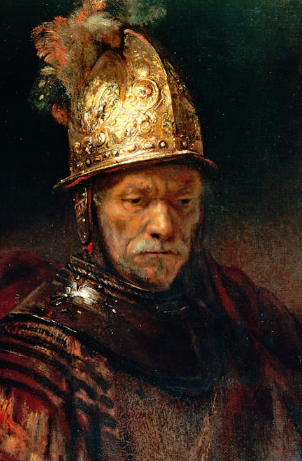
The Man With the Golden Helmet
(c. 1650-55), Rembrandt


Rembrandt (1606-69), famous for painting ~75 self-portraits in his lifetime, was born July 15th. In every museum I've visited, I've challenged myself to find at least one Rembrandt. My favorite is The Man With the Golden Helmet (1650). It has been attributed to Rembrandt, but may actually have been painted by a student of someone in his circle or artists. It has resided in Berlin's Kaiser Friedrich Museum, which we didn't get to visit during our Baltic cruise in June 2019.


Lady Caroline Howard (1778),
Reynolds


Sir Joshua Reynolds (1723-92), born July 16th, was Principal Painter in Ordinary to the King from 1767–1784. Thomas Gainsborough, painter of Blue Boy (1770), was his rival for the position, never attaining the prominent title. Thomas Lawrence, who painted Pinky (1794), did eventually receive the coveted title.


In Front of the Mirror (1889), Degas

Edgar Degas (1834-1917), born July 19th, remained a bachelor all his life. He presented himself as a loner and his demeanor drove people away, something he desired as an artist. He was known to be a misogynist and was also anti-Semitic. No wonder nobody wanted to marry him (or vice versa)!

Like Modigliani, Degas signed this painting at the top righthand corner. Unusual! Especially since Modigliani was born a Sephardic Jew!!


Nighthawks (1942), Hopper


Edward Hopper (1882-1967), born July 22, is most famous for his melancholy painting, Nighthawks, of a sad group of people hanging out in a diner, very late at night or perhaps in the wee hours of the morning.


Nude Descending a Staircase,
No. 2
(1912), Duchamp


Our last artist was born under the sign of Leo (the Lion). Leos are ambitious and creative. Marcel Duchamp (1887-1968), born July 28, is most famous for his Cubist painting of a Nude Descending a Staircase, No. 2. In the 1970s, my own brother was inspired to paint a futuristic version of the Frazier-Ali fight on a large canvas.

As I was researching and writing this post. I realized that most of my selections have either birds or hats in them. I guess this last painting doesn't fit the bill (Ha!)!

Thursday, November 24, 2022

Famous Artists & Paintings -- By Century

The Arnolfini Portrait (1434), van Eyck
15th Century

In this article, I'd like to review famous artists and their paintings, starting with the 15th century, highlighting my favorites. Earlier art primarily focused on religious subjects which, though ornately detailed, was pretty homogenous. Let's start with a work by Jan van Eyck, whose Arnolfini Portrait was included in my Avatars, Doppelgangers, and Lookalikes post. One of the most recognizable paintings of the 15th century, this double portrait also captures the couple's reflection in the convex mirror hung in the background. I saw it in person at the National Gallery of London in 2017. Van Eyck was considered an innovator, some saying that he created oil painting.


"Salvator Mundi" (1500), da Vinci


16th Century


At the beginning of the 16th century, Leonardo da Vinci painted this classic portrait that eventually sold for $450.3M. It was supposed to be on display at the Louvre Abu Dhabi in 2018, but it has yet to be seen in public. See my June 2020 post, entitled Encouraging Artistic Expression, for more details. His other more famous portrait, Mona Lisa, was painted during the same period. I saw her at the Louvre in Paris in 2011. His Madonna Litta was painted toward the end of the 15th century, residing at the Hermitage in St. Petersburg, Russia, where I visited in 2019.


The Hunters in the Snow (1565),
Pieter Bruegel the Elder


Later in the 16th century, Flemish painter Pieter Bruegel the Elder created The Hunters in the Snow. A large print of the landscape hung in my father's office at Price Waterhouse in NYC. It has always been one of my favorites! I love the cool teal color of the sky and frozen river. It's also a wonderful example of the use of perspective to create depth and the illusion of space.


The Saviour of the World
(1608-14), El Greco


17th Century


Moving to the early 17th century, we see El Greco's version of the Christ. The blessing gesture is similar to that of da Vinci's portrait, including the hand on the orb representing the world, although the color scheme is much more modern. I like the use of contrast, especially accentuating the face and the halo effect.


The Man in the Golden Helmet
(1650), Rembrandt


The mid-17th century paintings that I've chosen are three of my all-time favorite portraits. I do seem to gravitate towards portraits. Rembrandt is famous for having painted the most self-portraits though I love The Man in the Golden Helmet. It also inspired my work nickname 'Gelmet' which my co-workers gave me because of my gel hairdo. I often found people staring at the top of my head, much like how museum patrons might focus on the helmet in this painting.


Las Meninas (1656), Velázquez


There's something about this amazing family portrait by Diego Velázquez. To find out more, see my August 2020 post entitled Things That Go Together in Art – Subjects, Portraits, Landscapes/Seascapes, Still Lifes, and Couples. It does appear to have all the detail in the lower half of the painting, but it seems to work!


Girl with a Paearl Earring
(1665), Vermeer


This classic by Johannes Vermeer is known as the 'Mona Lisa of the North' probably because of her mysterious identity. Vermeer often employed blue and yellow in his detailed portraits, usually of women.


The Blue Boy (1770), Gainsborough

18th Century


Thomas Gainsborough and Sir Joshua Reynolds were rivals for the position of Painter to the King. On our trip to the UK in 2017, their paintings were curiously hanging side-by-side in one of the national galleries. Growing up in New Jersey, my next-door neighbor had a red sitting room where a copy of Gainsborough's Blue Boy was hung. One of the houses we rented in Port Townsend's Fort Warden had needlepoint versions of Blue Boy and Pinkie (by Thomas Lawrence) hanging side-by-side. The pair, often seen together, also appears in episodes of Leave it to Beaver just inside the Cleavers' front door entry.


The Age of Innocence (1788), Reynolds


I use portraits from Sir Joshua Reynolds and Gilbert Stuart when I do my wrapping paper self-portraits project with fifth graders. Included in one of the packets provided by Interurban Center for the Arts was his portrait of Lady Caroline (1778). The girl in this painting is unknown but is likely Reynolds' great niece.


Athenaeum Portrait
(1796), Stuart


It's unusual to find unfinished paintings on display in galleries and I've only ever seen one of them. I find it interesting that Gilbert Stuart intentionally kept one of his first portraits of George Washington unfinished to use as a model for later works. Martha Washington admired it, but Stuart refused her and painted another one instead.


Cenotaph to the Memory
of Sir Joshua Reynolds
(1833-6), Constable


19th Century


Another painting I saw at the National Gallery in London is John Constable's homage to Sir Joshua Reynolds. I enjoy seeing artwork in person, especially when it's something I've studied in school or researched for my blog or one of my classes. The stag is meant to represent the wild locale of the monument, which in actuality would have been smaller than a full-sized deer. It's up to the artist to create the focal point and provide it the proper emphasis.


Tiger in a Tropical Storm (1891), Rousseau


Here's another diamond in the rough from the National Gallery in London. It's a landscape by Henri Rousseau that could be perceived as a portrait of a tiger. Crouching tiger but no hidden dragon!


Les Oliviers (1889), Van Gogh
Of course, my all-time favorite artist has to be Vincent Van Gogh. It's difficult for me to choose a favorite. While doing research for this blog I continue to discover new (to me) Van Gogh paintings. For example, I saw this one at the Scottish National Gallery in Edinburgh. Like Van Gogh's Sunflowers, olive trees were another of his favorite subjects to paint.


I love the paintings of the French Impressionists, but there are too many for me to down select for this blog post. I also love the paintings of Henri Matisse and Marc Chagall. I highly recommend visiting their museums in Nice, France.

Capri Girl (1878), Sargent


Let's finish with the 19th century artists/paintings by including John Singer Sargent's portrait of Capri Girl. My daughter and I saw this work while briefly on exhibit at the Seattle Art Museum and we immediately fell in love with it. She appears to be leaning against the branch of a tree and gracefully becomes part of nature. Her bodice and hair blend into the dark background and her skirt disappears into the flowery field. She was a favorite subject of the artist.


Christina's World (1948), Andrew Wyeth
20th Century

My favorite artists of the 20th century are Salvador Dali, Pablo Picasso, Edward Hopper, Jacob Lawrence, Norman Rockwell, and Andrew Wyeth. Since we're primarily showcasing portraits here, and as a transition from Sargent's Capri Girl, I'm including Christina's World by Andrew Wyeth. His wife Betsy modeled for the painting inspired by the Olson (~30-yr-old) girl he saw crawling in the field.


President Obama (2018), Wiley


Kehinde Wiley is probably the best known African American portrait painter of the 21st century, although Simmie Knox was the first to paint the portrait of a President (Bill Clinton). I had the opportunity to see Wiley's paintings on exhibit at the Seattle Art Museum. I also got to see Jacob Lawrence's Migration Series, which was impressive but on a smaller scale than the large decorative works of Wiley. His intricate backgrounds are beautiful! While Lawrence used colorful shapes to build his symbolic compositions, Wiley used colorful patterns to surround and highlight his subjects.


So, who are your favorite artists? Your favorite painting? I find that I often choose to listen to the B-side of a record, straying from the more popular featured song. I also enjoy hearing the more obscure and less played selections (e.g., of Tom Petty songs) just as much as seeing newly discovered works by my favorite visual artists. As with music, you learn to love and appreciate many genres, though you will likely gravitate towards your favorites.