Showing posts with label Pissarro. Show all posts

Wednesday, June 28, 2023

Artists With July Birthdays

Still Life with Parrot and Fruit (1951), Kahlo


Many of my favorite visual artists were born in July. In fact, all of them have been featured in this blog. Most were born under the sign of Cancer (or the Crab). They are typically emotional, hypersensitive, competitive, and often isolated people. 

Frida Kahlo (1907-54), born  July 6th, is famous for her unusual and often creepy self-portraits. I much prefer her still life paintings. Do parrots like watermelon?


The Wolffish (2004), Jamie Wyeth


Jamie Wyeth (1946-), son of Andrew Wyeth and grandson of N.C. Wyeth, was also born on July 6th. I chose this painting of a fierce wolffish preying on seagulls because it's unusual. Wyeth crowded the birds on the left side of the painting perhaps to balance the dark fish emerging from the right. His sense of humor reminds me of his father's Roadkill painting of a dead squirrel on a road alongside of a plantation house.


The Bridal Pair with The Eiffel Tower
(1939), Marc Chagall


Marc Chagall (1887-1985), born July 7th, is famous for his very large Surrealistic paintings. We visited his museum in Nice, France in May of 2011. Weddings are a popular theme for Chagall's works. As well as oversized farm animals! His dreamlike paintings are more like collages.


Still Life with a Coffeepot (1900), Pissarro


French Neo-Impressionist, Camille Pissarro (1830-1903), born July 10th, is most famous for his pastoral landscapes and harbor scenes. I had to include this still life, which happens to have bird wallpaper. The copper coffeepot and green ceramic mug are the stars of this painting, while the china teacup, bowl, and lemon are secondary in his composition.


Soaring (c. 1950), Andrew Wyeth
I seem to be including birds in my selections, so here is a magnificent scene of ravens soaring high above a small white farmhouse below. Andrew Wyeth (1917-2009), born July 12th, and his son, Jamie used ravens as their subjects in several paintings. Andrew spent long hours, weeks, even months alone in a barn painting, and wouldn't show anyone his work until it was done.


Head of a Woman (1918),
Modigliani


Amedeo Modigliani (1884-1920), also born July 12th, painted portraits of women with elongated faces and necks. His subjects appear stretched in subtle 'S' shapes much like those of Marc Chagall.


James Abbott McNeill Whistler (1834-1903), also born July 12th, is most famous for his painting of his mother. His portraits, including his own self-portrait, have the subject facing in a left profile view. I feel like he was a one-hit wonder.

The Man With the Golden Helmet
(c. 1650-55), Rembrandt


Rembrandt (1606-69), famous for painting ~75 self-portraits in his lifetime, was born July 15th. In every museum I've visited, I've challenged myself to find at least one Rembrandt. My favorite is The Man With the Golden Helmet (1650). It has been attributed to Rembrandt, but may actually have been painted by a student of someone in his circle or artists. It has resided in Berlin's Kaiser Friedrich Museum, which we didn't get to visit during our Baltic cruise in June 2019.


Lady Caroline Howard (1778),
Reynolds


Sir Joshua Reynolds (1723-92), born July 16th, was Principal Painter in Ordinary to the King from 1767–1784. Thomas Gainsborough, painter of Blue Boy (1770), was his rival for the position, never attaining the prominent title. Thomas Lawrence, who painted Pinky (1794), did eventually receive the coveted title.


In Front of the Mirror (1889), Degas

Edgar Degas (1834-1917), born July 19th, remained a bachelor all his life. He presented himself as a loner and his demeanor drove people away, something he desired as an artist. He was known to be a misogynist and was also anti-Semitic. No wonder nobody wanted to marry him (or vice versa)!

Like Modigliani, Degas signed this painting at the top righthand corner. Unusual! Especially since Modigliani was born a Sephardic Jew!!


Nighthawks (1942), Hopper


Edward Hopper (1882-1967), born July 22, is most famous for his melancholy painting, Nighthawks, of a sad group of people hanging out in a diner, very late at night or perhaps in the wee hours of the morning.


Nude Descending a Staircase,
No. 2
(1912), Duchamp


Our last artist was born under the sign of Leo (the Lion). Leos are ambitious and creative. Marcel Duchamp (1887-1968), born July 28, is most famous for his Cubist painting of a Nude Descending a Staircase, No. 2. In the 1970s, my own brother was inspired to paint a futuristic version of the Frazier-Ali fight on a large canvas.

As I was researching and writing this post. I realized that most of my selections have either birds or hats in them. I guess this last painting doesn't fit the bill (Ha!)!

Sunday, April 30, 2023

My Favorite Landscapes with Trees

Landscape with Trees (1881), Van Gogh

Vincent Van Gogh is known for his post-Impressionist works that used bright, bold colors and emotionally expressive brushstrokes. Sometimes we stumble upon paintings that seem less characteristic of a very familiar artist. Here, in Landscape with Trees (1881), Van Gogh captures this autumn scene using a more monochromatic palette than usual. Such uncharacteristic Van Gogh paintings using charcoal and watercolor wash are from 1881-86 while he was in Holland.


Cypresses (1889), Van Gogh


Perhaps more popular are Van Gogh's paintings of cypress, olive, and almond trees. I love his Starry Night and Wheat Field series painted from 1889-90, showing compositions that included pairs of iconic cypress trees. I love the familiar swirling brushstrokes in Cypresses (1889). I featured one of his very last paintings, entitled (olive) Tree Roots (July 1890), in my April 2021 post Artists Who Died Young (like Van Gogh).


Almond Blossom (1890), Van Gogh


Van Gogh often took inspiration from other artists (e.g., Millet), copying their works and making them his own. He studied Japanese art and gifted his Almond Blossom to his brother Theo and sister-in-law Jo on the birth of their son, Vincent Willem. The early Spring flowers symbolized new life. His nephew founded the Van Gogh Museum (The Rijksmuseum) in Amsterdam in 1973, five years prior to his death.


Jean-François Millet's The Gleaners (1857) inspired my Layered Landscapes art project used to teach fifth graders about perspective. In it, students drew three trees ranging in size and emanating from three hills. We chose a color scheme of analogous colors using blended oil pastels.


Two Trees (1907-8), Picasso


Perhaps I could have shown my students Picasso's Two Trees as a way of encouraging their own abilities to draw trees. Though not one of my favorites, it depicts trees using watercolors and in Picasso's Cubist style.


Blue Poles (No. 11),
(1952), Pollock
Four Trees (1891), Monet
In 1891, Claude Monet painted a series of poplar trees. His Four Trees reminds me of Jackson Pollock's Blue Poles due to the repeated shapes resembling Monet's poplars.


Chestnut Trees at Louveciennes
(1870), Pissarro
Chestnut Trees at Louveciennes
(1872), Pissarro
Camille Pissarro painted apple, walnut, and chestnut trees in his impressionistic style. Which one do you like best? I think the one on the right may have inspired one of Dali's later surrealistic works.


Swans Reflecting Elephants (1937), Dali


When teaching about Surrealism and Salvador Dali, I use his Swans Reflecting Elephants (1937) as a warm up challenge for my fifth graders. Of course, I keep the title hidden. I wonder what kind of trees Dali was thinking about when he dreamt up this scene.


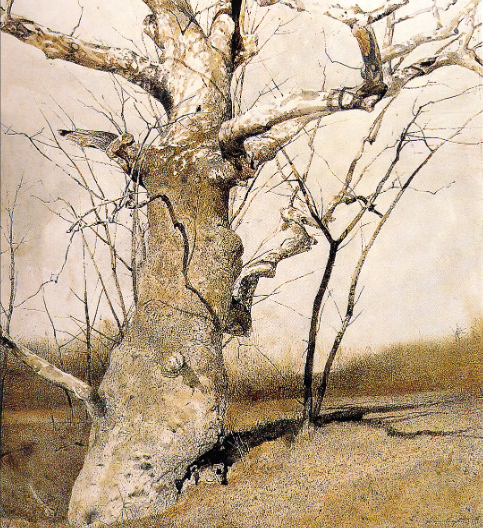
Sycamore (1982), Andrew Wyeth


This barren sycamore tree is recognizably the work of Andrew Wyeth. Wouldn't it be awesome to encounter such a magnificent and quirky tree on a walk through the Pennsylvania countryside of the Brandywine Battlefield?


Cairn in the Snow (1807), Friedrich


I also love 19th century German painter Caspar David Friedrich's (1774-1840) romantic landscape, Cairn in the Snow (1807). The subject is a pile of rocks (cairn) which is also known as a dolmen or a giant's grave (in the snow).


Capri Girl (1878), Sargent


My all-time favorite tree painting is by American portrait painter John Singer Sargent (1856-1925). It's a portrait of a favorite subject, Rosina Ferrara (a.k.a. Capri Girl), leaning on a birch tree. My daughter and I saw it on display at the Seattle Art Museum and couldn't stop looking at it. 

Thursday, December 8, 2022

Our National Gallery of Art in DC

Majorcan Fisherman (1908), Sargent

John Singer Sargent in Spain

Recently, my daughter attended a professional conference in Washington D.C. and took the opportunity to visit several museums. She shared her photos of famous works on exhibit at the National Gallery of Art. Curiously enough, there were two exhibits of one of our mutual favorite artists, John Singer Sargent, while on one of his seven trips to Spain (1879-1912) to study Velázquez. His painting of a Majorcan Fisherman is particularly captivating and unlike many of his other portraits, usually of women, and typically with a darker color palette. It reminds me of Renoir's Luncheon of the Boating Party (1888) with its canopy and view through to the water in the background. I love the shadows and the sharp contrast of the dominant orange tones with the striking blue of the water.


Newly Discovered Art & Artists

Blue Morning (1909), George Bellows
Another American artist, George Wesley Bellows (1882-1925), painted a similarly framed landscape looking out over water. He is famous for painting urban life in New York City. His Blue Morning scene is reminiscent of Edvard Munch's sad depictions of mine workers returning home in the snow. Here, the column, fence, and shadows frame a silhouetted portrait on a foggy morning. The 'blue' may represent either the color of the water or the sadness of the workers. This is the last of four paintings Bellows made from 1907-1909.


Street of Barns (1914), Feininger


German American painter, caricaturist, and comic strip artist, Lyonel Feininger grew up in New York City. He was a proponent of Expressionism, painting buildings, street scenes, and barns. His figures are elongated much like those painted by fellow German Expressionist, Ernst Ludwig Kirchner. At first blush, I thought this painting was one of the works by Cubist George Braque. I guess I need to practice guessing artists using Artle - the daily art exploration game created by the National Gallery of Art (it's free!).


Still Life (1918), Picasso
Peonies (1901), Picasso
Speaking of Cubists and other Expressionists, The National Gallery of Art was also showing several works by Pablo Picasso. Besides his recognizable Harlequin Musician and The Lovers, also on exhibit were Still Life and Peonies. I hadn't realized that Picasso painted these flowers. Normally, Manet and Monet are the artists whom I associate with them.


Impressionists

Children Playing on the Beach
(1884), Mary Cassatt


Many of the French Impressionists' works are also on display at the National Gallery of Art in Washington D.C. My daughter took photos of the works of Mary Cassatt, Édouard Manet, Henri Matisse, Claude Monet, Camille Pissarro, Georges Seurat, and Pierre Auguste Renoir. I love the innocence of Cassatt's Children Playing on the Beach (1884). Her portraits are some of my favorites -- they are timeless.


The Railway (1873), Manet


Édouard Manet preferred painting portraits, and I'd call him a French Realist. Here in The Railway we see a portrait of a mother and child waiting at the train station. I am distracted by the bars of the iron gate as well as the stitching in the mother's coat. Perhaps the daughter is dressed up to receive her father from the train. Did you notice the puppy cuddling in the woman's lap?


Still Life with Pineapple (1924), Matisse


Fauvist Henri Matisse is responsible for many colorful still lifes, and I especially like this one with a pineapple. We were lucky enough to visit his museum while in Nice, France in 2011. Like contemporary artist, Kehinde Wiley, Matisse backgrounds are always very interesting.


Woman with a Parasol - Madame
Monet and Her Son
(1875), Monet
The Artist's Garden at
Vétheuil
(1881), Monet


Like Manet, Claude Monet used members of his own family as his subjects. We also visited his garden at Giverny in 2011. Quite impressive!


Landscape, Ile-de-France (1873), Pissarro


My daughter knows how much I appreciate the works of Camille Pissarro, His works transcend all of the various Impressionist movements, although he is often referred to as a Neo-Impressionist. His version of Monet's haystacks is equally impressive.


Seurat Retrospective, Georges Seurat


The exhibition also featured a sort of retrospective wall showing the work of French Post-Impressionist and Pointillist, Georges Seurat. Of course, A Sunday Afternoon on the Island of La Grande Jatte (1884-86) is probably his best-known Pointillist works, made famous by the play starring Mandy Patinkin.


A Girl with a Watering Can (1876),
Pierre Auguste Renoir


It's always fun to find familiar artwork at the museum you're visiting. Here's probably the most famous Renoir, A Girl with a Watering Can (1876). I seem to focus on the girl's upper half with the red bow and the blue and white dress, but I never really noticed the watering can. And I consider myself very observant!


More 20th Century Artists

Ground Swell (1939), Edward Hopper
So, luckily my daughter took photos of four more of my favorites, who are more modern and contemporary than those of the French painters you usually spot at art museums. These artists are Edward Hopper, Wassily Kandinsky, Joan Miró, and Lee Krasner (wife of Jackson Pollock).

I love Hopper's clean and confident style. His paintings have no frills, little shading, and calming areas of color that capture a moment and illicit relaxation for the viewer. 


Head of a Catalan Peasant
(1934), Joan Miró
Improvisation 31 (Sea Battle)
(1913), Kandinsky

I love Abstract Expressionism and the playful compositions of Kandinsky and Miró. Whether I am teaching kids or seniors to make colorful Kandinsky concentric circles or cutting out shapes to make Miró balanced compositions, it is always fun to find new masterpieces to share with them as examples for our projects.


Cobalt Night (1962), Krasner

It's surprising how many of Jackson Pollock's work I've seen at various art museums. Like Kandinsky, his compositions are usually numbered and mention the dominant color used in the painting. While vacationing in Palm Springs, I saw the exhibit of the 12 Women of Abstract Expressionism, including some works by Lee Krasner.


I hope you enjoyed this post about some of the 'most important' works currently on display at the National Gallery of Art in D.C. While in St. Petersburg, Russia in June 2019, our tour guide only showed us the 'most important' artwork because of the vast number of pieces at the Hermitage Museum. While I certainly appreciate seeing those, I still enjoy stumbling upon those diamonds in the rough, lesser known or seldom seen works, and even those by artists I've only recently discovered. This is how we learn and grow in our ability to appreciate visual art! 

Monday, June 27, 2022

Artists' Beards, Mustaches, and Facial Hair

LAA Pitcher, Archie Bradley


I've been noticing the wild and often untamed facial hair of Major League Baseball of late while watching the Seattle Mariners on TV. Pitchers are known to 'paint' the corners of the strike zone. One of the more tamed beards belongs to Los Angeles Angels pitcher, Archie Bradley. It would fall into the category of a Garibaldi beard, after the famous Italian General Giuseppe Garibaldi.


LAA Outfielder, Brandon Marsh


LAA Outfielder, Brandon Marsh's is the polar opposite, including more of a Forest Gump look. 


Portrait of a Man in Red Chalk
(Early 1500s), da Vinci


It reminds me of portraits of old masters like Leonardo da Vinci and the statue of Michelangelo's Moses.


Impressionist, Camille Pissarro

M's Pitcher, Sergio Romo


Seattle Mariners pitcher, Sergio Romo's beard is also impressive, reminding me of Impressionists Camille Pissarro and Claude Monet, though opposite in color, like that of St. Nicholas. Romo's beard would be that of a Garibaldi style if it was less than 8 inches in length.


Autumn (1573), Arcimboldo


Artist, Giuseppe Arcimboldo's Autumn (1573) is a portrait of a man comprised of fruits and vegetables, including a beard made out of wheat.


Self-Portrait with Sunflower (~1633), Van Dyck

The van dyke style of beard popular in the 17th century was named after Flemish painter Anthony Van Dyck. Unlike the goatee, a van dyke is often pointed and also includes a mustache. You may remember the actor, Monte Woolley, from the 1942 movie The Man Who Came to Dinner co-starring Bette Davis. He also played an eccentric writer in The Bishop's Wife (1947) opposite David Niven and Cary Grant. Let's not forget General Armstrong Custer and KFC's iconic Colonel Sanders.


Dali Photographic Closeup


Often, it's the mustache that stands out most among the wearers of facial hair. One of the most iconic belongs to Spanish Surrealist Salvador Dali. I enjoy teaching about contrast and opposite colors to elementary school students using Dali's Persistence of Memory (1931). He was as eccentric as his unusual paintings, keeping an ocelot as a pet, and focusing on Sigmund Freud and his study of dreams. Perhaps he should have spent more time taming those bushy eyebrows!


Portrait of Joseph Roulin (1889), Van Gogh


Vincent Van Gogh and other artists painted portraits of men sporting muttonchops. This style of beard often leaves the chin area without hair and the mustache area also shaven. Hugh Jackman's X-Men character, Wolverine sports such a beard sans mustache. Such split beards are known as French forks.


Self Portrait Dedicated to
Dr. Eloesser 
(1940), Frida Kahlo


Another of my favorites is Mexican artist, Frida Kahlo, famous for her somewhat unique and iconic unibrow. Nowadays, even men will groom their eyebrows -- some may refer to them as 'metrosexuals'. Back in the day, when men let their beards grow wild, they also let their eyebrows and ear and nose hairs go untrimmed. In my opinion, if you're going to bother to precisely trim a mustache, goatee, or van dyke style beard, then you should also pay attention to those other wild areas. I'll forgive those who grow full beards as long as they occasionally trim them and always keep them void of food remnants!


Kenneth Branagh
David Suchet
Another mustache example is that of Agatha Christie's character, Hercule Poirot. I've been watching reruns of the 1989 TV series starring David Suchet as Poirot. His signature stache looks fake and almost plastic. The more recent Murder on the Orient Express (2017) and Death on the Nile (2022) films, starring Kenneth Branagh as the famous sleuth, created a much more believable, even spectacular, layered mustache, complete with soul patch.

(Apparently, Poirot's stache is meant to cover up scars from lacerations he suffered during a WWI explosion.)