Showing posts with label Dali. Show all posts

Sunday, January 11, 2026

Museums of Spain

Las Meninas (1656), Velázquez

I'm anxious to explore Madrid and Barcelona, Spain for the architecture, history, scenery, and of course the art museums. The Museo del Prado in Madrid would be the first place I'd like to visit. I am interested in the works of El Greco, Velázquez, and Goya, and as a bonus: Titian, Van Dyck and Rembrandt. It's always a welcomed surprise to find a Rembrandt! In 1656, as part of the royal court of King Philip IV in the Spanish Golden Age, Diego Velázquez painted his iconic Las Meninas. In the group portrait, images of the King and Queen are reflected in a mirror, while the Queen's attendant, José Nieto pulls back the curtain to let more light into the room through the doorway. Édouard Manet admired Velázquez as Painter of the Painters.


Assumption of the Virgin
(1515-18), Titian
Assumption of the Virgin
(1577-79), El Greco


Unfortunately, I missed the Prado exhibition that ended in June 2025 displaying El Greco's (Greek artist born Doménikos Theotokópoulos) Assumption of the Virgin. It resembles Titian's earlier Assumption of 1515-18.


Dogs on a Leash (1775), Goya
Another 'Assumption' painter is Francisco Goya, who, besides painting religious panels, also painted this portrait of two dogs on a leash. It's disturbing to see them chained together, as if being enslaved by the unseen hunter. The detail reminds me of the portraits of Sir Joshua Reynolds, famous for being the President and founding member of the British Royal Academy.


Modern and Contemporary Painters


The Elephants (1948), Dali

Other artists I would encounter are modern artists such as Dali, Picasso, and Miró. Salvador Dali has museums in Barcelona and Figueres (his hometown), Spain and St Petersburg, Florida. His works are also featured at the Prado in Madrid. When I teach art to elementary school students, I often use Dali's Swans Reflecting Elephants (1937) as an example of surrealism. Later, he conceived of this more futuristic version of gigantic elephants.


Robots of Star Wars


Makes you wonder if Steven Spielberg was a fan of Salvador Dali's dreamt up pachyderm-like figures.


Guernica (1937), Picasso

Pablo Picasso and Joan Miró works are also exhibited at the Prado. Picasso's Guernica was returned to the Museo Reina Sofía in Spain in 1981. It depicts the bombing of a town in the Basque country in Northern Spain in 1937 by Nazi Germany and Fascist Italy.


House with the Palm Tree (1918), Miró 


Born in Barcelona, Catalan Surrealist Joan Miró's paintings may be found in multiple Spanish museums and galleries. While The Farm (1921-22) may be seen in Washington D.C., you'll have to visit the Museo Reina Sofía to admire the earlier House with the Palm Tree (1918).


Harlequin with a Mirror
(1923), Picasso


While in Madrid, you may also want to explore the Thyssen-Bornemisza Museum. An exhibit of Warhol and Pollock artwork will be there until January 2026, with Picasso and Klee paintings through February 2026. I will surely miss those!  Harlequin with Mirror (1923) and Bullfight (1934) are apparently part of the museum's permanent collection, though the website says, 'not exhibited'. I guess you'll have to go there and see!


View onto a Square (1912), Klee
This rather primitive landscape by Swiss German artist Paul Klee is at Thyssen-Bornemisza Museum in Madrid. As you may have guessed it is chalk and crayon on paper and mounted on cardboard. He used gouache, an opaque, watercolor paint thickened with a glue-like substance. I can envision an art project for kindergarten thru 3rd grade students, using crayon or oil pastels to resist washes of watercolor paint, that would surely not intimidate the young artists.


After visiting France and Italy in 2011, the UK in 2017, and cruising the Baltics in 2019, I was able to check off several of the 14 must-see museums from my bucket list. The Prado is next! And, if I make it back to Florida, I will not miss the Dali Museum!!


Sunday, May 14, 2023

Mothers of Famous Artists -- A New Dedication

The Artist's Mother: Head and Bust,
Three-Quarters Right
(1628), Rembrandt


In May of 2021, I posted Mother's Day Dedication and Artist Inspirations. It included artists: Mary Cassatt, Vincent Van Gogh, and James Whistler. For 2023, let's explore several other famous artists who memorialized moms with portraits. Happy Mother's Day!
Rembrandt captured his mother, Neeltgen Willemsdochter van Zuytbrouck, in several early etchings and painted portraits, since he was unable to afford to pay models to sit for his paintings. The squiggly lines figure well in showing the woman's age softly and with a subtly pleasant expression.


Mother's Day Off (1916), Rockwell


James Abbott McNeill Whistler's portrait of his mother, Anna Whistler, is yet another Portrait of the Artist's Mother (1871) and is famously known simply as Whistler's Mother. Van Gogh's mother, Anna Carbentus van Gogh, and Norman Rockwell's mother, Anne Mary (Hill) Rockwell share similar first names. See the link above for the Van Gogh and Whistler portraits. Norman Rockwell's dedication to mothers appeared in one of his first publications of the Saturday Evening Post in 1916's Mother's Day Off.


Mrs. Robert S. Cassatt,
the Artist's Mother

(1889), Cassatt
Portrait of the Artist's Mother
(1889), Mary Cassatt
Henrietta Benson Homer, an artist in her own right, was mother to Winslow Homer. I included her work in my recent April Flowers in Art post. I've also featured the works of Mary Cassatt in my posts. Here are portraits of her mother, Mrs. Robertt S. Cassatt (nee Katherine Kelso Johnston). Perhaps the portrait on the left is the final version and much truer to her impressionist style. The one on the right must have been a study. The flowers seem to be floating about her head.


Mother and Child (1938), Picasso
Portrait of the Artist's Mother
(1896), Picasso
Pablo Picasso did this portrait of his mother, Maria Ruiz Picasso, and has represented motherhood in many of his works. The portrait on the left shows his ability to paint in a realistic style. He has captured the softness of his mother's blouse and the light caressing her face. Contrast it with his painting of lover, Marie-Thérèse Walter, and their child Maya, long after he became a Cubist painter.


The Dead Mother (1902),
Edvard Munch

Dead Mother (1889), Munch
Edvard Munch was only five years old when his mother, Laura Much, died of tuberculosis following the birth of his sister, Inger. Death was a common subject for Munch. The child's pose is reminiscent of that of The Scream.


Portrait of Artist's Mother (1902),
by Franz Marc


German Expressionist, Franz Marc, painted this portrait of his mother Sophie in 1902. Its muted colors and natural realism are unlike his later more colorful abstract paintings of animals. I wonder if the 'postage stamp' picture in the top right corner is meant to be Franz as a toddler. Without it, my eye may have focused on the book. Its subtle presence in the background suggests that the woman is a mother. Although Franz was married twice during his short life, he never gave his mother any grandchildren.


The Artist's Mother (1916), Hopper


Edward Hopper is most famous for his melancholy painting, Nighthawks, showing patrons hanging out in a diner late at night. He also painted this portrait of his mother, Elizabeth Griffiths Smith Hopper. You can see the resemblance between mother and son. The richness of her vibrant purple dress is complemented by details of her face and right hand and contrasted by the pastel yellows in the background.


Portrait of the Artist's Mother
(1918), Salvador Dali

Portrait of the Artist's Mother
(1920), Salvador Dali

Salvador Dali's portraits of his mother, Felipa Domenech Ferrés differ dramatically. His 1918 Portrait of the Artist's Mother is in a realistic style, while his later version more impressionistic. Later, in 1929, he made a surrealist version entitled, The Enigma Of Desire, My Mother, My Mother.


Woman with Plant (1929), Grant Wood

Hattie Weaver Wood (mother of Grant Wood) is represented in Woman with Plant (1929). In Wood's later more famous American Gothic (1930), he used likenesses of his sister, Nan Wood Graham, and their dentist Dr. Byron McKeeby. The clothing on the woman is very similar to that of the farmer's daughter. Wood put a lot of detail in the woman's face, while the rest of the subject and background are flatter, simpler and more cartoonish.

American folk artist, Grandma (Anna Mary Robinson) Moses, painted her simple landscapes beginning in 1938 at the age of 78. See Artists Born Under Virgo or Libra.


Maga's Daughter (1966), Andrew Wyeth


Betsy Wyeth, wife of painter Andrew Wyeth, had two sons, Nicholas and James (artist Jamie). She was the model for Wyeth's 1966 painting Maga's Daughter. She likened her role as director and Andrew's career as that of an actor. One might also consider her his agent, collaborator, and muse.


Camille Monet and a Child in the Artist’s Garden
in Argenteuil
(1875), Claude Monet

I am a sucker for the Impressionists. Claude Monet painted this beautiful scene of his wife, Camille and their daughter relaxing in their garden at Argenteuil, where he lived from 1871-1878. While visiting Paris in 2011, my family and I drove to see Monet's garden in Giverny, where Monet lived from 1883-1926. The focus seems to be on his wife and the vivid blue and white brushstrokes in her dress. The child leaves more of an impression. I like how Monet has framed his composition with the path in the foreground and the flowers fading into the background.

Tuesday, May 9, 2023

Reflections in Art

Landscapes


Reflections (1983), Bob Ross
I found this great article about Landscape Composition: 16 Reflections. Whether it is Sisley, Turner, or Monet painting the landscape, the result is always more pleasant and serene with the addition of a reflection in water to reveal atmospheric conditions. I particularly enjoyed watching Bob Ross' TV series The Joy of Painting, especially when he'd show us how to paint water and reflections. He pulled down color using a large dry brush, then lightly dragged his brush across to soften the reflections.


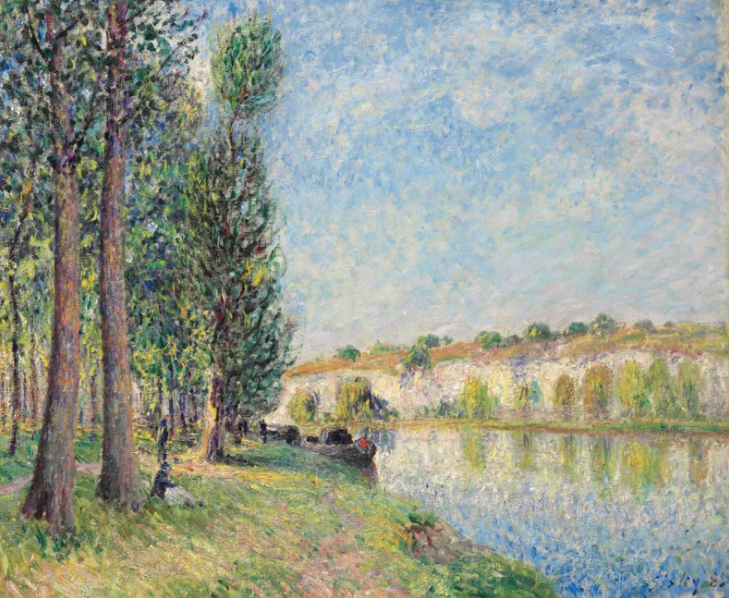
Le Loing à Moret (1885), Sisley


Impressionist painter, Alfred Sisley (1839-1899), was born to British parents in France, where he spent most of his life. His landscapes may have been inspired by the paintings of J. M. W. Turner and John Constable. I much prefer this softer work to some of his other more intricate landscapes.


Boats (1885), Sisley


While this landscape by Sisley may make a wonderful jigsaw puzzle, it makes for a very complex painting. His reflections seem to be concentrated toward the bottom, focusing on the subject boats. The clouds reflect in the water in the middle of the composition. The jetty seems to divide the painting in two.


The Studio Boat (1874), Monet

Some say that Sisley's career was overshadowed by that of Franch Impressionist Claude Monet. Monet's Studio Boat became the subject of four of his paintings. The reflections are well done. Monet has also balanced his composition by offsetting the dark boat hull with the large bank of brown autumn trees and highlighting the studio structure. Many of Monet's other works use dark purple in place of black.


The Grand Canal of Venice (1875), Manet


In Édouard Manet's Blue Venice or The Grand Canal of Venice (1875) the reflections are suggested using impressionistic brushstrokes. Like Monet's work above, Manet has atypically used black for his gondola. Everything else in the painting is bright and textured. 


Le Bateau (1953), Matisse


In 1961, Henri Matisse's Le Bateau ("The Boat") was hung upside-down at New York's Museum of Modern Art for 47 days until a patron pointed it out to a museum guard. In this simple papercut and gouache work, it was apparently difficult to distinguish between the sailboat and its reflection.


Starry Night Over the Rhône (1888), Van Gogh


Before Vincent Van Gogh painted his famous Starry Night with the swirling sky and cypress trees, he captured a moment of calm in Starry Night Over the Rhône (1888). I love the reflected lights of the city. The couple in the foreground seem to be standing in the water due to the repetition of the brushstrokes, colors, and subtle transition from water to shore.


Valley of the Yosemite (1864), Bierstadt

German-born American artist, Albert Bierstadt, painted this landscape of the Yosemite Valley in California along the Merced River in 1864. Everything about this masterpiece is amazing! I love the colors of the sky, the brightness of the sunlight reflecting off the mountains, the sliver of reflected trees in the water, and the silhouettes of the deer grazing in the foreground.


Portraits

Triple Self-Portrait
(1960), Rockwell


Some artists used mirrors in their portraits. One of the most recognizable is Norman Rockwell's self-portrait with him seated in front of a mirror and a large canvas capturing his own image three times. I enjoy seeing what he has pinned to his easel, including his own sketches on one side opposite self-portraits of fellow artists: Durer, Rembrandt, Picasso and Van Gogh. Possibly as a nod to Rembrandt, he has collected a golden helmet as a souvenir of a trip to Paris.


 'Self Portrait', from Behind Gala,
Reflected in Mirror
(1972), Dali
In 1972, Salvador Dali painted a double portrait of the artist and his muse (wife Gala). It reminds me of an interior, painted by Johannes Vermeer, with light streaming in from a window. It may also be a nod to Diego Velázquez's 1656 masterpiece of Las Meninas, where the King and Queen were subtly reflected in a mirror.

Here, we get to see both figures from the front reflected in a mirror and from the back seated. If only we could see what's on his easel! Notice how Gala's chair is downplayed in both color and value so as not to compete with the artist's chair and mirror frame.


A Bar at the Folies-Bergère (1882), Manet
Some say that the man in the upper right of the mirror is Édouard Manet himself in A Bar at the Folies-Bergère (1882). Artists often hide their self-portraits in their paintings. You don't see the back of the man at the bar because he is perhaps (Manet) the viewer of the bar scene. 

The horizontal blueish band may be the stage. The reflection of the bar itself runs behind the barmaid's hips and may be reflecting the two bottles from the lower left corner.


Girl at Mirror (1954), Norman Rockwell


Finally, here's another painting by Norman Rockwell celebrating the innocence of a young girl checking herself out in an attic mirror while reading a glamour magazine. The girl reminds me of actress Margaret O'Brien who starred opposite Judy Garland in the classic Meet Me in St. Louis ten years earlier.

Sunday, April 30, 2023

My Favorite Landscapes with Trees

Landscape with Trees (1881), Van Gogh

Vincent Van Gogh is known for his post-Impressionist works that used bright, bold colors and emotionally expressive brushstrokes. Sometimes we stumble upon paintings that seem less characteristic of a very familiar artist. Here, in Landscape with Trees (1881), Van Gogh captures this autumn scene using a more monochromatic palette than usual. Such uncharacteristic Van Gogh paintings using charcoal and watercolor wash are from 1881-86 while he was in Holland.


Cypresses (1889), Van Gogh


Perhaps more popular are Van Gogh's paintings of cypress, olive, and almond trees. I love his Starry Night and Wheat Field series painted from 1889-90, showing compositions that included pairs of iconic cypress trees. I love the familiar swirling brushstrokes in Cypresses (1889). I featured one of his very last paintings, entitled (olive) Tree Roots (July 1890), in my April 2021 post Artists Who Died Young (like Van Gogh).


Almond Blossom (1890), Van Gogh


Van Gogh often took inspiration from other artists (e.g., Millet), copying their works and making them his own. He studied Japanese art and gifted his Almond Blossom to his brother Theo and sister-in-law Jo on the birth of their son, Vincent Willem. The early Spring flowers symbolized new life. His nephew founded the Van Gogh Museum (The Rijksmuseum) in Amsterdam in 1973, five years prior to his death.


Jean-François Millet's The Gleaners (1857) inspired my Layered Landscapes art project used to teach fifth graders about perspective. In it, students drew three trees ranging in size and emanating from three hills. We chose a color scheme of analogous colors using blended oil pastels.


Two Trees (1907-8), Picasso


Perhaps I could have shown my students Picasso's Two Trees as a way of encouraging their own abilities to draw trees. Though not one of my favorites, it depicts trees using watercolors and in Picasso's Cubist style.


Blue Poles (No. 11),
(1952), Pollock
Four Trees (1891), Monet
In 1891, Claude Monet painted a series of poplar trees. His Four Trees reminds me of Jackson Pollock's Blue Poles due to the repeated shapes resembling Monet's poplars.


Chestnut Trees at Louveciennes
(1870), Pissarro
Chestnut Trees at Louveciennes
(1872), Pissarro
Camille Pissarro painted apple, walnut, and chestnut trees in his impressionistic style. Which one do you like best? I think the one on the right may have inspired one of Dali's later surrealistic works.


Swans Reflecting Elephants (1937), Dali


When teaching about Surrealism and Salvador Dali, I use his Swans Reflecting Elephants (1937) as a warm up challenge for my fifth graders. Of course, I keep the title hidden. I wonder what kind of trees Dali was thinking about when he dreamt up this scene.


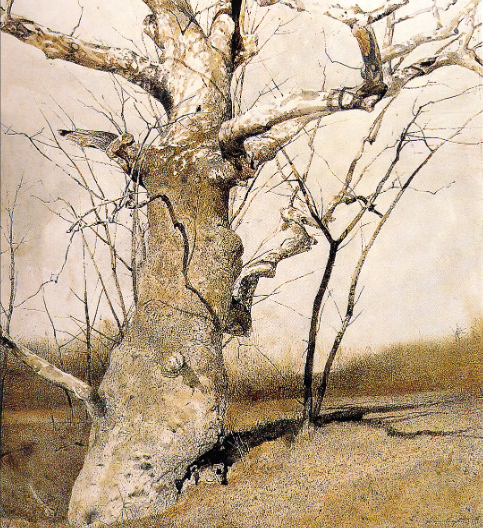
Sycamore (1982), Andrew Wyeth


This barren sycamore tree is recognizably the work of Andrew Wyeth. Wouldn't it be awesome to encounter such a magnificent and quirky tree on a walk through the Pennsylvania countryside of the Brandywine Battlefield?


Cairn in the Snow (1807), Friedrich


I also love 19th century German painter Caspar David Friedrich's (1774-1840) romantic landscape, Cairn in the Snow (1807). The subject is a pile of rocks (cairn) which is also known as a dolmen or a giant's grave (in the snow).


Capri Girl (1878), Sargent


My all-time favorite tree painting is by American portrait painter John Singer Sargent (1856-1925). It's a portrait of a favorite subject, Rosina Ferrara (a.k.a. Capri Girl), leaning on a birch tree. My daughter and I saw it on display at the Seattle Art Museum and couldn't stop looking at it.