Showing posts with label El Greco. Show all posts

Sunday, January 11, 2026

Museums of Spain

Las Meninas (1656), Velázquez

I'm anxious to explore Madrid and Barcelona, Spain for the architecture, history, scenery, and of course the art museums. The Museo del Prado in Madrid would be the first place I'd like to visit. I am interested in the works of El Greco, Velázquez, and Goya, and as a bonus: Titian, Van Dyck and Rembrandt. It's always a welcomed surprise to find a Rembrandt! In 1656, as part of the royal court of King Philip IV in the Spanish Golden Age, Diego Velázquez painted his iconic Las Meninas. In the group portrait, images of the King and Queen are reflected in a mirror, while the Queen's attendant, José Nieto pulls back the curtain to let more light into the room through the doorway. Édouard Manet admired Velázquez as Painter of the Painters.


Assumption of the Virgin
(1515-18), Titian
Assumption of the Virgin
(1577-79), El Greco


Unfortunately, I missed the Prado exhibition that ended in June 2025 displaying El Greco's (Greek artist born Doménikos Theotokópoulos) Assumption of the Virgin. It resembles Titian's earlier Assumption of 1515-18.


Dogs on a Leash (1775), Goya
Another 'Assumption' painter is Francisco Goya, who, besides painting religious panels, also painted this portrait of two dogs on a leash. It's disturbing to see them chained together, as if being enslaved by the unseen hunter. The detail reminds me of the portraits of Sir Joshua Reynolds, famous for being the President and founding member of the British Royal Academy.


Modern and Contemporary Painters


The Elephants (1948), Dali

Other artists I would encounter are modern artists such as Dali, Picasso, and Miró. Salvador Dali has museums in Barcelona and Figueres (his hometown), Spain and St Petersburg, Florida. His works are also featured at the Prado in Madrid. When I teach art to elementary school students, I often use Dali's Swans Reflecting Elephants (1937) as an example of surrealism. Later, he conceived of this more futuristic version of gigantic elephants.


Robots of Star Wars


Makes you wonder if Steven Spielberg was a fan of Salvador Dali's dreamt up pachyderm-like figures.


Guernica (1937), Picasso

Pablo Picasso and Joan Miró works are also exhibited at the Prado. Picasso's Guernica was returned to the Museo Reina Sofía in Spain in 1981. It depicts the bombing of a town in the Basque country in Northern Spain in 1937 by Nazi Germany and Fascist Italy.


House with the Palm Tree (1918), Miró 


Born in Barcelona, Catalan Surrealist Joan Miró's paintings may be found in multiple Spanish museums and galleries. While The Farm (1921-22) may be seen in Washington D.C., you'll have to visit the Museo Reina Sofía to admire the earlier House with the Palm Tree (1918).


Harlequin with a Mirror
(1923), Picasso


While in Madrid, you may also want to explore the Thyssen-Bornemisza Museum. An exhibit of Warhol and Pollock artwork will be there until January 2026, with Picasso and Klee paintings through February 2026. I will surely miss those!  Harlequin with Mirror (1923) and Bullfight (1934) are apparently part of the museum's permanent collection, though the website says, 'not exhibited'. I guess you'll have to go there and see!


View onto a Square (1912), Klee
This rather primitive landscape by Swiss German artist Paul Klee is at Thyssen-Bornemisza Museum in Madrid. As you may have guessed it is chalk and crayon on paper and mounted on cardboard. He used gouache, an opaque, watercolor paint thickened with a glue-like substance. I can envision an art project for kindergarten thru 3rd grade students, using crayon or oil pastels to resist washes of watercolor paint, that would surely not intimidate the young artists.


After visiting France and Italy in 2011, the UK in 2017, and cruising the Baltics in 2019, I was able to check off several of the 14 must-see museums from my bucket list. The Prado is next! And, if I make it back to Florida, I will not miss the Dali Museum!!


Thursday, November 24, 2022

Famous Artists & Paintings -- By Century

The Arnolfini Portrait (1434), van Eyck
15th Century

In this article, I'd like to review famous artists and their paintings, starting with the 15th century, highlighting my favorites. Earlier art primarily focused on religious subjects which, though ornately detailed, was pretty homogenous. Let's start with a work by Jan van Eyck, whose Arnolfini Portrait was included in my Avatars, Doppelgangers, and Lookalikes post. One of the most recognizable paintings of the 15th century, this double portrait also captures the couple's reflection in the convex mirror hung in the background. I saw it in person at the National Gallery of London in 2017. Van Eyck was considered an innovator, some saying that he created oil painting.


"Salvator Mundi" (1500), da Vinci


16th Century


At the beginning of the 16th century, Leonardo da Vinci painted this classic portrait that eventually sold for $450.3M. It was supposed to be on display at the Louvre Abu Dhabi in 2018, but it has yet to be seen in public. See my June 2020 post, entitled Encouraging Artistic Expression, for more details. His other more famous portrait, Mona Lisa, was painted during the same period. I saw her at the Louvre in Paris in 2011. His Madonna Litta was painted toward the end of the 15th century, residing at the Hermitage in St. Petersburg, Russia, where I visited in 2019.


The Hunters in the Snow (1565),
Pieter Bruegel the Elder


Later in the 16th century, Flemish painter Pieter Bruegel the Elder created The Hunters in the Snow. A large print of the landscape hung in my father's office at Price Waterhouse in NYC. It has always been one of my favorites! I love the cool teal color of the sky and frozen river. It's also a wonderful example of the use of perspective to create depth and the illusion of space.


The Saviour of the World
(1608-14), El Greco


17th Century


Moving to the early 17th century, we see El Greco's version of the Christ. The blessing gesture is similar to that of da Vinci's portrait, including the hand on the orb representing the world, although the color scheme is much more modern. I like the use of contrast, especially accentuating the face and the halo effect.


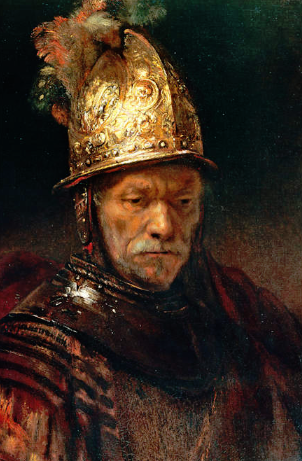
The Man in the Golden Helmet
(1650), Rembrandt


The mid-17th century paintings that I've chosen are three of my all-time favorite portraits. I do seem to gravitate towards portraits. Rembrandt is famous for having painted the most self-portraits though I love The Man in the Golden Helmet. It also inspired my work nickname 'Gelmet' which my co-workers gave me because of my gel hairdo. I often found people staring at the top of my head, much like how museum patrons might focus on the helmet in this painting.


Las Meninas (1656), Velázquez


There's something about this amazing family portrait by Diego Velázquez. To find out more, see my August 2020 post entitled Things That Go Together in Art – Subjects, Portraits, Landscapes/Seascapes, Still Lifes, and Couples. It does appear to have all the detail in the lower half of the painting, but it seems to work!


Girl with a Paearl Earring
(1665), Vermeer


This classic by Johannes Vermeer is known as the 'Mona Lisa of the North' probably because of her mysterious identity. Vermeer often employed blue and yellow in his detailed portraits, usually of women.


The Blue Boy (1770), Gainsborough

18th Century


Thomas Gainsborough and Sir Joshua Reynolds were rivals for the position of Painter to the King. On our trip to the UK in 2017, their paintings were curiously hanging side-by-side in one of the national galleries. Growing up in New Jersey, my next-door neighbor had a red sitting room where a copy of Gainsborough's Blue Boy was hung. One of the houses we rented in Port Townsend's Fort Warden had needlepoint versions of Blue Boy and Pinkie (by Thomas Lawrence) hanging side-by-side. The pair, often seen together, also appears in episodes of Leave it to Beaver just inside the Cleavers' front door entry.


The Age of Innocence (1788), Reynolds


I use portraits from Sir Joshua Reynolds and Gilbert Stuart when I do my wrapping paper self-portraits project with fifth graders. Included in one of the packets provided by Interurban Center for the Arts was his portrait of Lady Caroline (1778). The girl in this painting is unknown but is likely Reynolds' great niece.


Athenaeum Portrait
(1796), Stuart


It's unusual to find unfinished paintings on display in galleries and I've only ever seen one of them. I find it interesting that Gilbert Stuart intentionally kept one of his first portraits of George Washington unfinished to use as a model for later works. Martha Washington admired it, but Stuart refused her and painted another one instead.


Cenotaph to the Memory
of Sir Joshua Reynolds
(1833-6), Constable


19th Century


Another painting I saw at the National Gallery in London is John Constable's homage to Sir Joshua Reynolds. I enjoy seeing artwork in person, especially when it's something I've studied in school or researched for my blog or one of my classes. The stag is meant to represent the wild locale of the monument, which in actuality would have been smaller than a full-sized deer. It's up to the artist to create the focal point and provide it the proper emphasis.


Tiger in a Tropical Storm (1891), Rousseau


Here's another diamond in the rough from the National Gallery in London. It's a landscape by Henri Rousseau that could be perceived as a portrait of a tiger. Crouching tiger but no hidden dragon!


Les Oliviers (1889), Van Gogh
Of course, my all-time favorite artist has to be Vincent Van Gogh. It's difficult for me to choose a favorite. While doing research for this blog I continue to discover new (to me) Van Gogh paintings. For example, I saw this one at the Scottish National Gallery in Edinburgh. Like Van Gogh's Sunflowers, olive trees were another of his favorite subjects to paint.


I love the paintings of the French Impressionists, but there are too many for me to down select for this blog post. I also love the paintings of Henri Matisse and Marc Chagall. I highly recommend visiting their museums in Nice, France.

Capri Girl (1878), Sargent


Let's finish with the 19th century artists/paintings by including John Singer Sargent's portrait of Capri Girl. My daughter and I saw this work while briefly on exhibit at the Seattle Art Museum and we immediately fell in love with it. She appears to be leaning against the branch of a tree and gracefully becomes part of nature. Her bodice and hair blend into the dark background and her skirt disappears into the flowery field. She was a favorite subject of the artist.


Christina's World (1948), Andrew Wyeth
20th Century

My favorite artists of the 20th century are Salvador Dali, Pablo Picasso, Edward Hopper, Jacob Lawrence, Norman Rockwell, and Andrew Wyeth. Since we're primarily showcasing portraits here, and as a transition from Sargent's Capri Girl, I'm including Christina's World by Andrew Wyeth. His wife Betsy modeled for the painting inspired by the Olson (~30-yr-old) girl he saw crawling in the field.


President Obama (2018), Wiley


Kehinde Wiley is probably the best known African American portrait painter of the 21st century, although Simmie Knox was the first to paint the portrait of a President (Bill Clinton). I had the opportunity to see Wiley's paintings on exhibit at the Seattle Art Museum. I also got to see Jacob Lawrence's Migration Series, which was impressive but on a smaller scale than the large decorative works of Wiley. His intricate backgrounds are beautiful! While Lawrence used colorful shapes to build his symbolic compositions, Wiley used colorful patterns to surround and highlight his subjects.


So, who are your favorite artists? Your favorite painting? I find that I often choose to listen to the B-side of a record, straying from the more popular featured song. I also enjoy hearing the more obscure and less played selections (e.g., of Tom Petty songs) just as much as seeing newly discovered works by my favorite visual artists. As with music, you learn to love and appreciate many genres, though you will likely gravitate towards your favorites.

Sunday, April 4, 2021

Easter Eggs -- Symbols of the Resurrection in Pastel Colors

Easter Eggs

Persian Egg, Etsy


Easter is the time of year when Christians celebrate the resurrection of Jesus Christ. The Easter egg symbolizes the empty place from which Jesus emerged following his crucifixion and ultimate entombment. Other cultures have decorated eggs as a form of celebrating the Spring equinox, during which the Persian New Year (Nowruz) falls, for example. Themes of fertility, rebirth, and new life are also common in English, Germanic, and other European cultures.


Do you know why Easter eggs are traditionally dyed in pastel colors? Pale yellow symbolizes the resurrection, pink for the blood of Christ, lavender for the joy that Mary Magdalene and the other women felt when they saw the tomb was empty, and sky blue is a reminder of Christ's love.


Roger Moore,
Octopussy's Bond

So, how is this relative to art? Decorating eggs can be a fun art activity for young and old. Let's not forget the sought-after bejeweled Fabergé egg that belonged to the imperial family of Russia and was auctioned off in Ian Fleming's Bond classic, Octopussy. And by definition, the period of history (14th thru 16th centuries) known as the Renaissance was entirely dedicated to rebirth. One of the most famous artists and the architect of the Spanish Renaissance was Greek painter and sculptor, El Greco.


European Religious Art

Christ Blessing
('The Saviour of the World')

(ca. 1600), El Greco

British Sister Wendy (Beckett), one of the foremost art historians of the 20th Century, was particularly enamored by the art of Diego Velazquez, Francisco Goya, and El Greco. I used to watch her somewhat quirky TV special presentations and happily own one of her books, Sister Wendy's Grand Tour, Discovering Europe's Great Art. which includes highlights of her privileged trip to the Prado Museum in Madrid, Spain. Someday, I would love to visit.

And Jesus was the subject of over a dozen religious works by El Greco. I don't recall seeing this particular painting while in Edinburgh, though it is apparently on display at the Scottish National Gallery. Christ is a common subject in many paintings, including those of Raphael, Bellini, and of course Leonardo da Vinci.


Salvator Mundi (ca. 1500), da Vinci


The famous Salvator Mundi painting of Jesus, often attributed to da Vinci, fetched a whopping $450 Million in 2017. It is one of a few surviving works from a private collection. I show it here because both artists depicted Christ in a similar pose with his left hand on a sphere (not an egg!). Personally, I prefer El Greco's!!


Pieta (1576), Titian


Probably the most recognizable image of the dead Christ is Michelangelo's marble statue of the Pieta, created in 1498-99 and residing in St. Peter's Basilica, Vatican City. While in Rome in May 2011 the lines were too long to visit St. Peter's. Both Michelangelo and Titian influenced El Greco, and all three created such portraits of Mother Mary and Jesus. Titian's Pieta was his final painting and includes his self-portrait as the old man in red holding the hand of the dead Christ.


Pastels -- The Renaissance & Beyond

It turns out that pastels as an art medium originated during the late Renaissance. Artists like Michelangelo and da Vinci used chalk mainly for sketching and they were initially only available in black, white, and red.

It wasn't until the mid-18th century that pastels were taken seriously by professional painters. Now, let's explore the works of three of the most famous artists who used pastels.


Mary Cassatt

Mother and Child (1914), Mary Cassatt


Continuing with the mother and child theme, here is a beautiful pastel painting by American portrait and figure artist Mary Cassatt (1844–1926). I love the color scheme and the fine blue strokes that subtly add shading to her figures. I'd love to see this one in person. Even the background is interesting and appears to marry together many of the colors, and contrasts nicely with the warm tones used on her subjects.


Edgar Degas

Four Ballerinas on the Stage (1885-90), Degas

French artist Edgar Degas is most famous for painting ballet dancers and occasionally portraits of friends and jockeys and their horses. He often used black outlines on his figures and was less concerned with facial details, leaving his impressions largely to the posing and positioning of his dancers. The contrasting orange tutu and the lines created by the dancers' arms keep our eyes focused on the three dancers in the middle, even though the blue figure is truncated. The patch of blue in the scenery serves to balance out her blue skirt, creating more diagonal movement.


Jean-François Millet

Shepherdess and Her Flock
(1864-65), Millet

When teaching elementary school-age children about French realist Jean-François Millet, I usually show The Gleaners (1857), one of his most famous works depicting peasant life. This pastel work, though less colorful, has a softness and peacefulness about it that I appreciate. Its atmospheric effect makes it hard to tell the time of day. Let's assume that the woman has led her sheep to pasture for an early morning breakfast.


Man with a Hoe (1860-62),
Jean-François Millet


In my pastels class taught to adults at Franke Tobey Jones' Senior University, we did pastel landscapes the first day, then switched to trying a more limited palette on the second day. I wish I had used these two pastel paintings by Millet as examples for my classes.


Untitled


One of my adult students completed this drawing of a reclining kitten. Her adaptation is reminiscent of the Millet (above) with its use of white pastel as an accent. Note how both artists made use of paper that was already a color (not white) and allows the background to peek through the black/brown and white pastel strokes. Very impressionistic kitty!


My Degas Recreation


As a demo for my pastels class, I did a copy of Degas' Ballerina and Lady With a Fan (1885) to show many of the various strokes one can use. The purple paper provided the perfect underpainting and my smudges served as shadows under the dancers' white legs. Don't forget that many artists, including Van Gogh, liked to copy the works of artists who preceded them, for example, artists such as Millet and various Japanese artists.


Bryce and Friends (2021), Ken Patterson

I really enjoyed painting my dog, Bryce, and his friends playing at a California dog park. It challenged me to use small strokes of light blue, browns and grays to emulate the rocks, including the shadows created by the trees. It reminds me of Georges Seurat, the famous French Post- or Neo-Impressionist who used Pointillism (a.k.a. Divionism or Chromoluminarism) to create light effects in his paintings. Seurat and Signac pioneered their technique in Paris in the mid-1880s. Seurat died at the young age of 31 of unknown causes in 1891, leaving his painting, The Circus, unfinished.