Showing posts with label Klimt. Show all posts

Thursday, April 9, 2026

Artworks With Green


The Park (1910), Klimt


My first pic is a good transition from my last 'interview' post about the style of Robert Milaschewski, though meant to be posted for St. Patrick's Day. Here we see what could be described as a landscape, although dominated by tree crowns, with only a hint of tree trunks at the bottom. Instead, Gustav Klimt has used primarily a mosaic of green dots forming an abstract composition. It comes on the heels of the late nineteenth century movement, called Pointillism, which was developed by French artists, Georges Seurat and Paul Signac.


Green Wheat Fields, Auvers (1890),
Van Gogh


Here is a closeup taken from (the lower left corner of) Van Gogh's Green Wheat Fields, Auvers (1890), which was painted during the last months of the artist's life. When viewed without the upper half containing the sky and clouds, his green and white brushstrokes become abstracted, much like the dots in Klimt's leaves.


The Green Wave (1866-67), Monet


Unlike other happier Impressionist paintings (from his gardens), Monet's The Green Wave (1866-67) is painted in monochromatic teal green and black. Boats and the seaside were common themes for Monet, though usually calmer depictions of couples enjoying a leisurely outing. I would not have guessed this was his work!


Green Still Life (1914), Picasso


Although the green in Picasso's Green Still Life (1914) encompasses the entire background, it fits the theme of my post. I enjoy the patterned shapes on the wall and tabletop, giving life to the flat green shapes above which the objects would be floating without the black lines and suggested picture frame.


The Allure (1939), O'Keeffe


I was intending to show Georgia O'Keefe's Green Tree (1953), but it was almost too light for this category of green artwork. Then I found The Allure (1939), which is also known as Waterfall, No. I, Iao Valley, Maui. Her paintings of the Hawaiian landscape are reminiscent of her closeup paintings of flowers. The layers of the lush green mountains seem to be opening up to reveal the thin waterfall, as though it's the stamen of a flower.


The Green Dancer (1879),
Degas


Degas' The Green Dancer (1879) is complemented by the bright-orange clad dancers in the background. This isn't quite the green I was looking to highlight, though there's enough of the hue to warrant both the title of the painting and my subject. Degas does like to use diagonal lines in his composition and arrangement of the dancers' limbs. He has intentionally left the floor unadorned and in shadow.


The Green Christ (1889), Gauguin
The last painting, The Green Christ (1889), is by Paul Gauguin. It depicts a Brenton woman seated beneath a green-tinted statue of Christ's crucifixion. It represents a combination of several different 'calvaires' from various locations. Gauguin lived for a time in Brittany, a peninsula of northwestern France.

Like many of Gaugin's works, the subject stands out from the backgrounds, which he decorates with more lively colors. Green is sprinkled throughout. Even the other figures are green, and the woman's face has a green tint as if she is an ogress (from the movie Shrek!).

The black lamb she's holding in the bottom right corner is balanced by the dark water in the distance.

Friday, February 10, 2023

ART - Controversial and Misunderstood

Point of Origin (1978), John Mason 
For this my 150th post, I want to take a more critical look at what we consider to be ART and why we create it. In my travels I've seen lots of 'art', whether it be famously hung in a museum or spraypainted on city walls. My July 2020 Art of the Pacific Northwest series explored the art of six NW cities, including commissioned works such as sculptures and murals as well as some museum pieces. This geometric steel sculpture currently stands on the lawn outside the Boise (Idaho) Art Museum. Though simple and repetitive, the shapes allow us to frame the surrounding scenery and the metal captures reflected light and shadows.

White Paintings (1951), Rauschenberg
Sometimes 'simple' makes sense but often the observer is left wondering why it is considered 'art'. Though I can understand and appreciate the collages of Robert Rauschenberg, I've never grasped the significance of his multi-paneled White Paintings of the 1950s. I get that it's challenging to paint a consistently unified color field absent of visible brushstrokes, but to repeat it multiple times doesn't seem interesting. And when they're displayed on white walls...nothing's there to see.


Fountain (1917), Duchamp
Just as confusing is Marcel Duchamp's Fountain (1917). He simply flipped a 'readymade' urinal onto its back and wrote a strange nom-de-plume on the side. Apparently, his use of an everyday object later inspired the Pop and Op Art movements. I think it was in Copenhagen at a brewery where I saw urinals made out of beer kegs. Apparently, functional objects are not considered objects d'art.

You may recall Campbell's Soup Cans (1962) by Andy Warhol. When I was a child, my dad took his 3 boys to Bermuda and my mom made us wear shorts with the soup can pattern. Wearable art?!


On our 2017 trip to Palm Springs, the local art museum had a sculpture of a composition of trash bags. I guess you can make art out of anything, though I'm not sure this was recycling. The arranged 'trash bags' were almost cubical and covered in a shiny, wrinkled dark brown medium. Though surprising, it left me wondering how the sculpture was made and trying to find beauty in what my eyes saw as a pile of trash or glistening poop. Maybe it's a box of chocolates!


Roadkill, Andrew Wyeth

When we see a sunset or a mountain landscape, we call it beauty, but when we paint (or photograph) it to share with others it becomes art. Animals also use beauty to get a reaction (from potential mates) much like artists from their observers. Andrew Wyeth used actual blood in a study of a dead squirrel for his painting Roadkill. You wouldn't know that unless you read his autobiography. The strong diagonal line seems to divide the painting in two.


Triptych Bleu I, II, III (1961), Miró
We create art to capture beauty or historical events for communication, memory recall and visualization, leading to education and understanding. Artists do it to make a statement, translate an emotion, or start a movement such as Surrealism or Abstract Expressionism. While I am personally a fan of Joan Miró, his blue works are only slightly more impressive than the Rauschenberg works in white. They become art solely because the artists intended them to be art.

Often artwork is judged or rejected and may be interpreted as controversial. Differences of opinion are expected when viewing works of art. Understanding why you like art or don't is part of the experience. Sometimes seeing it in person makes you appreciate it more, especially when exhibited as the artist intended.


An Allegory of Virtue
(mid-1520s), attributed to
Antonia Allegri


I am also puzzled by art curators who exhibit unfinished paintings, such as The Athenaeum Portrait of George Washington by Gilbert Stuart. I suppose that it preserves the historical portrait as Gilbert's model for the rest of the images of our first President and the likeness of him on the dollar bill. There are many unfinished artworks out there, although I've only seen one of them in person at the Scottish National Gallery. This shows us how some artists work on sections of a painting at a time. I understand if the subject or artist dies before completing a painting, like Gustav Klimt, who left several unfinished works upon his death in 1918 from pneumonia (due to the Spanish flu). 

Check out the Met's article, Unfinished: Thoughts Left Visible, for examples of incomplete works intentionally or unintentionally left unfinished.


Le Bateau (1953),
Henri Matisse


It's particularly telling when museum personnel are unable to determine which end is up, as with Henri Matisse's Le Bateau (1953) which hung for 47 days at the Museum of Modern Art in 1961. It took a museum patron to pose the question as to whether it was upside down. Imagine how many people viewing a work of art would agree that it's actually 'art' and further that it's 'good'.


Fat Car (2001), Erwin Wurm, PSAM
When an artist or artisan produces something 3-D like a car, (to me) it isn't as impressive as sculpting a figure. It's like when the motion picture academy nominates an ailing old musician for playing one. Where's the challenge? Some art installations are meant to impress us by virtue of their size or shock value, but you wouldn't display them in your home. It's fun to visit an art gallery and see the variety of art exhibited there.

Tuesday, March 8, 2022

Celebrities Who Dabble in the Visual Arts

Taken from gardenandgun.com

Continuing with the theme of celebrity art, I thought it would be fun to showcase art created by celebrities. This post is inspired by my wife's suggestion as well as People Magazine's 21 Celebrities Who Are Also Artists. In 2020, I posted Presidential Portraits, highlighting the portraits of George W. Bush. He has painted the portraits of over 66 American military veterans. They are collected in his book, Portraits of Courage: A Commander in Chief's Tribute to America's Warriors. You may also enjoy Out of Many, One: Portraits of America's Immigrants. You may be surprised to know how many U.S. Presidents spent their free time painting. Three other presidents -- Ulysses Grant, Dwight Eisenhower, and Jimmy Carter --  fancied themselves as painters. Even Prince Charles of the UK has painted watercolor landscapes and sold them to benefit his charitable foundation.


Cancer (1989), Pierce Brosnan
Two years ago I posted Movie Art Cameos, including René Magritte's "The Son of Man". It was spoofed in the 1999 version of the movie The Thomas Crown Affair starring Rene Russo and Pierce Brosnan. Apparently, Mr. Brosnan started out as a graphic artist prior to being bitten by the acting bug. He paints while on vacation, a tradition I have started myself during Palm Springs visits.


JM (1979), John Mellencamp
Another celebrity who started out as a student of the visual arts is singer songwriter John Mellencamp. I like that he is mainly a portrait artist and that he was influenced by German Expressionist Max Beckmann (one of my favorites). This one is an early self-portrait. Other musicians who paint include Bob Dylan, Tony Bennett, and the late David Bowie. Joni Mitchell dropped out of art school at the age of 19 to pursue a career in music. Her art can be seen on her album covers.


Endless Highway (2017), Bob Dylan
Singer songwriter Bob Dylan began painting in the 1960s, then studied art in 1974 at the Ashcan School, a movement in the Modernist style of early twentieth century America, and learned 
to paint what he saw rather than what he imagined. Dylan's urban landscapes are particularly compelling and have been exhibited all over the world.

The above landscape reminds me of Edvard Munch's The Scream, mainly for the color scheme and the mood it projects.

Night Time in St. Louis (2020), Bob Dylan
I also enjoy his Night Time in St. Louis, which reminds me of Edward Hopper's Nighthawks. Dylan is a true multi-media artist, who has drawn, painted, and sculpted a huge body of impressive work spanning six decades. His urban subject matter includes his German and Asian Series, but always with an American flair.


Kickin' Up Dirt 1 & 2 (2001), Benedetto

Tony Bennett (born Anthony Dominick Benedetto in 1926) is best known as a singer although as a child he wanted to be a painter. In 2001, he was commissioned as the official artist of the Kentucky Derby, producing the watercolors seen here.


Berlin Landscape with JO (1978),
Portrait of Iggy Pop (James Osterberg),
by David Bowie

Few people knew about the paintings of David Bowie (1947-2016) until his DHead portraits of family and friends were made public in 1994. In 1974, he and his friend, Iggy Pop, traveled to Berlin, Germany where he painted in a style similar to German and Neo-Expressionists. You can see the influence of artists such as Francis Bacon, Ernst Ludwig Kirchner, and even Max Beckmann in his paintings.


Hercules O'Clock, Sylvester Stallone

Most impressive are the works of action film star Sylvester Stallone. Having painted over several decades (like Bob Dylan), the artist turned to writing and acting after his early paintings, inspired by the art of Willem de Kooning and Jackson Pollock, didn't sell. In 2015, Stallone exhibited a retrospective at Galerie Contemporaine du Musee de Nice, France. Recently, in late 2021, Sylvester Stallone: The Magic of Being, an exhibit of 50 of his paintings, opened at the Osthaus Museum in Hagen, West Germany.


Murphy Brown's Candice Bergen (now 75) paints portraits of animals on one-of-a-kind handbags and totes and sells them for $1,000 each. Apparently, she has been doing such customized paintings for years. Who knew?!


Aloha Nui Loa (2009), Hopkins


Even actor/comedian Jim Carrey paints. Much of his artwork is politically motivated, so I won't display it on my blog. I do find it curious that actor Anthony Hopkins paints, since he portrayed Pablo Picasso in the 1996 film biopic, Surviving Picasso. I'd call his art 'primitive' because his faces look somewhat generic. Some even look like self-portraits. In this painting, he seems to be channeling Gustav Klimt.


Forever Goodbye (2010), Lucy Liu


Actresses, Michelle Pfeiffer and Charlie's Angels' Lucy Liu also paint. Liu is an all around artist who creates paintings, ink drawings, collages, silkscreens, and sculpture from recycled everyday objects in her New York studio. She has created this erotic lesbian embrace even more reminiscent of The Kiss by Gustav Klimt.


While I am surprised to find so many celebrities who could have second careers in the art of painting, I am even more amazed at how long some of them have been at it. I appreciate how some of these artists use ordinary house paint and large 6-inch wide brushes in their large-scale artwork.

Sunday, February 27, 2022

Palm Springs Art -- Marilyn Monroe & Museum Exhibitions

Forever Marilyn (2011),
John Seward Johnson II


The controversial Forever Marilyn statue returned to Palm Springs, CA in June of 2021 and is expected to stay there for 3 years. Created by artist, Seward Johnson in 2011, the city rented the 26-ft. tall statue of Monroe for 26 months before moving her to Hamilton, New Jersey for the Seward Johnson Retrospective. While she now faces Palm Canyon Drive, her backside is what you see when leaving the art museum. I don't remember seeing that angle in 1955's Billie Wilder film The Seven Year Itch. At first blush, the size of the statue reminded me of Daryl Hannah's character from the 1993 remake of the 1958 horror film, Attack of the 50-ft. Woman.


In the house where we are staying there's a movie poster from another Wilder/Monroe film, 1959's Some Like it Hot. Palm Springs seems to be enamored with Marilyn Monroe.


Love & Peace (2019), Curry Mendes

This year, when I arrived at the Palm Springs Art Museum (PSAM), I expected to see Marilyn out front. Instead, I looked out the museum window down the sidewalk toward Palm Canyon Drive to see her white panties under the spotlights. In a prior visit to the museum in 2018, Marilyn was featured in the Andy Warhol exhibition. She also adorns the wall of Lulu California Bistro on a floral-haired 15'X15' mural.


The second reason I wanted to visit PSAM again was to see the exhibit of American abstract expressionist Helen Frankenthaler (1928-2011). Previously, I saw the 12 Women of Abstract Expressionism exhibit which featured her early works along with those of Elaine de Kooning and Lee Krasner (among others). PSAM also once held another of Frankenthaler's works that was mostly in the color red. Unfortunately, I have to say that I much prefer her earlier works to those painted in her final years.


Mountains and Sea (1952), Frankenthaler


I love her softer early work in which she introduced her soak-stain technique, as displayed in her 1952 painting, Mountains and Sea.


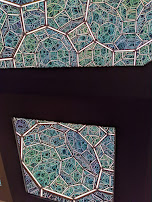
80" Great Rhombicosidodecahedron
(2020), Anthony James


I always look forward to seeing what artwork is featured in the lobby of PSAM. This year visitors are drawn to a fantastic dodecahedron made of stainless steel, mirrors, and LEDs. It's like something out of the TV series, The Twilight Zone or the original Start Trek. I'd bet that all could be explained by Mr. Spock! It's like a hall of mirrors filled with geometric shapes that appear to deepen into what I can only describe as wormholes.


What I especially enjoy about this work is that each window enables patrons of different heights to peer into the fascinating work and witness their own personal kaleidoscopic view. So amazing!


Le Même Si (1959), Roberto Matta


The final two pieces are by Chilean Modernist painter Roberto Matta (1911-2002). He was part of the Surrealism movement in Paris and influenced the beginning of Abstract Impressionism, along with his contemporary Jackson Pollock (married to Lee Krasner).


Monday, February 14, 2022

10 Famous Artists with Aquarius/Pisces Birthdays

Balloon Dog (Red)
(1994-2000), Koons
This post is inspired by the astrological signs of Aquarius (January 20 - February 18) and Pisces (February 18 - March 20). I decided to write about famous artists born under these signs, starting with American Pop Artist, Jeff Koons, who was born January 21, 1955. The Aquarian is famous for his pop culture sculptures of everyday objects. His balloon animals (e.g. dogs) are especially iconic. I stumbled upon his red dog while browsing for clipart to use for a Valentine I was making. I've always been fascinated by such imaginative creations made from those hard-to-inflate long, slender balloons that look like they are about to pop. Koons' (red, blue, yellow, orange, or magenta) dogs are made from stainless steel that has been covered by transparent varnish.


Blown Away Balloon Dog
(2020), Josh Mayhem


My daughter and I have watched the Netflix TV series, Blown Away, where contestants compete to make objects out of glass. Given the scale of such a sculpture, it probably wouldn't have worked in glass. Although I haven't seen anyone create balloon animals out of glass, I did locate some online that were made of acrylic resin on resin. Personally, I prefer the stainless Koons' steel version as opposed to Mayhem's mass-produced acrylic objects.


The Kiss (1907-08), Gustav Klimt

Originally, I was looking for artwork relating to Valentine's Day or the topic of Love. I had previously posted my Top 15 Paintings that Use Primary Colors -- Red, Yellow, and Blue, including Gustav Klimt's (born under CancerThe Kiss (Lovers). I received a jigsaw puzzle of it this year for my Capricorn birthday. I've also posted about Famous Capricorns Throughout History and 10 Artists with April Birthdays. Another one of my favorite posts is Things That Go Together in Art – Subjects, Portraits, Landscapes/Seascapes, Still Lifes, and Couples.


AQUARIAN Artists


I've already covered examples of Art of the Zodiac & Artists' Astrological Signs. Let's take a deeper look at the work of other famous Aquarian artists -- Édouard Manet, Jackson Pollock, Norman Rockwell, Max Beckmann, and Joan Mitchell.

Bouquet of Flowers
(1882), Manet


Édouard Manet (born January 23, 1832) is famous for his paintings of peonies. I often use Manet's peonies when I teach about the concept of positive and negative space. 


Convergence (1952), Pollock

Blue Poles (Number 11)
(1952), Pollock
Jackson Pollock (born January 28, 1912) is most famous for his Abstract Expressionist drip paintings. These are two of my favorites.


Triple Self-Portrait (1960),
Norman Rockwell


My favorite Norman Rockwell (born February 3, 1894) painting has to be his 1960 Triple Self-Portrait which I blogged about in August of 2020. He also famously put his own head in the peanut gallery of his baseball painting, The Dugout.


Self-Portrait with Green Scarf
(1917), Max Beckmann


Aquarian German Expressionist Max Beckmann (born February 12, 1884) painted this and several other self-portraits. I love his bold style with its use of black outlines!


No Birds (1987-88), Joan Mitchell

In 2017, I visited the Palm Springs Art Museum where they were exhibiting the Women of Abstract Expressionism, which included the works of 12 groundbreaking female expressionists. Here is one of the works of Aquarian Expressionist Joan Mitchell (born February 12, 1925). It is an homage to Vincent Van Gogh's Wheatfield with Crows (1890). This year, the work of her contemporary, Helen Frankenthaler, will be on display at PSAM.


PISCES Artists


Luncheon of the Boating Party (1880-81), Renoir

Now let's highlight the works of famous Pisces artists -- Pierre-Auguste Renoir (February 25, 1841), Michelangelo, Piet Mondrian, and Kehinde Wiley. Renoir's most famous painting has to be Luncheon of the Boating Party. It's a wonderful composition with the yellow hats, white fabric and offsetting striped awning to frame the group portrait.


David (1504), Michelangelo


Italian sculptor Michelangelo (born March 6, 1475) needs no introduction. On our trip to France and Italy in 2011, I saw his statue of David at the Accademia Gallery in Florence, Italy. If I had a bucket list, visiting Florence would definitely be on it.


Composition with Large Red Plane,
Yellow, Black, Grey and Blue

(1921), Piet Mondrian


I did an art lesson with kindergartners about LINE, inspired by the Dutch painter, Piet Mondrian (born March 7, 1872). His iconic geometric compositions may be recognized by his use of black lines and rectangles in primary colors. Mondrian is definitely one of those artists whose work is metaphorically an actor who has been typecast to repeatedly portray the same character .


Willem van Heythuysen (2005),
Kehinde Wiley


Let's end with Pisces American portrait artist, Kehinde Wiley (February 28, 1977). I saw his impressive work at the Seattle Art Museum's A New Republic exhibition in 2016. I love the intricate and often floral backgrounds he uses to highlight and celebrate urban black individuals in aristocratic poses. While the clothing is modern, his treatment and symbolism reach back to ancient Greece, imperial Rome, and the conquests of European Kings and Queens. Here he reimagines Frans Hals' portrait from 1625. You simply have to see these life-size portraits in person!