Showing posts with label Museums. Show all posts

Friday, April 12, 2024

Sculptors

Sometimes, entire museums full of sculptures can be overwhelming and even repetitive. You can only stare at a few busts or nudes in various poses before moving on and walking quickly by. Some of the European museums are jam-packed with similar pieces, with only a few standouts (in my opinion).

I appreciated being ushered through a 2019 tour of the Hermitage Museum by a guide who planned to show us only the most important works of art in the vast collection. I always find myself hunting around for the Rembrandts!

I prefer a middle ground between classical marble statues and grand, ultra modern, abstract installations.

Penitent Magdalene
(1440), Donatello 


I recall learning about Donatello's (1386–1466) unusual wooden sculpture of the Penitent Magdalene (1440) in an Art History class in college. It rather reminds me of melting chocolate. More impressive is how he executed this 6-ft masterpiece without using a chainsaw; it wasn't invented yet!

Unfortunately, we missed the Museo dell 'Opéra del Duomo, where she resides, during our 2011 trip to Florence, Italy.


The Pieta (1498-99),
Michelangelo 


We did get to see Michelangelo's (1475–1564) David while visiting Florence. And, although we splined through the Vatican museums and the Sistine Chapel, the lines to get into St. Peter's Basilica were too long, so we didn't get to see the Pieta. Which one is your favorite?


David (1623-24),
Bernini


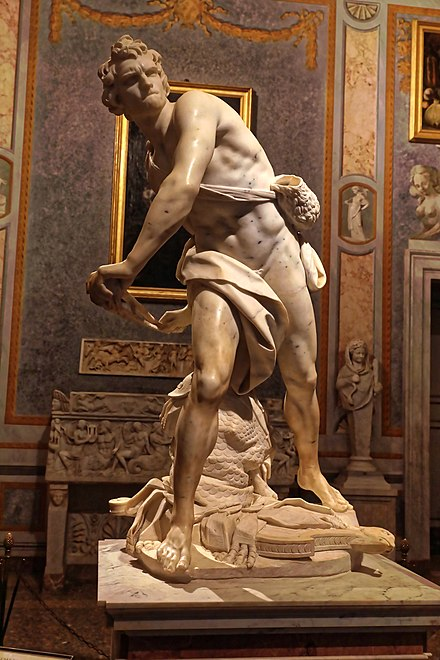
We missed Bernini's (1598–1680) marble David while in Rome. He's on display at Galleria Borghese. We also missed Donatello's David, which I studied in my art history class. Although Bernini's is more of an action  (sling) shot. I think I prefer Donatello's bronze version.


Degas (1834–1917), although best known for painting ballet dancers and racehorses, he also sculpted them. We saw examples of them at the Ny Carlsberg Glyptotek museum while in Copenhagen, Denmark in June 2019. See my May 2020 post, entitled Sculpture - Another Dimension of Art.


The Kiss (1882),
Rodin
While in Copenhagen, we also saw Rodin (1840–1917) sculptures, though I struggle to remember any. He never actually carved any of his sculptures, instead merely directing other artisans to create them, probably due to poor eyesight. Famous for The Kiss and The Thinker, it was so realistic that he was suspected of surmoulage --  casting directly on the model's body.

More impressive is the Palm Garden and Kai Nielsen's (1882–1924) Mother of Water  (1918-20) as its centerpiece.

Unfortunately, we missed the Auguste Rodin - Displacements exhibit in 2021.


The only Brancusi (1876–1957) sculpture that speaks to me is Suffering (1907), which currently resides at the Art Institute of Chicago. It's an expressive bronze bust of a child. Unfortunately, the image is copyrighted. The Institute is on my bucket list to visit.


King and Queen (1952),
Moore


Henry Moore's (1898–1986) bronze sculpture once resided in Glenkiln Sculpture Park, located in Dumfries, Scotland. While I'd been to Edinburgh, Scotland in 2017, we didn't visit its park either. Lots of sculpture to see all over the UK! My favorite park is Vigeland Sculpture Park in Oslo, Norway, where we visited in June 2019.


Spider (1996), Bourgeois


Surrealist & Feminist artist, Louise Bourgeois (1911–2010) created this creepy Spider sculpture in 1996. I wonder if she was consulted for creating Ron Weasley's nemeses in the Harry Potter movies?

Tuesday, January 10, 2023

MLK Jr -- Portrait of a Dreamer

MLK Jr. (2017), Glenridge
August of 2023 will mark the 60th anniversary of the 1963 March on Washington for Jobs and Freedom and Martin Luther King Jr's I Have a Dream speech. In February of 2017, a classroom of students from Glenridge Elementary School enlarged a photograph of MLK Jr. and posted it on a bulletin board in one of its hallways. It is a fun way to teach students about value range. My project used a black-and-white poster of Elvis Presley.

MLK Jr. (1962), Karsh

It turns out to be from the famous 1962 portrait by photographer Yousuf Karsh (1908–2002), on display at the National Portrait Gallery, Smithsonian Institution, in Washinton D.C. There is an I Have a Dream (2012) children's book with illustrations by artist Kadir Nelson. My brother has a book by Nelson with paintings of the Negro Leagues, some of which we saw at the Baseball HOF in 2019.

My First Year of Blogging: Teaching Art, Travels, and Observations, from August 2020, also includes MLK. Elvis, JFK, and de Kooning.
JFK (1965), de Kooning

JFK (1960), Rockwell

That same year, President John F. Kennedy was assassinated on November 22nd in Dallas, Texas. I remember it because it was my parents' wedding anniversary and my first-grade teacher cried when the announcement came over the PA system. Five years later, on April 4th, 1968, Martin Luther King Jr. was assassinated in Memphis, Tennessee. Norman Rockwell (1960) and Elaine de Kooning (1965) painted a series of portraits of the 35th President.


The Problem We All Live With (1964), Rockwell


In 1964, Norman Rockwell painted The Problem We All Live With, depicting six-year-old Ruby Bridges being escorted to an all-white elementary school during the New Orleans school desegregation crisis of 1960. Notice the racial slur and the tomato-stained wall.


Aesop's Fables (1970)
Dixie Café, (1948), Lawrence

The Smithsonian is a great place to view historical paintings. Here's one dealing with segregation by Jacob Lawrence. While I enjoy his colorful paintings, his compositional works in black-and-white are particularly striking. I gave a book (right) with such illustrations by Jacob Lawrence to my niece's 3rd-grade teacher.


Stone of Hope (2011), Lei Yixin


In August 2011, the Martin Luther King Jr. Memorial opened to the public in Washington D.C. Chinese sculptor Lei Yixin's inspiration came from a line from MLK's I have a Dream speech -- "Out of the mountain of despair, a stone of hope."


RFK (1972), Leroy Neiman


A month before his death, President Kennedy gave his own version of the I have a Dream speech. It was meant to be a call to action reminiscent of his inaugural address where he said, "...ask what you can do for your country." His brother (and Senator) Robert asked us to "Dream Things That Never Were". RFK's social justice agenda specifically targeted the poor and disadvantaged, while JFK's speech was about his desire for peace in his country, and MLK's speech dreamt of personal freedoms and a world free of discrimination. It's unfortunate that these three dreamers were singled out by fame-seeking assassins.


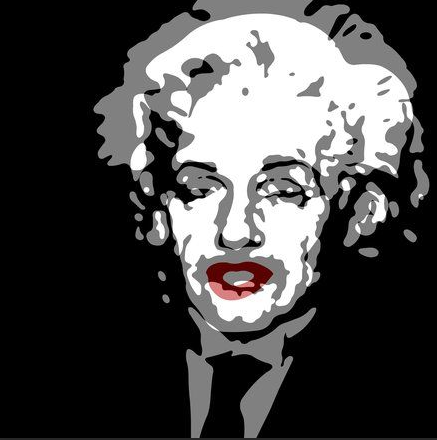
Brains and Beauty (Einstein
and Monroe), Troy Gua
Thomas Alva Edison (1890),
Abraham Archibald Anderson
You don't have to be a religious leader (like MLK Jr.), a politician (like JFK or RFK), an artist (like Jacob or Leroy), a scientist or inventor (like Edison or Einstein), a novelist or songwriter to be a dreamer.


Often, dreams lead to discoveries, breakthroughs, and even Nobel Prize winning contributions to the world. They reflect our personal values, behavior and aspirations to do good in the world.

Pablo Picasso was quoted as saying, "Action is the foundational key to all success."

Vincent Van Gogh may have said, "I dream my painting, and then I paint my dream."

I don't know who said it, but I like this quote: "Every possibility begins with the courage to imagine."

"You see things and you say, 'Why?' but dream things that never were, and I say, 'Why not?'" by George Bernard Shaw.

"Art has the power to transform, to illuminate, to educate, inspire and motivate." So have the courage to dream and share your art with others. Edgar Degas said, "Art is not what you see, but what you make others see."

Sunday, November 13, 2022

Mona Lisa -- Mysterious Enigma, Misunderstood Masterpiece?

Mona Lisa (1503-06), da Vinci

While Leonardo da Vinci's Mona Lisa is perhaps the most famous painting of all time, attracting tens of thousands of viewers each day at the Louvre in Paris, it is also one of the most misunderstood artworks. Initially, the 3/4-view portrait of the supposed Italian housewife was copied by artists who admired it for its realism and "subtle gradations of light and shadow" (sfumato) employed by Leonardo. The imaginary background is also admired for its smoky quality, making it both landscape and portrait. Viewers are more taken in by her 'smile'.

Da Vinci produced the small portrait of an ordinary woman whom scholars identify as Lisa Gherardini, wife of the Florentine silk merchant Francesco del Giocondo. She is wearing a veil which is difficult to make out amidst the rest of the dark shades employed in her hair and costume. Other paintings of Florentine women typically show more opulent dress including jewelry and rosy cheeks. The subtlety of expression and apparent lack of eyebrows make her less interesting, though more mysterious, than her contemporaries.

LHOOQ (1919), Duchamp

It wasn't until its theft in 1911 that the painting began to increase in popularity. Even when I visited the Louvre a hundred years later, people crowded around a small window to view it deeply shrouded inside a secured chamber. Get ready for disappointment!

Perhaps it was Marcel Duchamp's kitschy mustached reproduction, mocking her as 'the ideal of feminine beauty', that reinvigorated its post-war popularity. My March 2020 post about Shamrocks, Bowler Hats, and Irish Artists shows Lisa wearing a bowler hat. I guess it's the mystery behind the painting, its theft, and the desire to see the real painting amidst all the reproductions that fuel the attraction. See more in the article, "Why is the Mona Lis so Famous?".

Girl with a Paearl Earring
(1665), Vermeer


Personally, I much prefer Vermeer's Girl with a Pearl Earring, also known as the 'Mona Lisa of the North' or the 'Dutch Mona Lisa'. A young Scarlett Johansson portrayed the subject (Griet) in the 2003 movie. A little publicity for the northern version!


The Cast of Mona Lisa Smile (2003)


Although I've seen several movies depicting Leonardo da Vinci as a character, I've yet to see one about his Mona Lisa. Curiously, there is the 2003 movie entitled, Mona Lisa Smile, which starred Julia Roberts as an educator, along with three other beauties. And a 1986 British crime-drama movie called Mona Lisa about a call girl.


Tomei as Mona Lisa Vito (1992)


In My Cousin Vinny (1992), Marisa Tomei costars as Mona Lisa Vito, the spunky and obstinate fiancée of Joe Pesci. Even the name of the famous portrait subject gets reused, perpetuating the title and its worldwide recognition! Let's not forget the song of the same name recorded by Nat King Cole in March of 1950.


So, would Mona Lisa be as famous without the somewhat anonymous name, enigmatic expression (the smile), theft attempts, or admired painting techniques? Maybe the mystery itself is what attracts us to it!

Tuesday, October 11, 2022

My Inspirations for Creating Art

From Fox broadcast at Field of Dreams (8/12/21)

Lately, I have been inspired by what I see on social media, TV, commercial ads, and of course movies. I've even captured images from what is being displayed on my TV using my cellphone. It's overwhelming how many photos I've conveniently stored there. I wonder how the old masters would have used the technology and media of today to capture, store, and manipulate images more readily and without spending hours observing, sketching, and drawing what they saw. Of course, they had to rely much more on their own imagination, models, painting outdoors from nature, and the work of other artists for inspiration.

Paint 3D Landscapes
by Jon Patterson


Producing art can be its own inspiration. Practicing and experimenting with techniques and media provides new ideas and develops new skills. I'm constantly reading, consulting my own library of art books, researching topics and artists online, and journaling about future art posts. I find that my art colleagues and my own brother produce much more art than I do, which inspires me to create more art. I've already completed five new works using Paint 3D. And I'm working on an acrylic portrait of one of my favorite baseball players.


Ballet (after Degas)
Ken Patterson


While planning and preparing to teach art to others, I often get inspired to create my own examples for my students or pull images from online sources. For my pastels class, I tried my hand at reproducing a Degas painting as a way of employing many of the techniques I was intending to share with my students.


Bryce and Friends (2021), Ken Patterson

I am also inspired by things in my own life, including of course my pets. I look forward to our annual trip to Palm Springs and our visits to the California dog parks along the way. Here is a pastel version of a photo I took of my dog and two of his new dog park friends. The gravel surface gave me an opportunity to play with color and texture with a nod to impressionism.


Castle Landscape (2022), Ken Patterson


Sometimes my inspiration is a combination of an example I provided for a class, its rendition created by a student, and the challenge to recreate it in Paint 3D. I included it in my latest 'How To' post.


View from Cedar Butte (2022), Ken Patterson

Probably my favorite source of inspiration is nature. While I love doing portraits, I am learning to love painting landscapes, especially from photos. I plan to do more of these using some of my daughter's photos captured during her visits to Italy and adjacent countries. On our recent hike of the Cedar Butte Trail, I photographed the view from the top and painted it using Microsoft Paint 3D. Pretty good, considering I used a mouse on my desktop PC!


Milo Redwood & Studio


The work of other artists has inspired me in many ways. It inspires many of my blog posts. It's been fun for me to interview local artists and learn what inspires them. I often chat up artists when visiting their studios. I'll even engage with museum curators or volunteers to find out more about specific art exhibitions.


Son of Man (1963), René Magritte


Movies can be another source of inspiration and it's fun to watch for famous art being used in the background sets. I've blogged about that too, as far back as March 2020 with my Movie Art Cameos post. "The Thomas Crown Affair" uses the Metropolitan Museum of Art as a backdrop for its romantic art caper. In it, you will see works by Édouard Manet, Claude Monet, Camille Pissarro, Pablo Picasso, and, of course, René Magritte's "The Son of Man".

The photography can also be pretty impressive. Many of my brother's paintings were done using professional photographic compositions created by my sister-in-law.


So, what inspires you? Living with intentional observation, reading, journaling, sketching, drawing, taking photographs, taking art classes, visiting museums, and experiencing nature will enrich your life and may make you a better artist. If nothing else, it will allow you to appreciate life and share it with others.

Wednesday, July 27, 2022

Inspirations in Visual Art

What if a light bulb and a soft-serve
ice cream cone had a baby?

You'd get a CFL
(Compact Fluorescent Lamp)
[From the JoyReactor Website]

I'm always looking for inspiration for art projects, lesson plans, and especially what to blog about. Now that I have 136 posts, it is becoming increasingly more challenging to come up with ideas. I had hoped that my readers would comment, asking me to include topics of interest to them. After posting seven Baltics posts of June 2019, I received a request from one of my most avid readers for another in-depth series which resulted in six Art of the Pacific Northwest posts of July 2020.  I continued with Artist Interviews in September of 2020. That suggestion came from a website listing art blog ideas.


Smudgy the Cat from
PawsWithCause

Of late, my inspiration comes from baseball, shelter animals, teaching art to multiple age groups, art museums, and travel. When I visit new cities, I keep an eye out for local art such as sculptures and murals. Movies and other media also provide interest when I see art displayed in scenery, actors playing famous artists, or stolen artwork in the newspaper. It's fun to include Art in the News as part of my monthly elementary school lessons.

Vase of Peonies on a
Small Pedestal
(1864),
Édouard Manet


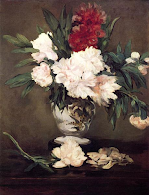
Following the art docent model of the Interurban Center for the Arts, I always include an inspirational work by a famous artist from which to pull an art concept, element, or principle of art. For example, I would use Jackson Pollock for a lesson about LINE. And for Positive-Negative Space I will always turn to Édouard Manet.


Two Crabs (1889), Vincent Van Gogh

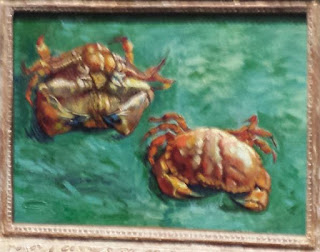
My family, friends, and colleagues encourage me to do more art. Museums are always stimulating, especially when I discover another Van Gogh painting or see a Rembrandt in person! Flemish artist, Peter Paul Rubens heavily influenced both artists. Van Gogh was also influenced by his friend, Paul Gauguin, who encouraged him to paint from his imagination, French realist Jean-François Millet, other Impressionists, and Japanese art. Van Gogh painted Two Crabs in 1889 as an experiment in complementary colors inspired by the color theory of Eugène Delacroix.
In May of 2017, I saw it hanging in The National Gallery in London's Trafalgar Square.

Emily's Chicken


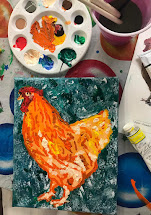
I wonder if PawsWithCause resident artist, Emily, was inspired by Van Gogh's crabs. Here is her portrait of a chicken in a very similar contrasting color scheme. Amazing! And I love the brushstrokes!!


My Charcuterie Board (2022)

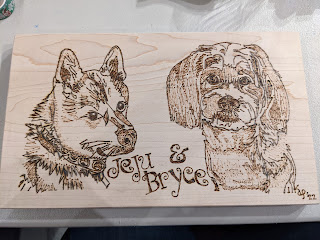
Taking art classes and exploring new mediums and techniques instigates new hobbies and adds to your toolbox. I especially enjoyed learning the art of wood burning when my daughter and I took a class to decorate charcuterie boards. The recent COVID pandemic prompted me to engage in teaching online classes with Heart Art Healing and their Circle of Love. I've also been moved by family members requesting me to teach art to homeschoolers. And while looking for classroom spaces to teach such groups I was asked to teach art at a city-sponsored Summer camp.
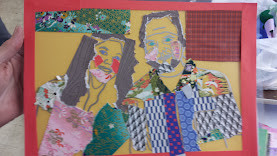


Judy's Family Portrait Collage (2019)

I think the students that inspire me the most are other seniors. While I am amazed at the existing talent of senior citizens, I am happy to see the less confident ones discover talent they weren't aware they had. This is why I teach at Franke Tobey Jones Senior University in Tacoma. It's almost always the same group of 12-15 artists, some who are painters, a quilter, and several novices, all of whom bring their enthusiasm to my classes. My Collage Portraits with Seniors class was particularly successful!


PushMePullYou from Dr. Dolittle (1967)
Inspiration
is different than motivation. Some say that inspiration is a 'pull' while motivation is a 'push'. Inspiration is typically an internal, mental or emotional influence to do something creative. Motivation is more of a process of external stimulation with definite actions designed to achieve a goal. For example, weight loss could be a goal motivated or prescribed by a doctor to make a person healthier. The inspiration could be imagining yourself in a bathing suit or noticing the successful weight loss journey of another person. It may inspire you to think of creative ways to cook meals and make healthier choices.

My own motivation to do art is to inspire others to do it. My goal is to write in my blog every two weeks, to keep it interesting, and to get comments as a way of improving it or gauging its success. My hope is that my writing inspires others to be more creative, recognize and appreciate creativity in themselves and others, and feel good looking at, doing, or talking about art.


So, what inspires you? Creativity comes from the inside although it is often sparked by an outside stimulus.


Observation gives us the opportunity to realize and gain creative insight. Hopefully, this blog will inspire you to put forth the effort and provide you with the means, energy and enthusiasm needed to dedicate yourself to reaping your own artistic rewards.


Thursday, July 21, 2022

More Artist Jeopardy

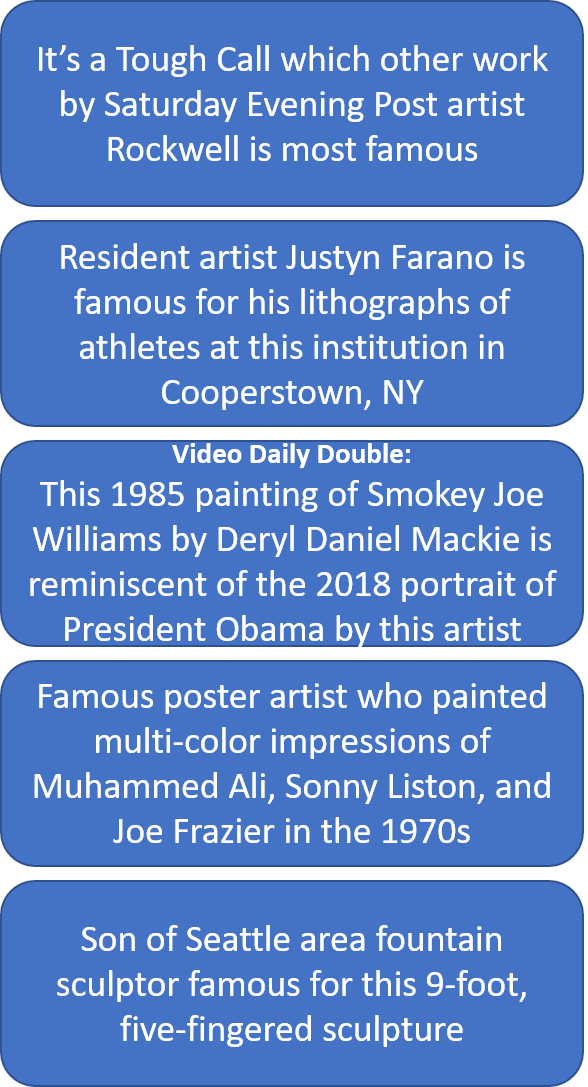
Back in February of 2020, I posted Artist Jeopardy. As a follow-on challenge for both Jeopardy fans and art enthusiasts, here are four more categories to test your knowledge of famous artists. I'll start with my own Jeopardy bio-story.

I’ve been watching Jeopardy since Art Fleming hosted it prior to my high school graduation in 1975. I’ve written several of my own Jeopardy answers over the years. My first game was in 1992 in honor of my parents' 40th wedding anniversary; the answers were all about their married life and Mom won. Fun fact: Mom was a 3-day winner on Concentration (with Host Hugh Downs) when I was in the first grade.

My next game was in the late 1990s with several Art categories that I presented on behalf of the Interurban Center for the Arts in my version of their Projects, Projects class taught to prospective elementary school parent volunteer art docents. Then, in 2005 during my City University Master’s Program, I played Jeopardy Host, Alex Trebek in a version of the game devoted to the subject of Project Management. So, I’ve been part of the game for over 50 years! Maybe I should become a writer for Jeopardy!! Do they even have guest writers?

And the categories are...


WOMEN OF ABSTRACT
EXPRESSIONISM


THE ART OF BASEBALL

For the Video Daily Double


ARTIST'S MUSEUMS

(Name the City)


FATHERS OF ART

MOVEMENTS


Sunday, June 12, 2022

Portraits of Artists' Fathers

Winter 1946 (1946), Andrew Wyeth

Last year, I posted Fathers of Art Movements in honor of Father's Day. This year, I thought I'd research artwork that honors the fathers of famous painters. A good example would be Andrew Wyeth's Winter 1946, a portrait of a young man running aimlessly down a hill, which, following the tragic death of his father, Newell Convers Wyeth (and grandson), became a sort of tribute. The boy may actually represent the artist himself trying to make sense of his father's tragic death.

Portrait of Camille Pissarro
(1893), Lucien Pissarro


I like Lucien Pissarro's rendering of this simple drawing of his father, Camille Pissarro, who is one of my favorite impressionist painters. It may be seen at Tate Britain in London, although I don't recall seeing it during our UK trip in June 2017.


Portrait of Alexander J. Cassatt
and His Son, Robert Kelso Cassatt

(1884), Mary Cassatt

We've all seen the iconic Whistler's Mother, a portrait of the artist's Mother, a subject common to many artists. Its title is actually, Arrangement in Grey and Black No. 1. More common are paintings of mother and child. French impressionist, Mary Cassatt, painted this portrait of her brother and her nephew. The father is reading a newspaper, offset by the boy's white collar. Their heads and hands stand out from the contrasting black shape of their suits.


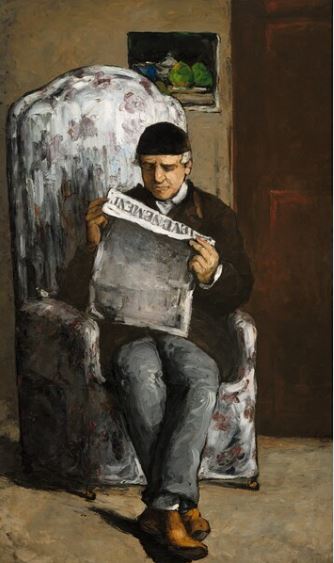
The Artist's Father, Reading
"L'Événement"
(1866),
Paul Cézanne


The perspective in Paul Cézanne's portrait of his father seems a bit off and his father's body twisted, making him look uncomfortable while reading his newspaper (~The Event). It also looks like the subject is wearing gray stone-washed Levi's.


The Return of the Prodigal Son
(1663 - 1665), Rembrandt


Although there's a category of painting known as Rembrandt's Father, such paintings have NOT been attributed to the artist. Instead, I'm including Rembrandt's The Return of the Prodigal Son, which hangs in the Hermitage Museum in St. Petersburg, Russia. I saw lots of dark portraits when I visited the museum during our Baltics cruise in June 2019. It would have taken days to see everything!


First Steps After Millet (1890), Van Gogh


My daughter recently visited the Metropolitan Museum of Art in NYC and saw Van Gogh's Starry Night hanging there. Also on display there is his painting of a child taking its first steps toward the farmer father. It is one of Van Gogh's final paintings inspired by a similar painting by Jean-François Millet.


Brita and me (1895),
Larsson


I love this watercolor portrait of Swedish artist Carl Larsson and his two-year-old daughter, Brita. It hangs in the National Museum in Stockholm. The colors and expressions indicate the happy childhood of Brita, unlike that of the artist, who himself had a rather contentious relationship with his own father. He and his wife went on to have eight children. Although we visited the Moderna Museet while in port on our Baltic Cruise in June2019, we did not get to see the National Museum


Portrait of My Father (1951), Kahlo


Frida Kahlo painted this portrait of her father, Wilhelm, in 1951. He has the same eyebrow(s) and a marvelous mustache. He was a Hungarian-German artist-photographer.


Escher's Father (1916),
M.C. Escher


Expressionist M. C. Escher produced this portrait of his father in 1916. It looks like a block print. I like the simplicity, probably for the same reason that I liked Pissarro's portrait (above).


Facts of Life (1956), Rockwell


I end this post with a dedication to my father, who in his own right was an artist that inspired all of us boys to explore our talents. Although Norman Rockwell did not pay tribute to his own father, I enjoy his Facts of Life illustration of a father giving advice to his son. Curiously, there is a maternal cameo silhouette hanging on the wall in the top left corner. The pair is also surrounded by what appears to be a mother cat and her kittens. I wonder what this father-son talk is about!