Showing posts with label Degas. Show all posts

Thursday, April 9, 2026

Artworks With Green


The Park (1910), Klimt


My first pic is a good transition from my last 'interview' post about the style of Robert Milaschewski, though meant to be posted for St. Patrick's Day. Here we see what could be described as a landscape, although dominated by tree crowns, with only a hint of tree trunks at the bottom. Instead, Gustav Klimt has used primarily a mosaic of green dots forming an abstract composition. It comes on the heels of the late nineteenth century movement, called Pointillism, which was developed by French artists, Georges Seurat and Paul Signac.


Green Wheat Fields, Auvers (1890),
Van Gogh


Here is a closeup taken from (the lower left corner of) Van Gogh's Green Wheat Fields, Auvers (1890), which was painted during the last months of the artist's life. When viewed without the upper half containing the sky and clouds, his green and white brushstrokes become abstracted, much like the dots in Klimt's leaves.


The Green Wave (1866-67), Monet


Unlike other happier Impressionist paintings (from his gardens), Monet's The Green Wave (1866-67) is painted in monochromatic teal green and black. Boats and the seaside were common themes for Monet, though usually calmer depictions of couples enjoying a leisurely outing. I would not have guessed this was his work!


Green Still Life (1914), Picasso


Although the green in Picasso's Green Still Life (1914) encompasses the entire background, it fits the theme of my post. I enjoy the patterned shapes on the wall and tabletop, giving life to the flat green shapes above which the objects would be floating without the black lines and suggested picture frame.


The Allure (1939), O'Keeffe


I was intending to show Georgia O'Keefe's Green Tree (1953), but it was almost too light for this category of green artwork. Then I found The Allure (1939), which is also known as Waterfall, No. I, Iao Valley, Maui. Her paintings of the Hawaiian landscape are reminiscent of her closeup paintings of flowers. The layers of the lush green mountains seem to be opening up to reveal the thin waterfall, as though it's the stamen of a flower.


The Green Dancer (1879),
Degas


Degas' The Green Dancer (1879) is complemented by the bright-orange clad dancers in the background. This isn't quite the green I was looking to highlight, though there's enough of the hue to warrant both the title of the painting and my subject. Degas does like to use diagonal lines in his composition and arrangement of the dancers' limbs. He has intentionally left the floor unadorned and in shadow.


The Green Christ (1889), Gauguin
The last painting, The Green Christ (1889), is by Paul Gauguin. It depicts a Brenton woman seated beneath a green-tinted statue of Christ's crucifixion. It represents a combination of several different 'calvaires' from various locations. Gauguin lived for a time in Brittany, a peninsula of northwestern France.

Like many of Gaugin's works, the subject stands out from the backgrounds, which he decorates with more lively colors. Green is sprinkled throughout. Even the other figures are green, and the woman's face has a green tint as if she is an ogress (from the movie Shrek!).

The black lamb she's holding in the bottom right corner is balanced by the dark water in the distance.

Thursday, June 13, 2024

The Art of Perspective

Perspective is one of my favorite art elements of Space. Using perspective can create the illusion of depth in a painting. It's important in creating the focal point of a painting, not only to create interest, but to emphasize the importance of an object, figure, or shape in your composition. To make your two-dimensional painting look three-dimensional, you may choose to vary size, position objects relative to each other, and use overlapping.

My personal favorite for teaching this topic is The Gleaners by Jean-François Millet. See More Seniors' Art -- Acrylic Landscapes for the six ways to create depth in a two-dimensional painting.

Café Terrace at Night (1888), Van Gogh

Perhaps one of the best examples of the use of perspective may be found in Van Gogh's Café Terrace at Night (1888). While somewhat cartoon-like, I appreciate his use of color and repetition of shapes. I hadn't noticed the color and relative size of the figures walking up the street outside the café, as I was focused more on the silhouetted patrons against the elliptical white tabletops. The oval shapes are echoed in the starry night sky, and the cobblestone street has more of a pointillist vibe. I'd have to see this in-person.


Bedroom in Arles (1888), Van Gogh


Also painted in 1888 is Van Gogh's Bedroom in Arles. Much more shortened in its perspective, the floorboards and the placement and size of the chair against the back wall create the depth. A second version added a checkerboard texture to the floor. Van Gogh was very selective about the colors of the objects and wanted to create a restful and dreamlike setting. I love the simplicity and absence of light and shadow.


The Last Supper (c. 1495–1498),
Leonardo da Vinci


Other versions of single-point perspective include Leonardo da Vinci's and Raphael's versions of The Last Supper. All lines converge just to the right of Christ's head, focusing on the central figure of the feast. The overlapping figures subtly emphasize depth in the foreground. The horizon lines up with Christ's head, with orthogonal lines radiating outward, and the long horizontal table grounding the scene.


The Dance Class
(1874), Degas


Edgar Degas used perspective in his painting of ballet dancers. In The Dance Class, Degas uses size and placement of his dancers to achieve depth in his painting. Like Van Gogh's bedroom, the floorboards recede from view and vanish in the distance. There's even a window far off in the distance through the ornate doorway. The cluster of dancers represents the ~horizontal line. The orthogonal line from the dancer with the red and blue bows to the teacher draws our eyes toward the light blue tutu at the end of the horizontal line. The red bow holds our attention left of center.


Rue de la Bavolle, Honfleur
(1864), Monet


Using mostly orthogonal lines, Claude Monet captured this street scene in the old port town of Honfleur. Due to the shadowing, Monet has divided his painting in half. He once again uses the contrasting colors characteristic of the Impressionists. He seems to have been experimenting with light and dark values as well. The figures in red and blue hold your interest and draw your eyes toward the center.


The Gold Weigher (1675),
Cornelius de Man


This final painting uses two-point perspective and is reminiscent of Dutch painter, Johannes Vermeer. It is painted by another Dutch painter, Cornelius de Man (1621-1706). Here, there are two vanishing points, one on the left and one on the right. Initially, I thought this painting was done by Vermeer, but even with the checkered floor, there is no bright blue and yellow that would be characteristic of his work. Well, maybe the soft blue of the woman's shoulder and the golden highlights of the table!

Friday, April 12, 2024

Sculptors

Sometimes, entire museums full of sculptures can be overwhelming and even repetitive. You can only stare at a few busts or nudes in various poses before moving on and walking quickly by. Some of the European museums are jam-packed with similar pieces, with only a few standouts (in my opinion).

I appreciated being ushered through a 2019 tour of the Hermitage Museum by a guide who planned to show us only the most important works of art in the vast collection. I always find myself hunting around for the Rembrandts!

I prefer a middle ground between classical marble statues and grand, ultra modern, abstract installations.

Penitent Magdalene
(1440), Donatello 


I recall learning about Donatello's (1386–1466) unusual wooden sculpture of the Penitent Magdalene (1440) in an Art History class in college. It rather reminds me of melting chocolate. More impressive is how he executed this 6-ft masterpiece without using a chainsaw; it wasn't invented yet!

Unfortunately, we missed the Museo dell 'Opéra del Duomo, where she resides, during our 2011 trip to Florence, Italy.


The Pieta (1498-99),
Michelangelo 


We did get to see Michelangelo's (1475–1564) David while visiting Florence. And, although we splined through the Vatican museums and the Sistine Chapel, the lines to get into St. Peter's Basilica were too long, so we didn't get to see the Pieta. Which one is your favorite?


David (1623-24),
Bernini


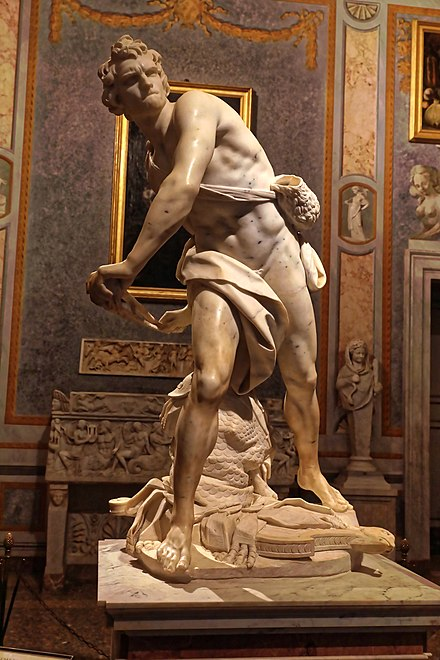
We missed Bernini's (1598–1680) marble David while in Rome. He's on display at Galleria Borghese. We also missed Donatello's David, which I studied in my art history class. Although Bernini's is more of an action  (sling) shot. I think I prefer Donatello's bronze version.


Degas (1834–1917), although best known for painting ballet dancers and racehorses, he also sculpted them. We saw examples of them at the Ny Carlsberg Glyptotek museum while in Copenhagen, Denmark in June 2019. See my May 2020 post, entitled Sculpture - Another Dimension of Art.


The Kiss (1882),
Rodin
While in Copenhagen, we also saw Rodin (1840–1917) sculptures, though I struggle to remember any. He never actually carved any of his sculptures, instead merely directing other artisans to create them, probably due to poor eyesight. Famous for The Kiss and The Thinker, it was so realistic that he was suspected of surmoulage --  casting directly on the model's body.

More impressive is the Palm Garden and Kai Nielsen's (1882–1924) Mother of Water  (1918-20) as its centerpiece.

Unfortunately, we missed the Auguste Rodin - Displacements exhibit in 2021.


The only Brancusi (1876–1957) sculpture that speaks to me is Suffering (1907), which currently resides at the Art Institute of Chicago. It's an expressive bronze bust of a child. Unfortunately, the image is copyrighted. The Institute is on my bucket list to visit.


King and Queen (1952),
Moore


Henry Moore's (1898–1986) bronze sculpture once resided in Glenkiln Sculpture Park, located in Dumfries, Scotland. While I'd been to Edinburgh, Scotland in 2017, we didn't visit its park either. Lots of sculpture to see all over the UK! My favorite park is Vigeland Sculpture Park in Oslo, Norway, where we visited in June 2019.


Spider (1996), Bourgeois


Surrealist & Feminist artist, Louise Bourgeois (1911–2010) created this creepy Spider sculpture in 1996. I wonder if she was consulted for creating Ron Weasley's nemeses in the Harry Potter movies?

Wednesday, June 28, 2023

Artists With July Birthdays

Still Life with Parrot and Fruit (1951), Kahlo


Many of my favorite visual artists were born in July. In fact, all of them have been featured in this blog. Most were born under the sign of Cancer (or the Crab). They are typically emotional, hypersensitive, competitive, and often isolated people. 

Frida Kahlo (1907-54), born  July 6th, is famous for her unusual and often creepy self-portraits. I much prefer her still life paintings. Do parrots like watermelon?


The Wolffish (2004), Jamie Wyeth


Jamie Wyeth (1946-), son of Andrew Wyeth and grandson of N.C. Wyeth, was also born on July 6th. I chose this painting of a fierce wolffish preying on seagulls because it's unusual. Wyeth crowded the birds on the left side of the painting perhaps to balance the dark fish emerging from the right. His sense of humor reminds me of his father's Roadkill painting of a dead squirrel on a road alongside of a plantation house.


The Bridal Pair with The Eiffel Tower
(1939), Marc Chagall


Marc Chagall (1887-1985), born July 7th, is famous for his very large Surrealistic paintings. We visited his museum in Nice, France in May of 2011. Weddings are a popular theme for Chagall's works. As well as oversized farm animals! His dreamlike paintings are more like collages.


Still Life with a Coffeepot (1900), Pissarro


French Neo-Impressionist, Camille Pissarro (1830-1903), born July 10th, is most famous for his pastoral landscapes and harbor scenes. I had to include this still life, which happens to have bird wallpaper. The copper coffeepot and green ceramic mug are the stars of this painting, while the china teacup, bowl, and lemon are secondary in his composition.


Soaring (c. 1950), Andrew Wyeth
I seem to be including birds in my selections, so here is a magnificent scene of ravens soaring high above a small white farmhouse below. Andrew Wyeth (1917-2009), born July 12th, and his son, Jamie used ravens as their subjects in several paintings. Andrew spent long hours, weeks, even months alone in a barn painting, and wouldn't show anyone his work until it was done.


Head of a Woman (1918),
Modigliani


Amedeo Modigliani (1884-1920), also born July 12th, painted portraits of women with elongated faces and necks. His subjects appear stretched in subtle 'S' shapes much like those of Marc Chagall.


James Abbott McNeill Whistler (1834-1903), also born July 12th, is most famous for his painting of his mother. His portraits, including his own self-portrait, have the subject facing in a left profile view. I feel like he was a one-hit wonder.

The Man With the Golden Helmet
(c. 1650-55), Rembrandt


Rembrandt (1606-69), famous for painting ~75 self-portraits in his lifetime, was born July 15th. In every museum I've visited, I've challenged myself to find at least one Rembrandt. My favorite is The Man With the Golden Helmet (1650). It has been attributed to Rembrandt, but may actually have been painted by a student of someone in his circle or artists. It has resided in Berlin's Kaiser Friedrich Museum, which we didn't get to visit during our Baltic cruise in June 2019.


Lady Caroline Howard (1778),
Reynolds


Sir Joshua Reynolds (1723-92), born July 16th, was Principal Painter in Ordinary to the King from 1767–1784. Thomas Gainsborough, painter of Blue Boy (1770), was his rival for the position, never attaining the prominent title. Thomas Lawrence, who painted Pinky (1794), did eventually receive the coveted title.


In Front of the Mirror (1889), Degas

Edgar Degas (1834-1917), born July 19th, remained a bachelor all his life. He presented himself as a loner and his demeanor drove people away, something he desired as an artist. He was known to be a misogynist and was also anti-Semitic. No wonder nobody wanted to marry him (or vice versa)!

Like Modigliani, Degas signed this painting at the top righthand corner. Unusual! Especially since Modigliani was born a Sephardic Jew!!


Nighthawks (1942), Hopper


Edward Hopper (1882-1967), born July 22, is most famous for his melancholy painting, Nighthawks, of a sad group of people hanging out in a diner, very late at night or perhaps in the wee hours of the morning.


Nude Descending a Staircase,
No. 2
(1912), Duchamp


Our last artist was born under the sign of Leo (the Lion). Leos are ambitious and creative. Marcel Duchamp (1887-1968), born July 28, is most famous for his Cubist painting of a Nude Descending a Staircase, No. 2. In the 1970s, my own brother was inspired to paint a futuristic version of the Frazier-Ali fight on a large canvas.

As I was researching and writing this post. I realized that most of my selections have either birds or hats in them. I guess this last painting doesn't fit the bill (Ha!)!

Wednesday, May 31, 2023

My Life as a Struggling Artist and Volunteer

Manet +/- Space Project, Lowell Elementary
I've been encouraged all my life to create art. While I am not as prolific as other artists, I do try to share what I've learned about art with others; and that has been one of my goals in retirement. Early on, my focus was volunteering in elementary schools, but that ended with the pandemic. I am now much more challenged to find outlets for my creativity.

Bo the Dog, PwC


Probably my most successful retirement endeavor has been volunteering with PawsWithCause. The non-profit organization allowed me to continue teaching others how to do art at paint parties, to employ salesmanship in raising money for a cause, show artwork of others, build community, and do custom pet portraits upon request.


Kandinsky Circles, Old Friends Club

I have been successful at teaching seniors in multiple locations, including assisted living communities, adult memory daycares, senior centers, and a senior university (in Tacoma). I've also taught online classes a few times. I don't understand why it takes so much effort to volunteer my services. Even with websites like VolunteerMatch, it is difficult to get pro-bono work that doesn't limit my own creativity or require me to use my own supplies.


My Degas Demo, FTJ Pastels Class


I've been happy teaching at Franke Tobey Jones' Senior University in Tacoma, where I get a stipend and get paid, but that's only twice a year, if I'm lucky. My students are a willing and captive audience. It surprises me that senior centers are less interested in doing art and favor playing Bingo. Assisted Living communities should also welcome someone to conduct art activities, but they have their own staff and such limited budgets. I wonder if I could apply for a grant to bring my own prepaid art supplies to senior communities.


Castle Landscape in Paint3D

So, here I sit in my office blogging about past experiences. I occasionally paint portraits or landscapes in my spare time. My brother helped encourage me to learn Paint3D and I've done several awesome paintings on my PC using a mouse. I've even tried homeschooling 'grandkids' and got paid to bring art lessons to a nearby summer camp. Both gigs challenged me to adapt my lesson plans for students ranging in age from 4-13 years old.


Palm Tree, Circle of Love Class


What all of this 'struggle' is meant to convey is that sometimes creativity is required in order to successfully dedicate oneself to volunteering. I guess I thought that it would get easier over time, and that with blogging and posting on Facebook more people would be asking me to teach classes and volunteer.


City Dog Park, Palm Springs, CA
Bryce and Friends, Redding, CA

Over the past few years, I've used our trips to Palm Springs as an opportunity to paint, do animal portraits of dogs from the local dog park, and develop lesson plans and project demos.


Retirement may not mean that you will stop working. Instead, you may find creative ways of playing and exploring your newfound independence with a spirit of adventure. Living a creative life means to focus on curiosity rather than a fear of failure. Imagination, innovation, and persistence are the energies that also help us solve problems. While I've experienced some disappointment along the way, I've enjoyed the process and haven't given up. As American Christian author and speaker Joyce Meyer once said, "Patience is not the ability to wait but the ability to keep a good attitude while waiting". 

Tuesday, October 11, 2022

My Inspirations for Creating Art

From Fox broadcast at Field of Dreams (8/12/21)

Lately, I have been inspired by what I see on social media, TV, commercial ads, and of course movies. I've even captured images from what is being displayed on my TV using my cellphone. It's overwhelming how many photos I've conveniently stored there. I wonder how the old masters would have used the technology and media of today to capture, store, and manipulate images more readily and without spending hours observing, sketching, and drawing what they saw. Of course, they had to rely much more on their own imagination, models, painting outdoors from nature, and the work of other artists for inspiration.

Paint 3D Landscapes
by Jon Patterson


Producing art can be its own inspiration. Practicing and experimenting with techniques and media provides new ideas and develops new skills. I'm constantly reading, consulting my own library of art books, researching topics and artists online, and journaling about future art posts. I find that my art colleagues and my own brother produce much more art than I do, which inspires me to create more art. I've already completed five new works using Paint 3D. And I'm working on an acrylic portrait of one of my favorite baseball players.


Ballet (after Degas)
Ken Patterson


While planning and preparing to teach art to others, I often get inspired to create my own examples for my students or pull images from online sources. For my pastels class, I tried my hand at reproducing a Degas painting as a way of employing many of the techniques I was intending to share with my students.


Bryce and Friends (2021), Ken Patterson

I am also inspired by things in my own life, including of course my pets. I look forward to our annual trip to Palm Springs and our visits to the California dog parks along the way. Here is a pastel version of a photo I took of my dog and two of his new dog park friends. The gravel surface gave me an opportunity to play with color and texture with a nod to impressionism.


Castle Landscape (2022), Ken Patterson


Sometimes my inspiration is a combination of an example I provided for a class, its rendition created by a student, and the challenge to recreate it in Paint 3D. I included it in my latest 'How To' post.


View from Cedar Butte (2022), Ken Patterson

Probably my favorite source of inspiration is nature. While I love doing portraits, I am learning to love painting landscapes, especially from photos. I plan to do more of these using some of my daughter's photos captured during her visits to Italy and adjacent countries. On our recent hike of the Cedar Butte Trail, I photographed the view from the top and painted it using Microsoft Paint 3D. Pretty good, considering I used a mouse on my desktop PC!


Milo Redwood & Studio


The work of other artists has inspired me in many ways. It inspires many of my blog posts. It's been fun for me to interview local artists and learn what inspires them. I often chat up artists when visiting their studios. I'll even engage with museum curators or volunteers to find out more about specific art exhibitions.


Son of Man (1963), René Magritte


Movies can be another source of inspiration and it's fun to watch for famous art being used in the background sets. I've blogged about that too, as far back as March 2020 with my Movie Art Cameos post. "The Thomas Crown Affair" uses the Metropolitan Museum of Art as a backdrop for its romantic art caper. In it, you will see works by Édouard Manet, Claude Monet, Camille Pissarro, Pablo Picasso, and, of course, René Magritte's "The Son of Man".

The photography can also be pretty impressive. Many of my brother's paintings were done using professional photographic compositions created by my sister-in-law.


So, what inspires you? Living with intentional observation, reading, journaling, sketching, drawing, taking photographs, taking art classes, visiting museums, and experiencing nature will enrich your life and may make you a better artist. If nothing else, it will allow you to appreciate life and share it with others.

Sunday, September 4, 2022

Artists Born Under Virgo or Libra

Chrysanthemums (1874-6), Tissot

To start posting for the month of September let's look at artists born under the Zodiac signs of Virgo (Aug 23rd thru Sept 22nd) and Libra (Sept 23rd thru Oct 23rd). Virgo artists are hardworking, intelligent, and adventurous, having traits including rational thinking, problem-solving, and an adventurous spirit. Libras, unlike other introverted, unsociable artists, are social butterflies who are outgoing and charming. Libras also have great taste in art and fashion.

French artist, James Tissot (1836-1902), born (in October) under the sign of Libra, painted Chrysanthemums, shown here as the floral symbol for the sign Virgo. Tissot was a friend and mentor of Edgar Degas.


VIRGOS

Thunderstorm (1948), Grandma Moses

One of the most famous American artists born (September 7th) under Virgo is Grandma Moses (1860-1961). She appears in my January 2021 post entitled, Master Artists -- Inspired Late Bloomers and Resilient, Active Seniors. She turned to painting when arthritis kept her from doing her elaborate needlework, but she kept her 'primitive' style. Teachers may use her work as an inspiration for a lesson about the elements of a landscape for younger children. Older children will need to learn the principles of perspective and proportion, not present in her work, for learning about space.


Constellations (1938), Hans Arp


German-French Sculptor, painter, poet, Jeans Hans Arp (1886-1966) was born September 15th. His Constellations linoleum cut is reminiscent of the biomorphic shapes used by (Capricorn) Henri Matisse. Years ago when I taught my daughter in her 6th-grade classroom, my students traced a Matisse shape and were asked to design a composition around it.


Mecklenburg Autumn (1979), Bearden


American artist Romare Bearden (1911-1988), born September 2nd, is famous for collages using photographs and painted paper in a style derived from Cubism. His work also depicts American black culture like his colleague, Jacob Lawrence. Another great artist for studying the art of collage would be American painter, (Libra) Robert Rauschenberg. I use collage for doing wrapping paper self-portraits, which could also be inspired by portrait artists: Amedeo Modigliani, Gilbert Stuart and Sir Joshua Reynolds.


The Migration Series (1941),
Jacob Lawrence
Felix (inspired by N.C. Wyeth)

In 2017 I visited the Seattle Art Museum and saw the exhibit, Jacob Lawrence: The Migration Series. Born September 7th, 1917, his work chronicled the migration of African Americans from the rural South to the industrious North in the decades following World War I.

Here's a project inspired by N.C. Wyeth that was designed to demonstrate the concept of movement. It would also work for a lesson about Jacob Lawrence. The challenge is cutting out the figures, so this lesson works best with 5th- or 6th-graders.


LIBRAS

Medusa (1597), Caravaggio


My first Libra artist is the controversial Italian painter, Caravaggio (1573-1610), born September 28th. He appeared in my March 2020 post entitled, Artist Frenemies - Friendships, Rivalries, and Competition, about his feud with artist Giovanni. Libras are supposedly non-confrontational although I imagine that Caravaggio exhibited the extremely emotional side of the sign. I've seen his artwork in several museums, but it may be somewhat inappropriate for younger viewers.


The Raft of Medusa (1819), Géricault 

This next artist is French painter and lithographer, Théodore Géricault (1791-1824), born September 26th. His epic masterpiece, The Raft of Medusa (1819), is often compared to Delacroix's Liberty Leading the People (1839). Both are good examples of Romanticism, a movement characterized by intense emotion. A young Delacroix (Taurus) actually posed as one of the dying figures on the raft!


No. 1 (Royal Red and Blue)
(1954), Mark Rothko

Libra Mark Rothko (1903-1970), was an American artist, born September 25th, who was famous for his abstract color field paintings designed to evoke emotion from viewers. While initially studying Architecture in college we did many color studies in order to explore color combinations and the optical effect of placing them adjacent to each other. Another Libra artist whose work I don't claim to understand is Robert Rauschenberg. His three-panel White Painting (1951) is particularly unusual and rather uninspiring!

I focus a lot on art history and researching various artists to add interest to my art lessons. And it's important to find inspiration when creating art! I hope this group of artists inspires you to create your own artwork or delve deeper into learning about these artists and their art movements and styles.