Showing posts with label Constable. Show all posts

Tuesday, May 9, 2023

Reflections in Art

Landscapes


Reflections (1983), Bob Ross
I found this great article about Landscape Composition: 16 Reflections. Whether it is Sisley, Turner, or Monet painting the landscape, the result is always more pleasant and serene with the addition of a reflection in water to reveal atmospheric conditions. I particularly enjoyed watching Bob Ross' TV series The Joy of Painting, especially when he'd show us how to paint water and reflections. He pulled down color using a large dry brush, then lightly dragged his brush across to soften the reflections.


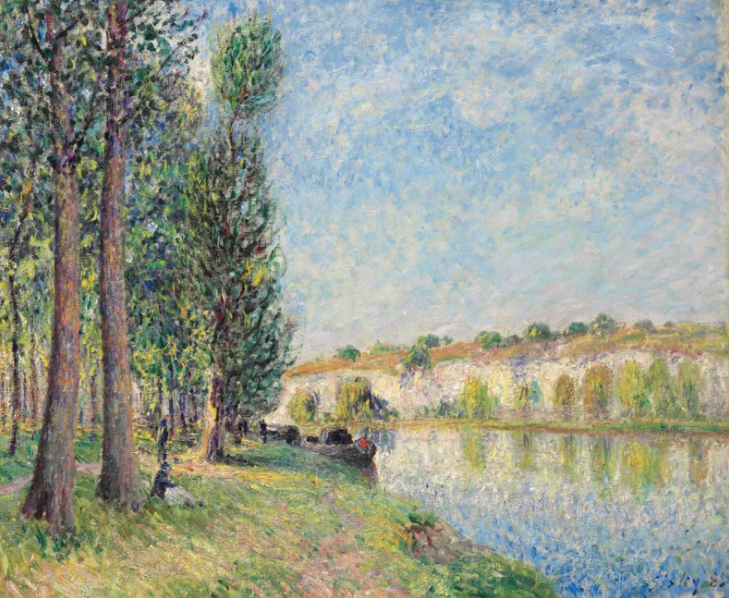
Le Loing à Moret (1885), Sisley


Impressionist painter, Alfred Sisley (1839-1899), was born to British parents in France, where he spent most of his life. His landscapes may have been inspired by the paintings of J. M. W. Turner and John Constable. I much prefer this softer work to some of his other more intricate landscapes.


Boats (1885), Sisley


While this landscape by Sisley may make a wonderful jigsaw puzzle, it makes for a very complex painting. His reflections seem to be concentrated toward the bottom, focusing on the subject boats. The clouds reflect in the water in the middle of the composition. The jetty seems to divide the painting in two.


The Studio Boat (1874), Monet

Some say that Sisley's career was overshadowed by that of Franch Impressionist Claude Monet. Monet's Studio Boat became the subject of four of his paintings. The reflections are well done. Monet has also balanced his composition by offsetting the dark boat hull with the large bank of brown autumn trees and highlighting the studio structure. Many of Monet's other works use dark purple in place of black.


The Grand Canal of Venice (1875), Manet


In Édouard Manet's Blue Venice or The Grand Canal of Venice (1875) the reflections are suggested using impressionistic brushstrokes. Like Monet's work above, Manet has atypically used black for his gondola. Everything else in the painting is bright and textured. 


Le Bateau (1953), Matisse


In 1961, Henri Matisse's Le Bateau ("The Boat") was hung upside-down at New York's Museum of Modern Art for 47 days until a patron pointed it out to a museum guard. In this simple papercut and gouache work, it was apparently difficult to distinguish between the sailboat and its reflection.


Starry Night Over the Rhône (1888), Van Gogh


Before Vincent Van Gogh painted his famous Starry Night with the swirling sky and cypress trees, he captured a moment of calm in Starry Night Over the Rhône (1888). I love the reflected lights of the city. The couple in the foreground seem to be standing in the water due to the repetition of the brushstrokes, colors, and subtle transition from water to shore.


Valley of the Yosemite (1864), Bierstadt

German-born American artist, Albert Bierstadt, painted this landscape of the Yosemite Valley in California along the Merced River in 1864. Everything about this masterpiece is amazing! I love the colors of the sky, the brightness of the sunlight reflecting off the mountains, the sliver of reflected trees in the water, and the silhouettes of the deer grazing in the foreground.


Portraits

Triple Self-Portrait
(1960), Rockwell


Some artists used mirrors in their portraits. One of the most recognizable is Norman Rockwell's self-portrait with him seated in front of a mirror and a large canvas capturing his own image three times. I enjoy seeing what he has pinned to his easel, including his own sketches on one side opposite self-portraits of fellow artists: Durer, Rembrandt, Picasso and Van Gogh. Possibly as a nod to Rembrandt, he has collected a golden helmet as a souvenir of a trip to Paris.


 'Self Portrait', from Behind Gala,
Reflected in Mirror
(1972), Dali
In 1972, Salvador Dali painted a double portrait of the artist and his muse (wife Gala). It reminds me of an interior, painted by Johannes Vermeer, with light streaming in from a window. It may also be a nod to Diego Velázquez's 1656 masterpiece of Las Meninas, where the King and Queen were subtly reflected in a mirror.

Here, we get to see both figures from the front reflected in a mirror and from the back seated. If only we could see what's on his easel! Notice how Gala's chair is downplayed in both color and value so as not to compete with the artist's chair and mirror frame.


A Bar at the Folies-Bergère (1882), Manet
Some say that the man in the upper right of the mirror is Édouard Manet himself in A Bar at the Folies-Bergère (1882). Artists often hide their self-portraits in their paintings. You don't see the back of the man at the bar because he is perhaps (Manet) the viewer of the bar scene. 

The horizontal blueish band may be the stage. The reflection of the bar itself runs behind the barmaid's hips and may be reflecting the two bottles from the lower left corner.


Girl at Mirror (1954), Norman Rockwell


Finally, here's another painting by Norman Rockwell celebrating the innocence of a young girl checking herself out in an attic mirror while reading a glamour magazine. The girl reminds me of actress Margaret O'Brien who starred opposite Judy Garland in the classic Meet Me in St. Louis ten years earlier.

Thursday, November 24, 2022

Famous Artists & Paintings -- By Century

The Arnolfini Portrait (1434), van Eyck
15th Century

In this article, I'd like to review famous artists and their paintings, starting with the 15th century, highlighting my favorites. Earlier art primarily focused on religious subjects which, though ornately detailed, was pretty homogenous. Let's start with a work by Jan van Eyck, whose Arnolfini Portrait was included in my Avatars, Doppelgangers, and Lookalikes post. One of the most recognizable paintings of the 15th century, this double portrait also captures the couple's reflection in the convex mirror hung in the background. I saw it in person at the National Gallery of London in 2017. Van Eyck was considered an innovator, some saying that he created oil painting.


"Salvator Mundi" (1500), da Vinci


16th Century


At the beginning of the 16th century, Leonardo da Vinci painted this classic portrait that eventually sold for $450.3M. It was supposed to be on display at the Louvre Abu Dhabi in 2018, but it has yet to be seen in public. See my June 2020 post, entitled Encouraging Artistic Expression, for more details. His other more famous portrait, Mona Lisa, was painted during the same period. I saw her at the Louvre in Paris in 2011. His Madonna Litta was painted toward the end of the 15th century, residing at the Hermitage in St. Petersburg, Russia, where I visited in 2019.


The Hunters in the Snow (1565),
Pieter Bruegel the Elder


Later in the 16th century, Flemish painter Pieter Bruegel the Elder created The Hunters in the Snow. A large print of the landscape hung in my father's office at Price Waterhouse in NYC. It has always been one of my favorites! I love the cool teal color of the sky and frozen river. It's also a wonderful example of the use of perspective to create depth and the illusion of space.


The Saviour of the World
(1608-14), El Greco


17th Century


Moving to the early 17th century, we see El Greco's version of the Christ. The blessing gesture is similar to that of da Vinci's portrait, including the hand on the orb representing the world, although the color scheme is much more modern. I like the use of contrast, especially accentuating the face and the halo effect.


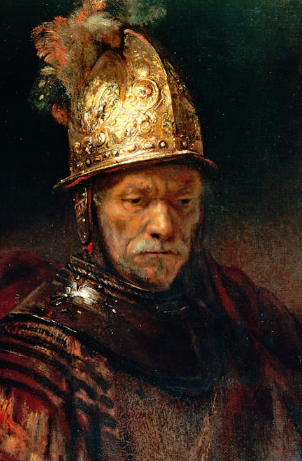
The Man in the Golden Helmet
(1650), Rembrandt


The mid-17th century paintings that I've chosen are three of my all-time favorite portraits. I do seem to gravitate towards portraits. Rembrandt is famous for having painted the most self-portraits though I love The Man in the Golden Helmet. It also inspired my work nickname 'Gelmet' which my co-workers gave me because of my gel hairdo. I often found people staring at the top of my head, much like how museum patrons might focus on the helmet in this painting.


Las Meninas (1656), Velázquez


There's something about this amazing family portrait by Diego Velázquez. To find out more, see my August 2020 post entitled Things That Go Together in Art – Subjects, Portraits, Landscapes/Seascapes, Still Lifes, and Couples. It does appear to have all the detail in the lower half of the painting, but it seems to work!


Girl with a Paearl Earring
(1665), Vermeer


This classic by Johannes Vermeer is known as the 'Mona Lisa of the North' probably because of her mysterious identity. Vermeer often employed blue and yellow in his detailed portraits, usually of women.


The Blue Boy (1770), Gainsborough

18th Century


Thomas Gainsborough and Sir Joshua Reynolds were rivals for the position of Painter to the King. On our trip to the UK in 2017, their paintings were curiously hanging side-by-side in one of the national galleries. Growing up in New Jersey, my next-door neighbor had a red sitting room where a copy of Gainsborough's Blue Boy was hung. One of the houses we rented in Port Townsend's Fort Warden had needlepoint versions of Blue Boy and Pinkie (by Thomas Lawrence) hanging side-by-side. The pair, often seen together, also appears in episodes of Leave it to Beaver just inside the Cleavers' front door entry.


The Age of Innocence (1788), Reynolds


I use portraits from Sir Joshua Reynolds and Gilbert Stuart when I do my wrapping paper self-portraits project with fifth graders. Included in one of the packets provided by Interurban Center for the Arts was his portrait of Lady Caroline (1778). The girl in this painting is unknown but is likely Reynolds' great niece.


Athenaeum Portrait
(1796), Stuart


It's unusual to find unfinished paintings on display in galleries and I've only ever seen one of them. I find it interesting that Gilbert Stuart intentionally kept one of his first portraits of George Washington unfinished to use as a model for later works. Martha Washington admired it, but Stuart refused her and painted another one instead.


Cenotaph to the Memory
of Sir Joshua Reynolds
(1833-6), Constable


19th Century


Another painting I saw at the National Gallery in London is John Constable's homage to Sir Joshua Reynolds. I enjoy seeing artwork in person, especially when it's something I've studied in school or researched for my blog or one of my classes. The stag is meant to represent the wild locale of the monument, which in actuality would have been smaller than a full-sized deer. It's up to the artist to create the focal point and provide it the proper emphasis.


Tiger in a Tropical Storm (1891), Rousseau


Here's another diamond in the rough from the National Gallery in London. It's a landscape by Henri Rousseau that could be perceived as a portrait of a tiger. Crouching tiger but no hidden dragon!


Les Oliviers (1889), Van Gogh
Of course, my all-time favorite artist has to be Vincent Van Gogh. It's difficult for me to choose a favorite. While doing research for this blog I continue to discover new (to me) Van Gogh paintings. For example, I saw this one at the Scottish National Gallery in Edinburgh. Like Van Gogh's Sunflowers, olive trees were another of his favorite subjects to paint.


I love the paintings of the French Impressionists, but there are too many for me to down select for this blog post. I also love the paintings of Henri Matisse and Marc Chagall. I highly recommend visiting their museums in Nice, France.

Capri Girl (1878), Sargent


Let's finish with the 19th century artists/paintings by including John Singer Sargent's portrait of Capri Girl. My daughter and I saw this work while briefly on exhibit at the Seattle Art Museum and we immediately fell in love with it. She appears to be leaning against the branch of a tree and gracefully becomes part of nature. Her bodice and hair blend into the dark background and her skirt disappears into the flowery field. She was a favorite subject of the artist.


Christina's World (1948), Andrew Wyeth
20th Century

My favorite artists of the 20th century are Salvador Dali, Pablo Picasso, Edward Hopper, Jacob Lawrence, Norman Rockwell, and Andrew Wyeth. Since we're primarily showcasing portraits here, and as a transition from Sargent's Capri Girl, I'm including Christina's World by Andrew Wyeth. His wife Betsy modeled for the painting inspired by the Olson (~30-yr-old) girl he saw crawling in the field.


President Obama (2018), Wiley


Kehinde Wiley is probably the best known African American portrait painter of the 21st century, although Simmie Knox was the first to paint the portrait of a President (Bill Clinton). I had the opportunity to see Wiley's paintings on exhibit at the Seattle Art Museum. I also got to see Jacob Lawrence's Migration Series, which was impressive but on a smaller scale than the large decorative works of Wiley. His intricate backgrounds are beautiful! While Lawrence used colorful shapes to build his symbolic compositions, Wiley used colorful patterns to surround and highlight his subjects.


So, who are your favorite artists? Your favorite painting? I find that I often choose to listen to the B-side of a record, straying from the more popular featured song. I also enjoy hearing the more obscure and less played selections (e.g., of Tom Petty songs) just as much as seeing newly discovered works by my favorite visual artists. As with music, you learn to love and appreciate many genres, though you will likely gravitate towards your favorites.

Friday, November 6, 2020

Autumn Leaves in Landscapes of Famous Artists

Introduction

As a kickoff to November, I'd like to show landscapes that celebrate the colors of Autumn leaves. The artists will pretty much be from the 19th through the 21st centuries.


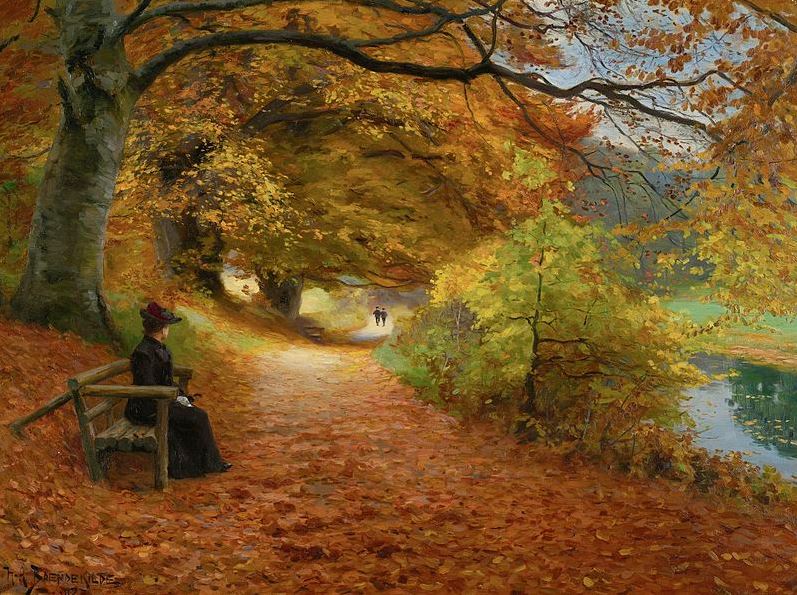
Wooded Path in Autumn (1902), Brendekilde


My first example is a colorful Autumn masterpiece by Danish artist, Hans Anderson Brendekilde. I love the vibrant colors, and the figures in the foreground and background make for a welcoming scene. This would be a fine place for a cool, brisk walk. I am, however, confused by the reflection of the green tree, though it does provide balance to the composition.


19th Century

The Cenotaph To Reynolds’ Memory
(1836)John Constable


My next more wintery example is this classic tribute to Sir Joshua Reynolds. While in the UK in 2017, I was afforded the opportunity to see the work of both of these artists -- Constable's landscapes and Reynolds' portraits. The monument depicted here was erected in Coleorton, Leicestershire, England in the Winter Garden by George Beaumont in honor of one of the many artists he supported. Although this painting may seem monochromatic, Constable was famous for painting with "a thousand greens" in his landscapes. You have to see it in person!


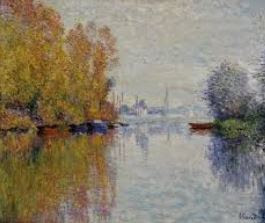
Autumn on the Seine
at Argenteuil 
(1873), Monet

Autumn Effect
at Argenteuil
(1873), Monet
Monet painted several Autumn scenes along the Seine River near Argenteuil. Although the first painting horizontally uses the rule-of-thirds, his colors make it look like only half-Autumn. I much prefer his second version, "Autumn Effect..." which is much more seasonally consistent. 

He's edited out the boats though it looks like he painted it
from a similar vantage point and on a less overcast day.

The Studio Boat (1876), Monet


My favorite of Monet's Autumn water scenes has to be The Studio Boat. There's another version with a closeup of the boat and the people inside.


Gathering Autumn Leaves (1877), Homer


The following year, we have Winslow Homer’s Gathering Autumn Leaves. This painting feels like one of Andrew Wyeth's portraits to me. I love the sharp angles and shadows.


Autumn Landscape, near Pontoise (1871-72), Pissarro


Another of my favorites is impressionist, Camille Pissarro. I like the depth he was able to achieve with the hill in the foreground, the clearing in the middle ground, and the small white house in the background and below the horizon. Unlike his earlier Landscape at Louveciennes (Autumn) (1870), the colors are more saturated and the brushstrokes seem less like those of an impressionist. I'd like to see this one in person.


Jules Le Coeur Walking
With His Dogs
(1866), Renoir


I am somewhat reluctant to show this painting by Pierre-Auguste Renoir because I have not seen it in person and I, therefore, do not know its original color scheme. I've also seen it depicted in much darker greens and almost black hues. Anyway, it is a portrait of his friend, architect-turned-painter, Jules Le Coeur walking in the Fontainbleau Forest with his Dogs. He apparently painted this outdoors and in his studio.


Landscape with Trees (1881), Van Gogh


I've said it before, it is exciting to discover paintings by Vincent Van Gogh that I haven't seen before. Here, the artist uses a limited color palette of brown and gold, much like the Constable painting above. Check out Van Gogh in Holland for more of his uncharacteristically less-colorful landscapes from 1881-86.


20th Century

Birch Forest I (1902), Gustav Klimt


As we proceed into the 20th century, I want to highlight Austrian artist, Gustav Klimt, who is known as a symbolist who primarily painted the female body. This landscape is somewhat of a departure for Klimt. He has brightened up an otherwise dark forest by using tiny brushstrokes that give his Autumn leaves a shimmering quality. Klimt had a style all his own, though I am reminded of Pointillist Georges Seurat's dots and Henri Matisse's paper cutouts. It also has a surreal, dreamlike quality.


Autumn Leaves (1913), Sargent

One of my favorite artists is John Singer Sargent, who is famous for
his paintings of turn-of-the-century women.


Autumn Leaves (1924), O'Keeffe


When I was very young and living in Northern New Jersey, my family would vacation at a resort in Lake George, NY. Georgia O’Keeffe painted several versions of Autumn Leaves while in Lake George. I wish that I had seen these when I taught a lesson where we made compositions from tracings of leaf shapes. Instead, we learned about Cubism and Picasso and traced leaf shapes in a value study using geometric shapes in the background. I'll have to think of a project inspired by O'Keeffe.


Value Study/Cubism Leaves, Glenridge Elementary


Celebrating Three 21st Century Women Artists


Autumn Leaves by Aleyna Isik


Saatchi Art is a great source for buying or viewing art. Here is an oil painting of leaves by Turkish artist, Aleyna Isik.


Autumn Leaves (2015), Kim Testone


I also found this acrylic painting by Kim Testone of Upstate New York. In her blog, Paintings by Kim Testone, she gives step-by-step instructions on daily paintings of leaves.


Quiescent, Patricia J. Moss


One of my colleagues, Patricia J. Moss, from the Black Diamond Arts Alliance, painted this beautiful oil painting of Autumn leaves. I wonder if she was inspired by Georgia O'Keeffe. You can find out in my next Interview With an Artist.


Friday, March 20, 2020

Artist Frenemies - Friendships, Rivalries, and Competition

As I continue to do research for my art lessons I am finding that many artists befriend a fellow artist, sometimes becoming competitive rivals, and often challenging each other to improve and innovate.


In another post, I've talked about Van Gogh's friendship (late in life) with Gauguin. Van Gogh was a somewhat timid soul who was later institutionalized following his relationship with his bolder, adventurous friend Gauguin. 

While Vincent liked to paint outdoors from nature, Paul insisted that he make up scenes from his own imagination. Vincent used his imagination to re-colorize copies of paintings by Jean-Francois Millet and the works of Japanese artists. I will discuss other friendships and rivalries that were often based on copying each other's works and some works that were deemed plagiaries.


National Gallery London

Another rivalry I know about is between portrait painters Sir Joshua Reynolds and Thomas Gainsborough. I knew about this one while researching the life and work of Reynolds and prior to visiting the UK in 2017. Apparently, Gainsborough was jealous of Reynolds having been appointed the Painter to the King (George III) and President of the Royal Academy of the Arts. At the Tate Britain museum, I stumbled upon works by both artists that were curiously displayed side-by-side (Reynolds on the left). I was taken aback and commented about their placement to two young patrons who were summarily impressed by my knowledge of the strained relationship. I then revealed to them how Gainsborough put aside his differences when he visited Reynolds's deathbed before he died. It's always a good idea to do the right thing and avoid regret later.


While in self-imposed isolation during the recent outbreak of Covid-19, I find myself accelerating my blogging, though struggling to come up with interesting topics. In order to learn more about artist rivalries, I turned to the Internet, finding a couple more strained friendships as well as a book on the subject.


Edouard Manet and Edgar Degas had a falling out after Manet slashed the face of his wife in a portrait Degas had painted of his friends. In retaliation, Degas returned a painting that Manet had gifted him.


Pablo Picasso and Henri Matisse would often choose similar subjects to paint and occasionally use the same titles for the works. This form of flattery went on for a while until Picasso criticized Matisse's design for  Chapelle Du Rosaire in Venice, likening it to a bathroom (salle de bain in French).

Rival art writers/critics created a rivalry between Jackson Pollock and Willem de Kooning.


The next set of three rivaled pairs comes from Sebastian Smee's book entitled, The Art of Rivalry: Four Friendships, Betrayals, and Breakthroughs in Modern Art. He cited four pairs, but I am not interested in the feud between Freud and Bacon.


Not sure about this one: when John Constable was to exhibit his painting, "The Opening of Waterloo Bridge", Joseph Mallord William Turner was to exhibit side-by-side with his. Turner decided to upstage Constable by adding a red buoy to his own painting, "Helvoetsluys".


Battle of Anghiari, da Vinci
Battle of Cascina, Michelangelo
The rivalry of a well-established, mature Leonardo da Vinci and up-and-coming,  young Michelangelo had an adverse effect on art history and the celebration of two famous battles in Florence history. 


Both were commissioned for Florence's Hall of Five-Hundred and neither was ever finished due to their utter dislike for each other. Not so mature after all, eh!?


Caravaggio's Cupid
Giovanni's Version

The final is a bitter rivalry. Michelangelo Caravaggio was criticized by Giovanni Baglione, who claimed that Caravaggio's "Amor Vincit Omnia" painting of Cupid was plagiarized. So, in response to the Cupid painting, Giovanni painted "Sacred and Profane Love", giving the face of the devil a likeness of Caravaggio. Caravaggio was so inflamed that he engaged in libel and spent a few days in jail as a result.
Now that's a rivalry!