Showing posts with label Sculpture. Show all posts

Friday, April 12, 2024

Sculptors

Sometimes, entire museums full of sculptures can be overwhelming and even repetitive. You can only stare at a few busts or nudes in various poses before moving on and walking quickly by. Some of the European museums are jam-packed with similar pieces, with only a few standouts (in my opinion).

I appreciated being ushered through a 2019 tour of the Hermitage Museum by a guide who planned to show us only the most important works of art in the vast collection. I always find myself hunting around for the Rembrandts!

I prefer a middle ground between classical marble statues and grand, ultra modern, abstract installations.

Penitent Magdalene
(1440), Donatello 


I recall learning about Donatello's (1386–1466) unusual wooden sculpture of the Penitent Magdalene (1440) in an Art History class in college. It rather reminds me of melting chocolate. More impressive is how he executed this 6-ft masterpiece without using a chainsaw; it wasn't invented yet!

Unfortunately, we missed the Museo dell 'Opéra del Duomo, where she resides, during our 2011 trip to Florence, Italy.


The Pieta (1498-99),
Michelangelo 


We did get to see Michelangelo's (1475–1564) David while visiting Florence. And, although we splined through the Vatican museums and the Sistine Chapel, the lines to get into St. Peter's Basilica were too long, so we didn't get to see the Pieta. Which one is your favorite?


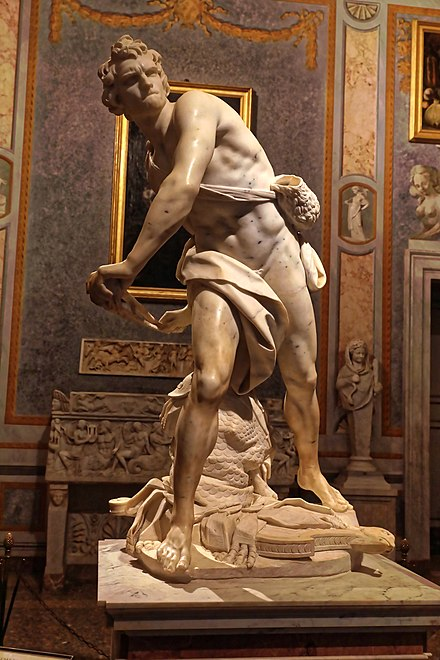
David (1623-24),
Bernini


We missed Bernini's (1598–1680) marble David while in Rome. He's on display at Galleria Borghese. We also missed Donatello's David, which I studied in my art history class. Although Bernini's is more of an action  (sling) shot. I think I prefer Donatello's bronze version.


Degas (1834–1917), although best known for painting ballet dancers and racehorses, he also sculpted them. We saw examples of them at the Ny Carlsberg Glyptotek museum while in Copenhagen, Denmark in June 2019. See my May 2020 post, entitled Sculpture - Another Dimension of Art.


The Kiss (1882),
Rodin
While in Copenhagen, we also saw Rodin (1840–1917) sculptures, though I struggle to remember any. He never actually carved any of his sculptures, instead merely directing other artisans to create them, probably due to poor eyesight. Famous for The Kiss and The Thinker, it was so realistic that he was suspected of surmoulage --  casting directly on the model's body.

More impressive is the Palm Garden and Kai Nielsen's (1882–1924) Mother of Water  (1918-20) as its centerpiece.

Unfortunately, we missed the Auguste Rodin - Displacements exhibit in 2021.


The only Brancusi (1876–1957) sculpture that speaks to me is Suffering (1907), which currently resides at the Art Institute of Chicago. It's an expressive bronze bust of a child. Unfortunately, the image is copyrighted. The Institute is on my bucket list to visit.


King and Queen (1952),
Moore


Henry Moore's (1898–1986) bronze sculpture once resided in Glenkiln Sculpture Park, located in Dumfries, Scotland. While I'd been to Edinburgh, Scotland in 2017, we didn't visit its park either. Lots of sculpture to see all over the UK! My favorite park is Vigeland Sculpture Park in Oslo, Norway, where we visited in June 2019.


Spider (1996), Bourgeois


Surrealist & Feminist artist, Louise Bourgeois (1911–2010) created this creepy Spider sculpture in 1996. I wonder if she was consulted for creating Ron Weasley's nemeses in the Harry Potter movies?

Friday, April 5, 2024

Alexander Calder - In Motion Exhibit

Untitled, Calder
Three-dimensional art is seldom taught in school, which is a shame. Alexander Calder (1898-1976) spent his early years drawing in space using wire to create 3D artworks. He was always building things using whatever he could find, perhaps because his parents were both artists who moved around to follow their commissions and exhibitions. Born in 1898, he created his first kinetic sculpture in 1931.


Figure, Dog, Birds (1946), Joan Miro


Calder was part of a group of avant-garde artists including Joan Miro, whose 2D drawings curiously resemble Calder's wire sculptures.


Yellow Circle

My daughter got me tickets to see the Alexander Calder - In Motion exhibit at the Seattle Art Museum. I once discovered a painting by Calder, which was hung rather obscurely near the information desk at the Palm Springs Art Museum. This 2D painting from the In Motion exhibit is similar to the one I found in Palm Springs.


I hope to eventually encounter some of Calder's grand-scale steel sculptures, like this one, that have been installed around the world. I believe there is at least one here locally in the Olympic Sculpture Park!

I believe this one is a stabile, rather than a mobile that would be in motion, and called a kinetic sculpture.


The In Motion exhibit is worth visiting, especially when witnessing the scale and breadth of Calder's work. In-person viewing allows one to appreciate the size and spatial quality. Even the shadows are impressive!

In Paris, Calder became inspired by the effect light had on the colored rectangles tacked on the wall of Piet Mondrian’s studio. Apparently, this image led to his working with mobiles.


Other Innovative Artists

For more kinetic sculptures, see 7 Artist Who Created Innovative Mobiles -- Beyond Alexander Calder. I've placed these artists in chronological order by birth year, and selected specific images.

1. Marcel Duchamp (1887–1968):


Bicycle Wheel (1951),
Duchamp


While I prefer Duchamp's futuristic Nude Descending a Staircase (No. 2) from 1912, some of his other works are pretty puzzling.


2. Man Ray (1890–1976):

Le Violon d'Ingres
(1924), Ray


Ray used everyday objects, such as hangers (Obstruction, 1920), in his kinetic art, though he's more famous for his photographs that were considered works of art.


3. Alberto Giacometti (1901–1966):


The Nose (1949),
Giacometti


Giacometti was obsessed with human heads and tall, slender figurines. They remind me of something an art teacher would use as a first project for students to study posing human figures. He had an interesting face, but his sculptures were repetitive and rather primitive.


4. Bruno Munari (1907–1998) 

My Multi-faceted Jacks (2015)


Boo! My multi-faced jack-o-lantern from 2015 has creatively designed mini carvings on a single pumpkin. Munari designed human faces in his graphical drawings made up of shapes. See Multiple Identities of a Face.


5. Roy Lichtenstein (1923–1997)


Barcelona Head (1992),
Lichtenstein


The father of pop art, his sculptures in his brushstroke series are 3D representations of movement in the style of his 2D Op Art images. He used benday dots to make his art look machine-made. He apparently designed Five Brushstrokes sculpture in 1984, but it wasn't fabricated until 2010, long after his death.


6. Swiss artist, Jean Tinguely (1925–1991)

The Métamatic, Tinguely


Tinguely is famous for using motor-powered automation, for his 'Métamatic' machines that produce artwork.


7. Julio Le Parc (1928–)


Blue Sphere (2001/13),
Le Parc


Much of his art is more like Op Artist, Victor Vasarely than Calder. Again, it is perhaps the 3D representation of 2D Op Art.