Showing posts with label Michelangelo. Show all posts

Friday, April 12, 2024

Sculptors

Sometimes, entire museums full of sculptures can be overwhelming and even repetitive. You can only stare at a few busts or nudes in various poses before moving on and walking quickly by. Some of the European museums are jam-packed with similar pieces, with only a few standouts (in my opinion).

I appreciated being ushered through a 2019 tour of the Hermitage Museum by a guide who planned to show us only the most important works of art in the vast collection. I always find myself hunting around for the Rembrandts!

I prefer a middle ground between classical marble statues and grand, ultra modern, abstract installations.

Penitent Magdalene
(1440), Donatello 


I recall learning about Donatello's (1386–1466) unusual wooden sculpture of the Penitent Magdalene (1440) in an Art History class in college. It rather reminds me of melting chocolate. More impressive is how he executed this 6-ft masterpiece without using a chainsaw; it wasn't invented yet!

Unfortunately, we missed the Museo dell 'Opéra del Duomo, where she resides, during our 2011 trip to Florence, Italy.


The Pieta (1498-99),
Michelangelo 


We did get to see Michelangelo's (1475–1564) David while visiting Florence. And, although we splined through the Vatican museums and the Sistine Chapel, the lines to get into St. Peter's Basilica were too long, so we didn't get to see the Pieta. Which one is your favorite?


David (1623-24),
Bernini


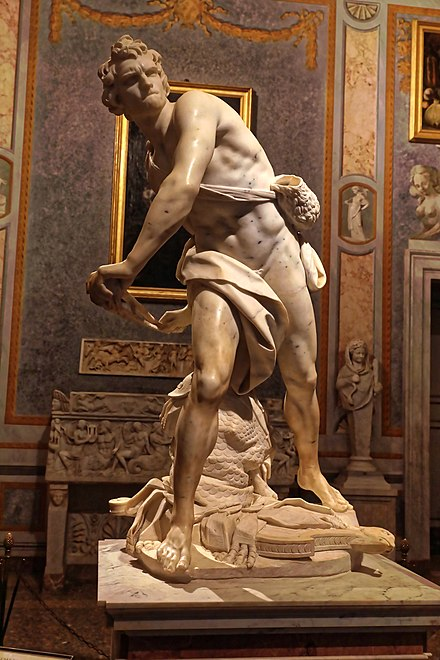
We missed Bernini's (1598–1680) marble David while in Rome. He's on display at Galleria Borghese. We also missed Donatello's David, which I studied in my art history class. Although Bernini's is more of an action  (sling) shot. I think I prefer Donatello's bronze version.


Degas (1834–1917), although best known for painting ballet dancers and racehorses, he also sculpted them. We saw examples of them at the Ny Carlsberg Glyptotek museum while in Copenhagen, Denmark in June 2019. See my May 2020 post, entitled Sculpture - Another Dimension of Art.


The Kiss (1882),
Rodin
While in Copenhagen, we also saw Rodin (1840–1917) sculptures, though I struggle to remember any. He never actually carved any of his sculptures, instead merely directing other artisans to create them, probably due to poor eyesight. Famous for The Kiss and The Thinker, it was so realistic that he was suspected of surmoulage --  casting directly on the model's body.

More impressive is the Palm Garden and Kai Nielsen's (1882–1924) Mother of Water  (1918-20) as its centerpiece.

Unfortunately, we missed the Auguste Rodin - Displacements exhibit in 2021.


The only Brancusi (1876–1957) sculpture that speaks to me is Suffering (1907), which currently resides at the Art Institute of Chicago. It's an expressive bronze bust of a child. Unfortunately, the image is copyrighted. The Institute is on my bucket list to visit.


King and Queen (1952),
Moore


Henry Moore's (1898–1986) bronze sculpture once resided in Glenkiln Sculpture Park, located in Dumfries, Scotland. While I'd been to Edinburgh, Scotland in 2017, we didn't visit its park either. Lots of sculpture to see all over the UK! My favorite park is Vigeland Sculpture Park in Oslo, Norway, where we visited in June 2019.


Spider (1996), Bourgeois


Surrealist & Feminist artist, Louise Bourgeois (1911–2010) created this creepy Spider sculpture in 1996. I wonder if she was consulted for creating Ron Weasley's nemeses in the Harry Potter movies?

Monday, June 27, 2022

Artists' Beards, Mustaches, and Facial Hair

LAA Pitcher, Archie Bradley


I've been noticing the wild and often untamed facial hair of Major League Baseball of late while watching the Seattle Mariners on TV. Pitchers are known to 'paint' the corners of the strike zone. One of the more tamed beards belongs to Los Angeles Angels pitcher, Archie Bradley. It would fall into the category of a Garibaldi beard, after the famous Italian General Giuseppe Garibaldi.


LAA Outfielder, Brandon Marsh


LAA Outfielder, Brandon Marsh's is the polar opposite, including more of a Forest Gump look. 


Portrait of a Man in Red Chalk
(Early 1500s), da Vinci


It reminds me of portraits of old masters like Leonardo da Vinci and the statue of Michelangelo's Moses.


Impressionist, Camille Pissarro

M's Pitcher, Sergio Romo


Seattle Mariners pitcher, Sergio Romo's beard is also impressive, reminding me of Impressionists Camille Pissarro and Claude Monet, though opposite in color, like that of St. Nicholas. Romo's beard would be that of a Garibaldi style if it was less than 8 inches in length.


Autumn (1573), Arcimboldo


Artist, Giuseppe Arcimboldo's Autumn (1573) is a portrait of a man comprised of fruits and vegetables, including a beard made out of wheat.


Self-Portrait with Sunflower (~1633), Van Dyck

The van dyke style of beard popular in the 17th century was named after Flemish painter Anthony Van Dyck. Unlike the goatee, a van dyke is often pointed and also includes a mustache. You may remember the actor, Monte Woolley, from the 1942 movie The Man Who Came to Dinner co-starring Bette Davis. He also played an eccentric writer in The Bishop's Wife (1947) opposite David Niven and Cary Grant. Let's not forget General Armstrong Custer and KFC's iconic Colonel Sanders.


Dali Photographic Closeup


Often, it's the mustache that stands out most among the wearers of facial hair. One of the most iconic belongs to Spanish Surrealist Salvador Dali. I enjoy teaching about contrast and opposite colors to elementary school students using Dali's Persistence of Memory (1931). He was as eccentric as his unusual paintings, keeping an ocelot as a pet, and focusing on Sigmund Freud and his study of dreams. Perhaps he should have spent more time taming those bushy eyebrows!


Portrait of Joseph Roulin (1889), Van Gogh


Vincent Van Gogh and other artists painted portraits of men sporting muttonchops. This style of beard often leaves the chin area without hair and the mustache area also shaven. Hugh Jackman's X-Men character, Wolverine sports such a beard sans mustache. Such split beards are known as French forks.


Self Portrait Dedicated to
Dr. Eloesser 
(1940), Frida Kahlo


Another of my favorites is Mexican artist, Frida Kahlo, famous for her somewhat unique and iconic unibrow. Nowadays, even men will groom their eyebrows -- some may refer to them as 'metrosexuals'. Back in the day, when men let their beards grow wild, they also let their eyebrows and ear and nose hairs go untrimmed. In my opinion, if you're going to bother to precisely trim a mustache, goatee, or van dyke style beard, then you should also pay attention to those other wild areas. I'll forgive those who grow full beards as long as they occasionally trim them and always keep them void of food remnants!


Kenneth Branagh
David Suchet
Another mustache example is that of Agatha Christie's character, Hercule Poirot. I've been watching reruns of the 1989 TV series starring David Suchet as Poirot. His signature stache looks fake and almost plastic. The more recent Murder on the Orient Express (2017) and Death on the Nile (2022) films, starring Kenneth Branagh as the famous sleuth, created a much more believable, even spectacular, layered mustache, complete with soul patch.

(Apparently, Poirot's stache is meant to cover up scars from lacerations he suffered during a WWI explosion.)

Monday, February 14, 2022

10 Famous Artists with Aquarius/Pisces Birthdays

Balloon Dog (Red)
(1994-2000), Koons
This post is inspired by the astrological signs of Aquarius (January 20 - February 18) and Pisces (February 18 - March 20). I decided to write about famous artists born under these signs, starting with American Pop Artist, Jeff Koons, who was born January 21, 1955. The Aquarian is famous for his pop culture sculptures of everyday objects. His balloon animals (e.g. dogs) are especially iconic. I stumbled upon his red dog while browsing for clipart to use for a Valentine I was making. I've always been fascinated by such imaginative creations made from those hard-to-inflate long, slender balloons that look like they are about to pop. Koons' (red, blue, yellow, orange, or magenta) dogs are made from stainless steel that has been covered by transparent varnish.


Blown Away Balloon Dog
(2020), Josh Mayhem


My daughter and I have watched the Netflix TV series, Blown Away, where contestants compete to make objects out of glass. Given the scale of such a sculpture, it probably wouldn't have worked in glass. Although I haven't seen anyone create balloon animals out of glass, I did locate some online that were made of acrylic resin on resin. Personally, I prefer the stainless Koons' steel version as opposed to Mayhem's mass-produced acrylic objects.


The Kiss (1907-08), Gustav Klimt

Originally, I was looking for artwork relating to Valentine's Day or the topic of Love. I had previously posted my Top 15 Paintings that Use Primary Colors -- Red, Yellow, and Blue, including Gustav Klimt's (born under CancerThe Kiss (Lovers). I received a jigsaw puzzle of it this year for my Capricorn birthday. I've also posted about Famous Capricorns Throughout History and 10 Artists with April Birthdays. Another one of my favorite posts is Things That Go Together in Art – Subjects, Portraits, Landscapes/Seascapes, Still Lifes, and Couples.


AQUARIAN Artists


I've already covered examples of Art of the Zodiac & Artists' Astrological Signs. Let's take a deeper look at the work of other famous Aquarian artists -- Édouard Manet, Jackson Pollock, Norman Rockwell, Max Beckmann, and Joan Mitchell.

Bouquet of Flowers
(1882), Manet


Édouard Manet (born January 23, 1832) is famous for his paintings of peonies. I often use Manet's peonies when I teach about the concept of positive and negative space. 


Convergence (1952), Pollock

Blue Poles (Number 11)
(1952), Pollock
Jackson Pollock (born January 28, 1912) is most famous for his Abstract Expressionist drip paintings. These are two of my favorites.


Triple Self-Portrait (1960),
Norman Rockwell


My favorite Norman Rockwell (born February 3, 1894) painting has to be his 1960 Triple Self-Portrait which I blogged about in August of 2020. He also famously put his own head in the peanut gallery of his baseball painting, The Dugout.


Self-Portrait with Green Scarf
(1917), Max Beckmann


Aquarian German Expressionist Max Beckmann (born February 12, 1884) painted this and several other self-portraits. I love his bold style with its use of black outlines!


No Birds (1987-88), Joan Mitchell

In 2017, I visited the Palm Springs Art Museum where they were exhibiting the Women of Abstract Expressionism, which included the works of 12 groundbreaking female expressionists. Here is one of the works of Aquarian Expressionist Joan Mitchell (born February 12, 1925). It is an homage to Vincent Van Gogh's Wheatfield with Crows (1890). This year, the work of her contemporary, Helen Frankenthaler, will be on display at PSAM.


PISCES Artists


Luncheon of the Boating Party (1880-81), Renoir

Now let's highlight the works of famous Pisces artists -- Pierre-Auguste Renoir (February 25, 1841), Michelangelo, Piet Mondrian, and Kehinde Wiley. Renoir's most famous painting has to be Luncheon of the Boating Party. It's a wonderful composition with the yellow hats, white fabric and offsetting striped awning to frame the group portrait.


David (1504), Michelangelo


Italian sculptor Michelangelo (born March 6, 1475) needs no introduction. On our trip to France and Italy in 2011, I saw his statue of David at the Accademia Gallery in Florence, Italy. If I had a bucket list, visiting Florence would definitely be on it.


Composition with Large Red Plane,
Yellow, Black, Grey and Blue

(1921), Piet Mondrian


I did an art lesson with kindergartners about LINE, inspired by the Dutch painter, Piet Mondrian (born March 7, 1872). His iconic geometric compositions may be recognized by his use of black lines and rectangles in primary colors. Mondrian is definitely one of those artists whose work is metaphorically an actor who has been typecast to repeatedly portray the same character .


Willem van Heythuysen (2005),
Kehinde Wiley


Let's end with Pisces American portrait artist, Kehinde Wiley (February 28, 1977). I saw his impressive work at the Seattle Art Museum's A New Republic exhibition in 2016. I love the intricate and often floral backgrounds he uses to highlight and celebrate urban black individuals in aristocratic poses. While the clothing is modern, his treatment and symbolism reach back to ancient Greece, imperial Rome, and the conquests of European Kings and Queens. Here he reimagines Frans Hals' portrait from 1625. You simply have to see these life-size portraits in person!

Sunday, May 16, 2021

Mother's Day Dedication and Artist Inspirations

Mom (ca. 1958)

I'm dedicating this post to my Mom, a very snappy dresser who expressed her artistic side through clothes, costume jewelry, handbags, and shoes; she was the Imelda Marcos of the U.S. My favorite photograph of her is a black-and-white portrait with me and my older brother. Her haircut is reminiscent of Elizabeth Taylor’s short 1950s hairstyle from Father of the Bride. Even Lucille Ball dons a new hairstyle during the Black Wig episode of I Love Lucy (1954) where she tries to fool Ricky into believing she is an Italian temptress.

Liz Taylor (1963-5), Andy Warhol

Andy Warhol famously silk-screened portraits of Liz, Lucy, Marilyn Monroe, among others. Warhol and Ball share August 6th birthdays and iconic hairstyles -- Andy with his white wig and Lucy with her red henna-dyed hair. We saw his Marilyn exhibit while visiting Palm Springs in 2018. His work is currently on display at the Tate Museum in London, the birthplace of Ms. Taylor. As a mother, she had three biological children and one adopted child.

Vue de l'asile et de la Chapelle de Saint-Rémy
(1889), Vincent Van Gogh


She once owned a rare Van Gogh painting. Apparently, her art dealer father paid $130,000 for it in 1963 on her behalf, and it later sold at auction at Christie's in May 2018 for $39,687,500.


Portrait of the Artist's Mother
(1888), Van Gogh


Vincent's mother, Anna Carbentus Van Gogh, an amateur artist herself, is credited as having introduced him to art. He colorized her portrait from a black-and-white photograph.


Green Acres (1965-71)

Mom sported many hairstyles. One day I came home from school and was shocked to find a blonde woman talking on the phone in the kitchen. It was my Mom, but she looked like Eva Gabor from the 1965 sitcom Green Acres. Her hair was in a French twist, the signature hairstyle of Ms. Gabor. Mom remained a blonde from then on and even wore her hair like that as the mother of the groom in my wedding.

I bet you recognize the couple's pose as that of Grant Wood's American Gothic (1930). You may see it hanging today in the Art Institute of Chicago.


We even compared Mom to actress Dina Merrill, who appeared as a brunette in 1963’s The Courtship of Eddie's Father opposite Glenn Ford with little Ronnie Howard as Eddie. Earlier in 1959, she starred with Tony Curtis in the Cary Grant movie Operation Petticoat as a blonde. We’d watch her in the 1970s on the game show Match Game.


Mom was also on TV as a 3-day winner on the game show Concentration, hosted by Hugh Downs. I remember watching her in my older brother’s 3rd-grade classroom where we made Christmas wreaths on paper plates. It felt like I was the Beaver, spending time with Wally and watching Mrs. Cleaver on a game show. The show inspired us to create our own rebus puzzles after we exhausted all the ones that came with the board game.


One of the most prominent game show stars was Betty White, who often appeared on her husband’s show Password. In Mom’s later years, she was definitely channeling this Golden Girl. Mom also caught the acting bug when she imitated Betty Hutton by lip-synching a song for a church variety show. 


The song, "How Could You Believe Me When I Said I Loved You When You Know I've Been a Liar All My Life?", was actually from a Fred Astaire movie and was sung by actress Jane Powell. Ms. Hutton was famous for her portrayal of sharpshooter Annie Oakley in Annie Get Your Gun (1950).


Mother and Child (1914), Mary Cassatt


Now let's look at some of the more famous artwork depicting mothers. I included this beautiful pastel painting by American portrait and figure artist Mary Cassatt (1844–1926) in my April Easter Eggs post.


Whistler's Mother (1871), James Whistler


One of the most iconic American paintings is James McNeill Whistler's portrait of his mother, Anna McNeill Whistler. Known simply as Whistler's Mother, its actual title is Arrangement in Grey and Black No. 1. Not the most flattering image, though it made it into the Musée d'Orsay in Paris.


Pietà (1498-99), Michelangelo,
St. Peter's Basilica

Michelangelo’s Pieta, a common subject in religious art, is certainly one of the most well-known sculptures in the world. Sorrowful Mother Mary is compassionately cradling her dead son. She seems so robust compared to the frail Christ. Even under the magnificent amount of folds of her garment and his shroud you can see her strong lower legs supporting his weight. 

When we visited the Vatican in May 2011, St. Peter's was unfortunately too crowded for us to visit. The lines were too long and we had just finished winding our way through the Vatican to see the Sistine Chapel. Maybe next time!


Sunday, April 4, 2021

Easter Eggs -- Symbols of the Resurrection in Pastel Colors

Easter Eggs

Persian Egg, Etsy


Easter is the time of year when Christians celebrate the resurrection of Jesus Christ. The Easter egg symbolizes the empty place from which Jesus emerged following his crucifixion and ultimate entombment. Other cultures have decorated eggs as a form of celebrating the Spring equinox, during which the Persian New Year (Nowruz) falls, for example. Themes of fertility, rebirth, and new life are also common in English, Germanic, and other European cultures.


Do you know why Easter eggs are traditionally dyed in pastel colors? Pale yellow symbolizes the resurrection, pink for the blood of Christ, lavender for the joy that Mary Magdalene and the other women felt when they saw the tomb was empty, and sky blue is a reminder of Christ's love.


Roger Moore,
Octopussy's Bond

So, how is this relative to art? Decorating eggs can be a fun art activity for young and old. Let's not forget the sought-after bejeweled Fabergé egg that belonged to the imperial family of Russia and was auctioned off in Ian Fleming's Bond classic, Octopussy. And by definition, the period of history (14th thru 16th centuries) known as the Renaissance was entirely dedicated to rebirth. One of the most famous artists and the architect of the Spanish Renaissance was Greek painter and sculptor, El Greco.


European Religious Art

Christ Blessing
('The Saviour of the World')

(ca. 1600), El Greco

British Sister Wendy (Beckett), one of the foremost art historians of the 20th Century, was particularly enamored by the art of Diego Velazquez, Francisco Goya, and El Greco. I used to watch her somewhat quirky TV special presentations and happily own one of her books, Sister Wendy's Grand Tour, Discovering Europe's Great Art. which includes highlights of her privileged trip to the Prado Museum in Madrid, Spain. Someday, I would love to visit.

And Jesus was the subject of over a dozen religious works by El Greco. I don't recall seeing this particular painting while in Edinburgh, though it is apparently on display at the Scottish National Gallery. Christ is a common subject in many paintings, including those of Raphael, Bellini, and of course Leonardo da Vinci.


Salvator Mundi (ca. 1500), da Vinci


The famous Salvator Mundi painting of Jesus, often attributed to da Vinci, fetched a whopping $450 Million in 2017. It is one of a few surviving works from a private collection. I show it here because both artists depicted Christ in a similar pose with his left hand on a sphere (not an egg!). Personally, I prefer El Greco's!!


Pieta (1576), Titian


Probably the most recognizable image of the dead Christ is Michelangelo's marble statue of the Pieta, created in 1498-99 and residing in St. Peter's Basilica, Vatican City. While in Rome in May 2011 the lines were too long to visit St. Peter's. Both Michelangelo and Titian influenced El Greco, and all three created such portraits of Mother Mary and Jesus. Titian's Pieta was his final painting and includes his self-portrait as the old man in red holding the hand of the dead Christ.


Pastels -- The Renaissance & Beyond

It turns out that pastels as an art medium originated during the late Renaissance. Artists like Michelangelo and da Vinci used chalk mainly for sketching and they were initially only available in black, white, and red.

It wasn't until the mid-18th century that pastels were taken seriously by professional painters. Now, let's explore the works of three of the most famous artists who used pastels.


Mary Cassatt

Mother and Child (1914), Mary Cassatt


Continuing with the mother and child theme, here is a beautiful pastel painting by American portrait and figure artist Mary Cassatt (1844–1926). I love the color scheme and the fine blue strokes that subtly add shading to her figures. I'd love to see this one in person. Even the background is interesting and appears to marry together many of the colors, and contrasts nicely with the warm tones used on her subjects.


Edgar Degas

Four Ballerinas on the Stage (1885-90), Degas

French artist Edgar Degas is most famous for painting ballet dancers and occasionally portraits of friends and jockeys and their horses. He often used black outlines on his figures and was less concerned with facial details, leaving his impressions largely to the posing and positioning of his dancers. The contrasting orange tutu and the lines created by the dancers' arms keep our eyes focused on the three dancers in the middle, even though the blue figure is truncated. The patch of blue in the scenery serves to balance out her blue skirt, creating more diagonal movement.


Jean-François Millet

Shepherdess and Her Flock
(1864-65), Millet

When teaching elementary school-age children about French realist Jean-François Millet, I usually show The Gleaners (1857), one of his most famous works depicting peasant life. This pastel work, though less colorful, has a softness and peacefulness about it that I appreciate. Its atmospheric effect makes it hard to tell the time of day. Let's assume that the woman has led her sheep to pasture for an early morning breakfast.


Man with a Hoe (1860-62),
Jean-François Millet


In my pastels class taught to adults at Franke Tobey Jones' Senior University, we did pastel landscapes the first day, then switched to trying a more limited palette on the second day. I wish I had used these two pastel paintings by Millet as examples for my classes.


Untitled


One of my adult students completed this drawing of a reclining kitten. Her adaptation is reminiscent of the Millet (above) with its use of white pastel as an accent. Note how both artists made use of paper that was already a color (not white) and allows the background to peek through the black/brown and white pastel strokes. Very impressionistic kitty!


My Degas Recreation


As a demo for my pastels class, I did a copy of Degas' Ballerina and Lady With a Fan (1885) to show many of the various strokes one can use. The purple paper provided the perfect underpainting and my smudges served as shadows under the dancers' white legs. Don't forget that many artists, including Van Gogh, liked to copy the works of artists who preceded them, for example, artists such as Millet and various Japanese artists.


Bryce and Friends (2021), Ken Patterson

I really enjoyed painting my dog, Bryce, and his friends playing at a California dog park. It challenged me to use small strokes of light blue, browns and grays to emulate the rocks, including the shadows created by the trees. It reminds me of Georges Seurat, the famous French Post- or Neo-Impressionist who used Pointillism (a.k.a. Divionism or Chromoluminarism) to create light effects in his paintings. Seurat and Signac pioneered their technique in Paris in the mid-1880s. Seurat died at the young age of 31 of unknown causes in 1891, leaving his painting, The Circus, unfinished.