Showing posts with label da Vinci. Show all posts

Thursday, June 13, 2024

The Art of Perspective

Perspective is one of my favorite art elements of Space. Using perspective can create the illusion of depth in a painting. It's important in creating the focal point of a painting, not only to create interest, but to emphasize the importance of an object, figure, or shape in your composition. To make your two-dimensional painting look three-dimensional, you may choose to vary size, position objects relative to each other, and use overlapping.

My personal favorite for teaching this topic is The Gleaners by Jean-François Millet. See More Seniors' Art -- Acrylic Landscapes for the six ways to create depth in a two-dimensional painting.

Café Terrace at Night (1888), Van Gogh

Perhaps one of the best examples of the use of perspective may be found in Van Gogh's Café Terrace at Night (1888). While somewhat cartoon-like, I appreciate his use of color and repetition of shapes. I hadn't noticed the color and relative size of the figures walking up the street outside the café, as I was focused more on the silhouetted patrons against the elliptical white tabletops. The oval shapes are echoed in the starry night sky, and the cobblestone street has more of a pointillist vibe. I'd have to see this in-person.


Bedroom in Arles (1888), Van Gogh


Also painted in 1888 is Van Gogh's Bedroom in Arles. Much more shortened in its perspective, the floorboards and the placement and size of the chair against the back wall create the depth. A second version added a checkerboard texture to the floor. Van Gogh was very selective about the colors of the objects and wanted to create a restful and dreamlike setting. I love the simplicity and absence of light and shadow.


The Last Supper (c. 1495–1498),
Leonardo da Vinci


Other versions of single-point perspective include Leonardo da Vinci's and Raphael's versions of The Last Supper. All lines converge just to the right of Christ's head, focusing on the central figure of the feast. The overlapping figures subtly emphasize depth in the foreground. The horizon lines up with Christ's head, with orthogonal lines radiating outward, and the long horizontal table grounding the scene.


The Dance Class
(1874), Degas


Edgar Degas used perspective in his painting of ballet dancers. In The Dance Class, Degas uses size and placement of his dancers to achieve depth in his painting. Like Van Gogh's bedroom, the floorboards recede from view and vanish in the distance. There's even a window far off in the distance through the ornate doorway. The cluster of dancers represents the ~horizontal line. The orthogonal line from the dancer with the red and blue bows to the teacher draws our eyes toward the light blue tutu at the end of the horizontal line. The red bow holds our attention left of center.


Rue de la Bavolle, Honfleur
(1864), Monet


Using mostly orthogonal lines, Claude Monet captured this street scene in the old port town of Honfleur. Due to the shadowing, Monet has divided his painting in half. He once again uses the contrasting colors characteristic of the Impressionists. He seems to have been experimenting with light and dark values as well. The figures in red and blue hold your interest and draw your eyes toward the center.


The Gold Weigher (1675),
Cornelius de Man


This final painting uses two-point perspective and is reminiscent of Dutch painter, Johannes Vermeer. It is painted by another Dutch painter, Cornelius de Man (1621-1706). Here, there are two vanishing points, one on the left and one on the right. Initially, I thought this painting was done by Vermeer, but even with the checkered floor, there is no bright blue and yellow that would be characteristic of his work. Well, maybe the soft blue of the woman's shoulder and the golden highlights of the table!

Friday, April 7, 2023

April Flowers in Art -- Daisies & Sweet Peas

Red April (1970), Sam Gilliam

In honor of my wife's birthday, let's pay tribute to April flowers in art. We can all appreciate the lively Spring colors in Red April (1970) by African American color field painter and abstract expressionist, Sam Gilliam (1933-2022). Often compared to Rothko and Pollock, Gilliam experimented with sculptural 3D elements in his paintings by using stretched, draped, and wrapped canvases. Another of my favorite abstract expressionists and color field painters is Helen Frankenthaler. Both Frankenthaler and Gilliam are known as lyrical abstractionists.


Daisies (1919), Matisse


Going back to the early 20th century, French artist and Fauvist, Henri Matisse painted Daisies (1919). Considered to be a double flower, the daisy is our first April flower. Matisse's vaseful of flowers contains Shasta daisies. His later 1939 version, The Daisies, depicts the more traditional wild white and yellow flowers, and there's a nude in the upper left corner, but you are free to access the link.


Girl with a Bouquet of Daisies (1897),
Jules-Cyrille Cavé


Girl with a Bouquet of Daisies (1897) by Jules-Cyrille Cavé (1859-1949) shows a young girl holding a bunch of wild daisies. I'm not sure but the floral wreath on her head may contain sweet peas, which also represent April flowers.


Vase with Daisies and Anemones
(1887), Van Gogh


While Vincent Van Gogh is famous for his paintings of sunflowers and irises, he also painted daisies and anemones. The daisies are in Vincent's favorite color yellow and prominently displayed in a beautiful turquoise vase. The textured background has Van Gogh's characteristic brushstrokes.


Drawing, Sweet Peas (1875),
Henrietta Benson Homer


Daisies are naturally resistant to many plant diseases and pests. Like daisies, sweet pea leaves contain antifungal properties. Here's a drawing of sweet peas by Henrietta Benson Homer (mother to Winslow Homer). I wonder if Mamma Homer ever tried doing embroidery or cross stitch. 

My brother and I used to draw wildflowers using pen-and-ink and watercolors. As a kid, I remember watching Popeye and occasionally seeing him follow around his troublemaker foundling son, Swee' pea. Like other characters (Wimpy, Poopdeck Pappy, and Sea Hag) in E.C. Segar's comic strip Thimble Theater, he only made rare appearances.


Freya (November 2022)


In Norse mythology, the daisy is considered to be the sacred flower of Freya, the goddess of beauty, love, and fertility. My wife's sister has a beautiful dog named Freya. Here's a photo of her that I captured this past Thanksgiving. I love how the beautiful pattern in her fur repeats in the striped fabric of the sofa.

Symbolizing innocence and purity, an old Celtic legend says that God sprinkled daisies over the earth to cheer the parents up, after the death of an infant.

Daisy, from the comic strip Blondie, was the Bumstead's Cocker Spaniel/Poodle/Terrier.


The Madonna of the Carnation
(1478), Leonardo da Vinci


In the 19th century, parents would encourage their children to get up after a fall by saying, “ups-a-daisy”. My Nana would have said, “oopsy daisy” or “whoops-a-daisy”. My wife has received lots of encouragement from family and friends during her recent illness. Her favorite flower is the carnation, which has become a symbol of motherly love. Christians believe that they grew from the Virgin Mary’s tears as she watched Jesus carry the cross.

I hope you've enjoyed this tribute to my wife, April flowers, and the artists and artworks that celebrate them.

Thursday, November 24, 2022

Famous Artists & Paintings -- By Century

The Arnolfini Portrait (1434), van Eyck
15th Century

In this article, I'd like to review famous artists and their paintings, starting with the 15th century, highlighting my favorites. Earlier art primarily focused on religious subjects which, though ornately detailed, was pretty homogenous. Let's start with a work by Jan van Eyck, whose Arnolfini Portrait was included in my Avatars, Doppelgangers, and Lookalikes post. One of the most recognizable paintings of the 15th century, this double portrait also captures the couple's reflection in the convex mirror hung in the background. I saw it in person at the National Gallery of London in 2017. Van Eyck was considered an innovator, some saying that he created oil painting.


"Salvator Mundi" (1500), da Vinci


16th Century


At the beginning of the 16th century, Leonardo da Vinci painted this classic portrait that eventually sold for $450.3M. It was supposed to be on display at the Louvre Abu Dhabi in 2018, but it has yet to be seen in public. See my June 2020 post, entitled Encouraging Artistic Expression, for more details. His other more famous portrait, Mona Lisa, was painted during the same period. I saw her at the Louvre in Paris in 2011. His Madonna Litta was painted toward the end of the 15th century, residing at the Hermitage in St. Petersburg, Russia, where I visited in 2019.


The Hunters in the Snow (1565),
Pieter Bruegel the Elder


Later in the 16th century, Flemish painter Pieter Bruegel the Elder created The Hunters in the Snow. A large print of the landscape hung in my father's office at Price Waterhouse in NYC. It has always been one of my favorites! I love the cool teal color of the sky and frozen river. It's also a wonderful example of the use of perspective to create depth and the illusion of space.


The Saviour of the World
(1608-14), El Greco


17th Century


Moving to the early 17th century, we see El Greco's version of the Christ. The blessing gesture is similar to that of da Vinci's portrait, including the hand on the orb representing the world, although the color scheme is much more modern. I like the use of contrast, especially accentuating the face and the halo effect.


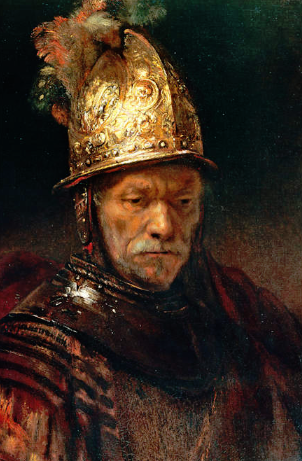
The Man in the Golden Helmet
(1650), Rembrandt


The mid-17th century paintings that I've chosen are three of my all-time favorite portraits. I do seem to gravitate towards portraits. Rembrandt is famous for having painted the most self-portraits though I love The Man in the Golden Helmet. It also inspired my work nickname 'Gelmet' which my co-workers gave me because of my gel hairdo. I often found people staring at the top of my head, much like how museum patrons might focus on the helmet in this painting.


Las Meninas (1656), Velázquez


There's something about this amazing family portrait by Diego Velázquez. To find out more, see my August 2020 post entitled Things That Go Together in Art – Subjects, Portraits, Landscapes/Seascapes, Still Lifes, and Couples. It does appear to have all the detail in the lower half of the painting, but it seems to work!


Girl with a Paearl Earring
(1665), Vermeer


This classic by Johannes Vermeer is known as the 'Mona Lisa of the North' probably because of her mysterious identity. Vermeer often employed blue and yellow in his detailed portraits, usually of women.


The Blue Boy (1770), Gainsborough

18th Century


Thomas Gainsborough and Sir Joshua Reynolds were rivals for the position of Painter to the King. On our trip to the UK in 2017, their paintings were curiously hanging side-by-side in one of the national galleries. Growing up in New Jersey, my next-door neighbor had a red sitting room where a copy of Gainsborough's Blue Boy was hung. One of the houses we rented in Port Townsend's Fort Warden had needlepoint versions of Blue Boy and Pinkie (by Thomas Lawrence) hanging side-by-side. The pair, often seen together, also appears in episodes of Leave it to Beaver just inside the Cleavers' front door entry.


The Age of Innocence (1788), Reynolds


I use portraits from Sir Joshua Reynolds and Gilbert Stuart when I do my wrapping paper self-portraits project with fifth graders. Included in one of the packets provided by Interurban Center for the Arts was his portrait of Lady Caroline (1778). The girl in this painting is unknown but is likely Reynolds' great niece.


Athenaeum Portrait
(1796), Stuart


It's unusual to find unfinished paintings on display in galleries and I've only ever seen one of them. I find it interesting that Gilbert Stuart intentionally kept one of his first portraits of George Washington unfinished to use as a model for later works. Martha Washington admired it, but Stuart refused her and painted another one instead.


Cenotaph to the Memory
of Sir Joshua Reynolds
(1833-6), Constable


19th Century


Another painting I saw at the National Gallery in London is John Constable's homage to Sir Joshua Reynolds. I enjoy seeing artwork in person, especially when it's something I've studied in school or researched for my blog or one of my classes. The stag is meant to represent the wild locale of the monument, which in actuality would have been smaller than a full-sized deer. It's up to the artist to create the focal point and provide it the proper emphasis.


Tiger in a Tropical Storm (1891), Rousseau


Here's another diamond in the rough from the National Gallery in London. It's a landscape by Henri Rousseau that could be perceived as a portrait of a tiger. Crouching tiger but no hidden dragon!


Les Oliviers (1889), Van Gogh
Of course, my all-time favorite artist has to be Vincent Van Gogh. It's difficult for me to choose a favorite. While doing research for this blog I continue to discover new (to me) Van Gogh paintings. For example, I saw this one at the Scottish National Gallery in Edinburgh. Like Van Gogh's Sunflowers, olive trees were another of his favorite subjects to paint.


I love the paintings of the French Impressionists, but there are too many for me to down select for this blog post. I also love the paintings of Henri Matisse and Marc Chagall. I highly recommend visiting their museums in Nice, France.

Capri Girl (1878), Sargent


Let's finish with the 19th century artists/paintings by including John Singer Sargent's portrait of Capri Girl. My daughter and I saw this work while briefly on exhibit at the Seattle Art Museum and we immediately fell in love with it. She appears to be leaning against the branch of a tree and gracefully becomes part of nature. Her bodice and hair blend into the dark background and her skirt disappears into the flowery field. She was a favorite subject of the artist.


Christina's World (1948), Andrew Wyeth
20th Century

My favorite artists of the 20th century are Salvador Dali, Pablo Picasso, Edward Hopper, Jacob Lawrence, Norman Rockwell, and Andrew Wyeth. Since we're primarily showcasing portraits here, and as a transition from Sargent's Capri Girl, I'm including Christina's World by Andrew Wyeth. His wife Betsy modeled for the painting inspired by the Olson (~30-yr-old) girl he saw crawling in the field.


President Obama (2018), Wiley


Kehinde Wiley is probably the best known African American portrait painter of the 21st century, although Simmie Knox was the first to paint the portrait of a President (Bill Clinton). I had the opportunity to see Wiley's paintings on exhibit at the Seattle Art Museum. I also got to see Jacob Lawrence's Migration Series, which was impressive but on a smaller scale than the large decorative works of Wiley. His intricate backgrounds are beautiful! While Lawrence used colorful shapes to build his symbolic compositions, Wiley used colorful patterns to surround and highlight his subjects.


So, who are your favorite artists? Your favorite painting? I find that I often choose to listen to the B-side of a record, straying from the more popular featured song. I also enjoy hearing the more obscure and less played selections (e.g., of Tom Petty songs) just as much as seeing newly discovered works by my favorite visual artists. As with music, you learn to love and appreciate many genres, though you will likely gravitate towards your favorites.

Sunday, November 13, 2022

Mona Lisa -- Mysterious Enigma, Misunderstood Masterpiece?

Mona Lisa (1503-06), da Vinci

While Leonardo da Vinci's Mona Lisa is perhaps the most famous painting of all time, attracting tens of thousands of viewers each day at the Louvre in Paris, it is also one of the most misunderstood artworks. Initially, the 3/4-view portrait of the supposed Italian housewife was copied by artists who admired it for its realism and "subtle gradations of light and shadow" (sfumato) employed by Leonardo. The imaginary background is also admired for its smoky quality, making it both landscape and portrait. Viewers are more taken in by her 'smile'.

Da Vinci produced the small portrait of an ordinary woman whom scholars identify as Lisa Gherardini, wife of the Florentine silk merchant Francesco del Giocondo. She is wearing a veil which is difficult to make out amidst the rest of the dark shades employed in her hair and costume. Other paintings of Florentine women typically show more opulent dress including jewelry and rosy cheeks. The subtlety of expression and apparent lack of eyebrows make her less interesting, though more mysterious, than her contemporaries.

LHOOQ (1919), Duchamp

It wasn't until its theft in 1911 that the painting began to increase in popularity. Even when I visited the Louvre a hundred years later, people crowded around a small window to view it deeply shrouded inside a secured chamber. Get ready for disappointment!

Perhaps it was Marcel Duchamp's kitschy mustached reproduction, mocking her as 'the ideal of feminine beauty', that reinvigorated its post-war popularity. My March 2020 post about Shamrocks, Bowler Hats, and Irish Artists shows Lisa wearing a bowler hat. I guess it's the mystery behind the painting, its theft, and the desire to see the real painting amidst all the reproductions that fuel the attraction. See more in the article, "Why is the Mona Lis so Famous?".

Girl with a Paearl Earring
(1665), Vermeer


Personally, I much prefer Vermeer's Girl with a Pearl Earring, also known as the 'Mona Lisa of the North' or the 'Dutch Mona Lisa'. A young Scarlett Johansson portrayed the subject (Griet) in the 2003 movie. A little publicity for the northern version!


The Cast of Mona Lisa Smile (2003)


Although I've seen several movies depicting Leonardo da Vinci as a character, I've yet to see one about his Mona Lisa. Curiously, there is the 2003 movie entitled, Mona Lisa Smile, which starred Julia Roberts as an educator, along with three other beauties. And a 1986 British crime-drama movie called Mona Lisa about a call girl.


Tomei as Mona Lisa Vito (1992)


In My Cousin Vinny (1992), Marisa Tomei costars as Mona Lisa Vito, the spunky and obstinate fiancée of Joe Pesci. Even the name of the famous portrait subject gets reused, perpetuating the title and its worldwide recognition! Let's not forget the song of the same name recorded by Nat King Cole in March of 1950.


So, would Mona Lisa be as famous without the somewhat anonymous name, enigmatic expression (the smile), theft attempts, or admired painting techniques? Maybe the mystery itself is what attracts us to it!

Monday, June 27, 2022

Artists' Beards, Mustaches, and Facial Hair

LAA Pitcher, Archie Bradley


I've been noticing the wild and often untamed facial hair of Major League Baseball of late while watching the Seattle Mariners on TV. Pitchers are known to 'paint' the corners of the strike zone. One of the more tamed beards belongs to Los Angeles Angels pitcher, Archie Bradley. It would fall into the category of a Garibaldi beard, after the famous Italian General Giuseppe Garibaldi.


LAA Outfielder, Brandon Marsh


LAA Outfielder, Brandon Marsh's is the polar opposite, including more of a Forest Gump look. 


Portrait of a Man in Red Chalk
(Early 1500s), da Vinci


It reminds me of portraits of old masters like Leonardo da Vinci and the statue of Michelangelo's Moses.


Impressionist, Camille Pissarro

M's Pitcher, Sergio Romo


Seattle Mariners pitcher, Sergio Romo's beard is also impressive, reminding me of Impressionists Camille Pissarro and Claude Monet, though opposite in color, like that of St. Nicholas. Romo's beard would be that of a Garibaldi style if it was less than 8 inches in length.


Autumn (1573), Arcimboldo


Artist, Giuseppe Arcimboldo's Autumn (1573) is a portrait of a man comprised of fruits and vegetables, including a beard made out of wheat.


Self-Portrait with Sunflower (~1633), Van Dyck

The van dyke style of beard popular in the 17th century was named after Flemish painter Anthony Van Dyck. Unlike the goatee, a van dyke is often pointed and also includes a mustache. You may remember the actor, Monte Woolley, from the 1942 movie The Man Who Came to Dinner co-starring Bette Davis. He also played an eccentric writer in The Bishop's Wife (1947) opposite David Niven and Cary Grant. Let's not forget General Armstrong Custer and KFC's iconic Colonel Sanders.


Dali Photographic Closeup


Often, it's the mustache that stands out most among the wearers of facial hair. One of the most iconic belongs to Spanish Surrealist Salvador Dali. I enjoy teaching about contrast and opposite colors to elementary school students using Dali's Persistence of Memory (1931). He was as eccentric as his unusual paintings, keeping an ocelot as a pet, and focusing on Sigmund Freud and his study of dreams. Perhaps he should have spent more time taming those bushy eyebrows!


Portrait of Joseph Roulin (1889), Van Gogh


Vincent Van Gogh and other artists painted portraits of men sporting muttonchops. This style of beard often leaves the chin area without hair and the mustache area also shaven. Hugh Jackman's X-Men character, Wolverine sports such a beard sans mustache. Such split beards are known as French forks.


Self Portrait Dedicated to
Dr. Eloesser 
(1940), Frida Kahlo


Another of my favorites is Mexican artist, Frida Kahlo, famous for her somewhat unique and iconic unibrow. Nowadays, even men will groom their eyebrows -- some may refer to them as 'metrosexuals'. Back in the day, when men let their beards grow wild, they also let their eyebrows and ear and nose hairs go untrimmed. In my opinion, if you're going to bother to precisely trim a mustache, goatee, or van dyke style beard, then you should also pay attention to those other wild areas. I'll forgive those who grow full beards as long as they occasionally trim them and always keep them void of food remnants!


Kenneth Branagh
David Suchet
Another mustache example is that of Agatha Christie's character, Hercule Poirot. I've been watching reruns of the 1989 TV series starring David Suchet as Poirot. His signature stache looks fake and almost plastic. The more recent Murder on the Orient Express (2017) and Death on the Nile (2022) films, starring Kenneth Branagh as the famous sleuth, created a much more believable, even spectacular, layered mustache, complete with soul patch.

(Apparently, Poirot's stache is meant to cover up scars from lacerations he suffered during a WWI explosion.)

Friday, May 27, 2022

Sketching and Drawing

White Cup and Saucer (1864), Henri Fantin-Latour
Everything is so instant nowadays. Instant photos, instant messages, instant coffee (not!). Remember when you did long division, or used a slide rule, before everything was made easier with a calculator? Or snapping a picture with a camera and waiting to develop the photos? How about whipping out a sketch pad and making your own impression of your surroundings? Today, we rely on a cellphone to readily capture what we see by clicking a button, never thinking of picking up a pencil and paper.

Portrait of Isabella d'Este
(1499-1500), Leonardo da Vinci


Sketching and drawing are lost arts. Yet, they are perfect examples of ways to settle your mind, reduce stress, and spend time observing the world around you. Artists use sketching to plan out their final paintings and to establish the value range of light to dark. They often focus on particular details, using them as components for later compositions. This approach helps cement the images in your mind for later retrieval. Da Vinci sketched this woman, using her costume and hand gestures later in his portrait of the Mona Lisa. Even musicians practice in jam sessions before cutting the final track.


You also need to sit down and focus your attention on a particular subject or scene, like these kangaroos from a zoo or wildlife setting. Begin with rough sketches and numerous studies. Take notes and some reference photographs or simply rely upon your own memories. Sometimes, just capturing various shapes of trees, shadows, and using shading to capture the direction of your light source is all you need. The arrangement of shapes composes an image. Having a black-and-white drawing allows you to experiment with the colors later, relying on your emotions and memories to depict a mood.


Van Gogh Sketches

In high school, a classmate and I would bring our sketchpads to sporting events and draw basketball players in action. My brother would sketch portraits of local professional baseball players. I remember going to a car dealership where some of the NY Yankees were doing a promotion, and my brother got Whitey Ford to sign his portrait. Vincent Van Gogh often included sketches in his letters to his brother, Theo.


Drawing of Jeju

Photo of Jeju

Photographs capture lighting and atmospheric conditions that may undergo change while trying to paint a scene outdoors (en plein air). Sketching, on the other hand, is interactive and very fluid, allowing you to experience the subject and etch it into your memory.


My Sketch / Painting

Photograph at Lake Sawyer

While sketching requires looking at a subject, it can also be completely made up from your mind. It helps to obtain an understanding of anatomy and proportion when sketching animals or human figures. Learning to rely upon quick lines and the ability to edit out unnecessary details simply takes practice. Start by working on the body of a subject, then fill in the background later. A finished drawing or painting will take much more time and practice to complete.


Final Painting of Dogs at Lake Sawyer

The paper you choose for drawing will usually be of higher quality than what you use for sketching. You can find sketch pads in a variety of sizes, textures, and finishes. Drawing paper is typically thicker and denser with rougher texture for grabbing graphite pencil, ink, charcoal, pastel, or other artistic medium. On watercolor paper, I suggest using a light colored pencil, while on a gessoed canvas surface I would use graphite pencil or charcoal. Such sketching is used more as a guide to laying out a painting, although my subjects (above) needed to be much more detailed.