Showing posts with label Picasso. Show all posts

Thursday, April 9, 2026

Artworks With Green


The Park (1910), Klimt


My first pic is a good transition from my last 'interview' post about the style of Robert Milaschewski, though meant to be posted for St. Patrick's Day. Here we see what could be described as a landscape, although dominated by tree crowns, with only a hint of tree trunks at the bottom. Instead, Gustav Klimt has used primarily a mosaic of green dots forming an abstract composition. It comes on the heels of the late nineteenth century movement, called Pointillism, which was developed by French artists, Georges Seurat and Paul Signac.


Green Wheat Fields, Auvers (1890),
Van Gogh


Here is a closeup taken from (the lower left corner of) Van Gogh's Green Wheat Fields, Auvers (1890), which was painted during the last months of the artist's life. When viewed without the upper half containing the sky and clouds, his green and white brushstrokes become abstracted, much like the dots in Klimt's leaves.


The Green Wave (1866-67), Monet


Unlike other happier Impressionist paintings (from his gardens), Monet's The Green Wave (1866-67) is painted in monochromatic teal green and black. Boats and the seaside were common themes for Monet, though usually calmer depictions of couples enjoying a leisurely outing. I would not have guessed this was his work!


Green Still Life (1914), Picasso


Although the green in Picasso's Green Still Life (1914) encompasses the entire background, it fits the theme of my post. I enjoy the patterned shapes on the wall and tabletop, giving life to the flat green shapes above which the objects would be floating without the black lines and suggested picture frame.


The Allure (1939), O'Keeffe


I was intending to show Georgia O'Keefe's Green Tree (1953), but it was almost too light for this category of green artwork. Then I found The Allure (1939), which is also known as Waterfall, No. I, Iao Valley, Maui. Her paintings of the Hawaiian landscape are reminiscent of her closeup paintings of flowers. The layers of the lush green mountains seem to be opening up to reveal the thin waterfall, as though it's the stamen of a flower.


The Green Dancer (1879),
Degas


Degas' The Green Dancer (1879) is complemented by the bright-orange clad dancers in the background. This isn't quite the green I was looking to highlight, though there's enough of the hue to warrant both the title of the painting and my subject. Degas does like to use diagonal lines in his composition and arrangement of the dancers' limbs. He has intentionally left the floor unadorned and in shadow.


The Green Christ (1889), Gauguin
The last painting, The Green Christ (1889), is by Paul Gauguin. It depicts a Brenton woman seated beneath a green-tinted statue of Christ's crucifixion. It represents a combination of several different 'calvaires' from various locations. Gauguin lived for a time in Brittany, a peninsula of northwestern France.

Like many of Gaugin's works, the subject stands out from the backgrounds, which he decorates with more lively colors. Green is sprinkled throughout. Even the other figures are green, and the woman's face has a green tint as if she is an ogress (from the movie Shrek!).

The black lamb she's holding in the bottom right corner is balanced by the dark water in the distance.

Sunday, January 11, 2026

Museums of Spain

Las Meninas (1656), Velázquez

I'm anxious to explore Madrid and Barcelona, Spain for the architecture, history, scenery, and of course the art museums. The Museo del Prado in Madrid would be the first place I'd like to visit. I am interested in the works of El Greco, Velázquez, and Goya, and as a bonus: Titian, Van Dyck and Rembrandt. It's always a welcomed surprise to find a Rembrandt! In 1656, as part of the royal court of King Philip IV in the Spanish Golden Age, Diego Velázquez painted his iconic Las Meninas. In the group portrait, images of the King and Queen are reflected in a mirror, while the Queen's attendant, José Nieto pulls back the curtain to let more light into the room through the doorway. Édouard Manet admired Velázquez as Painter of the Painters.


Assumption of the Virgin
(1515-18), Titian
Assumption of the Virgin
(1577-79), El Greco


Unfortunately, I missed the Prado exhibition that ended in June 2025 displaying El Greco's (Greek artist born Doménikos Theotokópoulos) Assumption of the Virgin. It resembles Titian's earlier Assumption of 1515-18.


Dogs on a Leash (1775), Goya
Another 'Assumption' painter is Francisco Goya, who, besides painting religious panels, also painted this portrait of two dogs on a leash. It's disturbing to see them chained together, as if being enslaved by the unseen hunter. The detail reminds me of the portraits of Sir Joshua Reynolds, famous for being the President and founding member of the British Royal Academy.


Modern and Contemporary Painters


The Elephants (1948), Dali

Other artists I would encounter are modern artists such as Dali, Picasso, and Miró. Salvador Dali has museums in Barcelona and Figueres (his hometown), Spain and St Petersburg, Florida. His works are also featured at the Prado in Madrid. When I teach art to elementary school students, I often use Dali's Swans Reflecting Elephants (1937) as an example of surrealism. Later, he conceived of this more futuristic version of gigantic elephants.


Robots of Star Wars


Makes you wonder if Steven Spielberg was a fan of Salvador Dali's dreamt up pachyderm-like figures.


Guernica (1937), Picasso

Pablo Picasso and Joan Miró works are also exhibited at the Prado. Picasso's Guernica was returned to the Museo Reina Sofía in Spain in 1981. It depicts the bombing of a town in the Basque country in Northern Spain in 1937 by Nazi Germany and Fascist Italy.


House with the Palm Tree (1918), Miró 


Born in Barcelona, Catalan Surrealist Joan Miró's paintings may be found in multiple Spanish museums and galleries. While The Farm (1921-22) may be seen in Washington D.C., you'll have to visit the Museo Reina Sofía to admire the earlier House with the Palm Tree (1918).


Harlequin with a Mirror
(1923), Picasso


While in Madrid, you may also want to explore the Thyssen-Bornemisza Museum. An exhibit of Warhol and Pollock artwork will be there until January 2026, with Picasso and Klee paintings through February 2026. I will surely miss those!  Harlequin with Mirror (1923) and Bullfight (1934) are apparently part of the museum's permanent collection, though the website says, 'not exhibited'. I guess you'll have to go there and see!


View onto a Square (1912), Klee
This rather primitive landscape by Swiss German artist Paul Klee is at Thyssen-Bornemisza Museum in Madrid. As you may have guessed it is chalk and crayon on paper and mounted on cardboard. He used gouache, an opaque, watercolor paint thickened with a glue-like substance. I can envision an art project for kindergarten thru 3rd grade students, using crayon or oil pastels to resist washes of watercolor paint, that would surely not intimidate the young artists.


After visiting France and Italy in 2011, the UK in 2017, and cruising the Baltics in 2019, I was able to check off several of the 14 must-see museums from my bucket list. The Prado is next! And, if I make it back to Florida, I will not miss the Dali Museum!!


Thursday, May 22, 2025

Melancholy, Sadness, Grief, and Loneliness in Art

It's been almost one year since the passing of my wife of >40 years. Spring flowers, as discussed in my previous post, bring me joy and remind me of my lovely wife, whose birthday is in early April. On the flip side is the loneliness I'm experiencing, along with the sadness and grief of losing the love of my life.

The Honorable Mrs. Graham
(1777), Gainsborough


Thomas Gainsborough's portrait of The Honorable Mrs. Graham was commissioned by Mary's husband, Thomas, though she died a few years later of tuberculosis after he attentively cared for her throughout her illness. Sadly, he couldn't bring himself to look at her portrait after her death, and he lived for another 50 years. I may have seen this painting in the Scottish National Gallery when we visited Edinburgh in 2017.


Sorrowing Old Man (1890),
Van Gogh


Most of my favorite artists were Impressionists, with their soft, yet vibrant colors, peaceful landscapes, and portraits. Van Gogh's At Eternity's Gate (a.k.a. Sorrowing Old Man) shows a tired, worn-out man seated beside a warm hearth and possibly contemplating life after death in heaven. The chair resembles the one in the painting of Vincent's bedroom. I believe both men were residents of the asylum at St. Rémy, where Van Gogh spent the last two years of his life battling mental illness.


The Old Guitarist (1903), Picasso


In my post, Making Connections with Artists & Animals, I highlight Picasso's The Old Guitarist, which I like to use in my art lesson plans. It frequently appears in episodes of Bewitched, which I have watched repeatedly in reruns. It was hung rotated 90 degrees to the right to fit over the Stephens' fireplace. I like to ask my students which orientation is correct and which they like best. Picasso began to paint figures of the downtrodden (like this blind, poor guitarist) in response to the death of his close friend, Casagemas.


Christina's World (1948), Wyeth

Probably my favorite American Realist artist is Andrew Wyeth. In my post entitled, Farms and Barns by Famous Artists, he is described as "an actor being typecast for a specific role, who struggles to be recognized for his other works, and is forever remembered for a single character". Christina is a disabled young woman in a field of grass. You may recall his obsession with Helga, who was his most often painted model.


Nighthawks (1942), Hopper
In a repeated commercial for the Looney Tunes Sylvester & Tweety Mysteries series, the backgrounds that fly by remind me of the paintings of Edward Hopper. Nighthawks depicts a late-night diner with four lonely people. There's a takeoff painting with James Dean, Humphrey Bogart, Marilyn Monroe, and Elvis Presley as the soda jerk behind the counter. A Simpsons episode, "Homer and the 18th Amendment" also spoofs the famous painting.


Hotel Room (1931), Hopper
Automat (1927), Hopper

Many of Hopper's images are melancholic, especially Automat and the Hotel Room. In both paintings, a young woman is seated alone, one at a restaurant table at night, and the other in a small hotel room during the day. They share a similar color scheme, perspective, and strong contrast of light and dark.


The Scream (1895), Munch

Norwegian Expressionist Edvard Munch is often considered to be the melancholiest artist of all time. His paintings dealt primarily with death, as many of his family members suffered and died from lung disease such as tuberculosis and some of his subjects from polio and syphilis. He (like Van Gogh) also suffered from mental illness, probably from experiencing trauma early and throughout his life. The Scream is sometimes referred to as the Mona Lisa of its time and is clearly one of his most recognizable works. I didn't realize that it was pastel-on-board. Apparently, in 2012, it sold for $120M. It is also considered to be his self-portrait, that of a mad man, although he has painted the figure asexually and almost inhuman, like a space alien.


Pocket Poodles (1962), Keane


The final painting I want to share is by 'Big-Eye' artist Margaret Keane, whose second husband tried to take credit for her paintings (Can you believe that!?). Tim Burton's 2014 biopic, Big Eyes starred Amy Adams as the blonde artist. Pocket Poodles (1962) is a portrait of a sad young girl holding two small dogs. You may find such portraits cute, but I think they're a little creepy. In my grief journey, I am blessed to have the comfort of my own two Shih-Tzu fur babies, without whom I'd be lost!

Friday, April 19, 2024

Owls in Art & Photography

Photo (2024),
McDonald


In May of 2021, I posted about Birds in Contemporary Art and Photography. Today, I am inspired by a photograph taken by my nephew while stationed in Kuwait. It is a Pallid Scops Owl, one of six species found there.


My Michigan sister-in-law professionally photographed this Snowy owl. It migrates from Canada to Michigan in the Winter. There are at least seven other kinds of owls found in Michigan: Barred owl, Great Horned owl, Northern Hawk owl, Eastern Screech owl, Long-eared owl, Northern saw-whet owl, and the Burrowing owl.


I've researched artists famous for painting owls and here's what I found:


Detail from Garden of
Earthly Delights,
Bosch

Perhaps the earliest and creepiest paintings of owls were done by Dutch artist, Hieronymus Bosch, famous for his tryptic Garden of Earthly Delights (1503-15). His tiny owl peers out from a log hidden amidst an otherwise busy menagerie of fantastical creatures and figures.

"Owls were generally associated with menace and death and had an emblematic, moralistic significance."


A Snowy Owl, Tunnicliffe


British Naturalist painter and etcher, Charles Frederick Tunnicliffe (1901-1979) is famous for painting birds and other wildlife. I like the white and black bird against the background's subdued color palette.

See  Royal Academy link to copyrighted Tunnicliffe paintings and etchings.


Wood Owl (1968),
Picasso 


Fun fact: Pablo Picasso rescued an injured owl and kept it as a pet that became the inspiration for a series of Picasso's whimsical painted ceramics.


See British wildlife artist, Robert Fuller's (1972) My Collection of Barn Owl Paintings. What I appreciate about owls is their ability to blend into their surroundings. Note the amber color highlighting its wings and repeating in the tree trunk's moss. It's like they camouflage during the daytime, and except for their eyes (and hoot) are pretty much invisible at night.


Barn Owls, Immature, Jamie Wyeth


Jamie Wyeth (1946-), son of Andrew Wyethpainted Immature Barn Owls in 2006. While the owls themselves are somewhat ghostly, the artist was successful at showing them hiding in the shadowy rafters of the barn.


AB Owl (2023), Patterson 


My 'owl' pumpkin was inspired by Angry Birds. I was going for eyes that got lighter and lighter with each concentric ring. Anyway, I'm happy with the final effect!


Sunday, April 30, 2023

My Favorite Landscapes with Trees

Landscape with Trees (1881), Van Gogh

Vincent Van Gogh is known for his post-Impressionist works that used bright, bold colors and emotionally expressive brushstrokes. Sometimes we stumble upon paintings that seem less characteristic of a very familiar artist. Here, in Landscape with Trees (1881), Van Gogh captures this autumn scene using a more monochromatic palette than usual. Such uncharacteristic Van Gogh paintings using charcoal and watercolor wash are from 1881-86 while he was in Holland.


Cypresses (1889), Van Gogh


Perhaps more popular are Van Gogh's paintings of cypress, olive, and almond trees. I love his Starry Night and Wheat Field series painted from 1889-90, showing compositions that included pairs of iconic cypress trees. I love the familiar swirling brushstrokes in Cypresses (1889). I featured one of his very last paintings, entitled (olive) Tree Roots (July 1890), in my April 2021 post Artists Who Died Young (like Van Gogh).


Almond Blossom (1890), Van Gogh


Van Gogh often took inspiration from other artists (e.g., Millet), copying their works and making them his own. He studied Japanese art and gifted his Almond Blossom to his brother Theo and sister-in-law Jo on the birth of their son, Vincent Willem. The early Spring flowers symbolized new life. His nephew founded the Van Gogh Museum (The Rijksmuseum) in Amsterdam in 1973, five years prior to his death.


Jean-François Millet's The Gleaners (1857) inspired my Layered Landscapes art project used to teach fifth graders about perspective. In it, students drew three trees ranging in size and emanating from three hills. We chose a color scheme of analogous colors using blended oil pastels.


Two Trees (1907-8), Picasso


Perhaps I could have shown my students Picasso's Two Trees as a way of encouraging their own abilities to draw trees. Though not one of my favorites, it depicts trees using watercolors and in Picasso's Cubist style.


Blue Poles (No. 11),
(1952), Pollock
Four Trees (1891), Monet
In 1891, Claude Monet painted a series of poplar trees. His Four Trees reminds me of Jackson Pollock's Blue Poles due to the repeated shapes resembling Monet's poplars.


Chestnut Trees at Louveciennes
(1870), Pissarro
Chestnut Trees at Louveciennes
(1872), Pissarro
Camille Pissarro painted apple, walnut, and chestnut trees in his impressionistic style. Which one do you like best? I think the one on the right may have inspired one of Dali's later surrealistic works.


Swans Reflecting Elephants (1937), Dali


When teaching about Surrealism and Salvador Dali, I use his Swans Reflecting Elephants (1937) as a warm up challenge for my fifth graders. Of course, I keep the title hidden. I wonder what kind of trees Dali was thinking about when he dreamt up this scene.


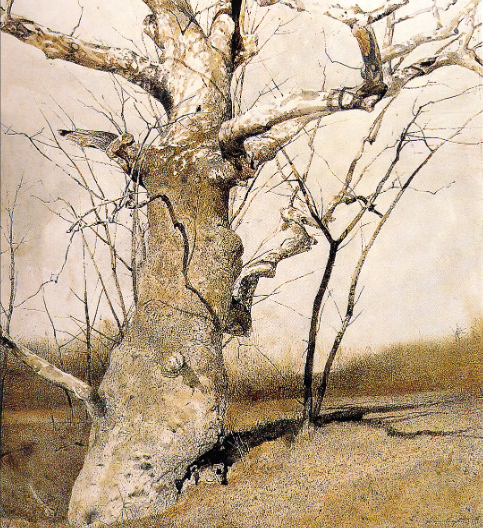
Sycamore (1982), Andrew Wyeth


This barren sycamore tree is recognizably the work of Andrew Wyeth. Wouldn't it be awesome to encounter such a magnificent and quirky tree on a walk through the Pennsylvania countryside of the Brandywine Battlefield?


Cairn in the Snow (1807), Friedrich


I also love 19th century German painter Caspar David Friedrich's (1774-1840) romantic landscape, Cairn in the Snow (1807). The subject is a pile of rocks (cairn) which is also known as a dolmen or a giant's grave (in the snow).


Capri Girl (1878), Sargent


My all-time favorite tree painting is by American portrait painter John Singer Sargent (1856-1925). It's a portrait of a favorite subject, Rosina Ferrara (a.k.a. Capri Girl), leaning on a birch tree. My daughter and I saw it on display at the Seattle Art Museum and couldn't stop looking at it. 

Thursday, December 8, 2022

Our National Gallery of Art in DC

Majorcan Fisherman (1908), Sargent

John Singer Sargent in Spain

Recently, my daughter attended a professional conference in Washington D.C. and took the opportunity to visit several museums. She shared her photos of famous works on exhibit at the National Gallery of Art. Curiously enough, there were two exhibits of one of our mutual favorite artists, John Singer Sargent, while on one of his seven trips to Spain (1879-1912) to study Velázquez. His painting of a Majorcan Fisherman is particularly captivating and unlike many of his other portraits, usually of women, and typically with a darker color palette. It reminds me of Renoir's Luncheon of the Boating Party (1888) with its canopy and view through to the water in the background. I love the shadows and the sharp contrast of the dominant orange tones with the striking blue of the water.


Newly Discovered Art & Artists

Blue Morning (1909), George Bellows
Another American artist, George Wesley Bellows (1882-1925), painted a similarly framed landscape looking out over water. He is famous for painting urban life in New York City. His Blue Morning scene is reminiscent of Edvard Munch's sad depictions of mine workers returning home in the snow. Here, the column, fence, and shadows frame a silhouetted portrait on a foggy morning. The 'blue' may represent either the color of the water or the sadness of the workers. This is the last of four paintings Bellows made from 1907-1909.


Street of Barns (1914), Feininger


German American painter, caricaturist, and comic strip artist, Lyonel Feininger grew up in New York City. He was a proponent of Expressionism, painting buildings, street scenes, and barns. His figures are elongated much like those painted by fellow German Expressionist, Ernst Ludwig Kirchner. At first blush, I thought this painting was one of the works by Cubist George Braque. I guess I need to practice guessing artists using Artle - the daily art exploration game created by the National Gallery of Art (it's free!).


Still Life (1918), Picasso
Peonies (1901), Picasso
Speaking of Cubists and other Expressionists, The National Gallery of Art was also showing several works by Pablo Picasso. Besides his recognizable Harlequin Musician and The Lovers, also on exhibit were Still Life and Peonies. I hadn't realized that Picasso painted these flowers. Normally, Manet and Monet are the artists whom I associate with them.


Impressionists

Children Playing on the Beach
(1884), Mary Cassatt


Many of the French Impressionists' works are also on display at the National Gallery of Art in Washington D.C. My daughter took photos of the works of Mary Cassatt, Édouard Manet, Henri Matisse, Claude Monet, Camille Pissarro, Georges Seurat, and Pierre Auguste Renoir. I love the innocence of Cassatt's Children Playing on the Beach (1884). Her portraits are some of my favorites -- they are timeless.


The Railway (1873), Manet


Édouard Manet preferred painting portraits, and I'd call him a French Realist. Here in The Railway we see a portrait of a mother and child waiting at the train station. I am distracted by the bars of the iron gate as well as the stitching in the mother's coat. Perhaps the daughter is dressed up to receive her father from the train. Did you notice the puppy cuddling in the woman's lap?


Still Life with Pineapple (1924), Matisse


Fauvist Henri Matisse is responsible for many colorful still lifes, and I especially like this one with a pineapple. We were lucky enough to visit his museum while in Nice, France in 2011. Like contemporary artist, Kehinde Wiley, Matisse backgrounds are always very interesting.


Woman with a Parasol - Madame
Monet and Her Son
(1875), Monet
The Artist's Garden at
Vétheuil
(1881), Monet


Like Manet, Claude Monet used members of his own family as his subjects. We also visited his garden at Giverny in 2011. Quite impressive!


Landscape, Ile-de-France (1873), Pissarro


My daughter knows how much I appreciate the works of Camille Pissarro, His works transcend all of the various Impressionist movements, although he is often referred to as a Neo-Impressionist. His version of Monet's haystacks is equally impressive.


Seurat Retrospective, Georges Seurat


The exhibition also featured a sort of retrospective wall showing the work of French Post-Impressionist and Pointillist, Georges Seurat. Of course, A Sunday Afternoon on the Island of La Grande Jatte (1884-86) is probably his best-known Pointillist works, made famous by the play starring Mandy Patinkin.


A Girl with a Watering Can (1876),
Pierre Auguste Renoir


It's always fun to find familiar artwork at the museum you're visiting. Here's probably the most famous Renoir, A Girl with a Watering Can (1876). I seem to focus on the girl's upper half with the red bow and the blue and white dress, but I never really noticed the watering can. And I consider myself very observant!


More 20th Century Artists

Ground Swell (1939), Edward Hopper
So, luckily my daughter took photos of four more of my favorites, who are more modern and contemporary than those of the French painters you usually spot at art museums. These artists are Edward Hopper, Wassily Kandinsky, Joan Miró, and Lee Krasner (wife of Jackson Pollock).

I love Hopper's clean and confident style. His paintings have no frills, little shading, and calming areas of color that capture a moment and illicit relaxation for the viewer. 


Head of a Catalan Peasant
(1934), Joan Miró
Improvisation 31 (Sea Battle)
(1913), Kandinsky

I love Abstract Expressionism and the playful compositions of Kandinsky and Miró. Whether I am teaching kids or seniors to make colorful Kandinsky concentric circles or cutting out shapes to make Miró balanced compositions, it is always fun to find new masterpieces to share with them as examples for our projects.


Cobalt Night (1962), Krasner

It's surprising how many of Jackson Pollock's work I've seen at various art museums. Like Kandinsky, his compositions are usually numbered and mention the dominant color used in the painting. While vacationing in Palm Springs, I saw the exhibit of the 12 Women of Abstract Expressionism, including some works by Lee Krasner.


I hope you enjoyed this post about some of the 'most important' works currently on display at the National Gallery of Art in D.C. While in St. Petersburg, Russia in June 2019, our tour guide only showed us the 'most important' artwork because of the vast number of pieces at the Hermitage Museum. While I certainly appreciate seeing those, I still enjoy stumbling upon those diamonds in the rough, lesser known or seldom seen works, and even those by artists I've only recently discovered. This is how we learn and grow in our ability to appreciate visual art!