Showing posts with label Lawrence. Show all posts

Monday, May 22, 2023

Indigenous Art - Animals


In this post, I will cover a small portion of Indigenous American and Canadian art. I am fascinated by the red, black and white graphical images of animals by various Indian tribes. Although I would love to attempt to produce such drawings, I respect that such art forms belong exclusively to native cultures. I love this Gitxsan (Canadian) Eagle for its symmetric composition and use of positive-negative space.


Front of Helmet
Inspired by a Seahawks football helmet, here is a jack-o-lantern that I carved one Halloween. I carved the Seahawks emblem around the sides and back of the pumpkin.

Back
Side


This Haida graphic includes a fish and the heads of an eagle and a wolf. I appreciate how the arrangement fits nicely inside a circle shape. Notice how the artist incorporates the eagle's wing, the wolf's claw, and the fish's fin and tail.


This wolf may have been drawn freehand by a high school student in an art class. I love the repetition of jagged black and red positive shapes. The negative white space fits them together (like a puzzle) to make the wolf head.


Another Halloween I found this amazing pumpkin carving of a wolf head. That year, I decided to do a Day of the Dead (Día de Muertos) skull and a raven instead.


I also found animals such as buffalo and bears captured uncommonly in indigenous graphics.
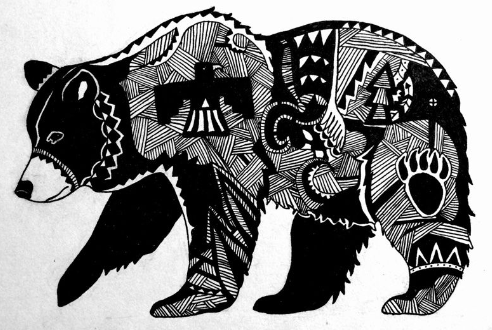


This bear is done in black and white and would make a great animal art project for fifth graders. I would have my students divide their animals into shapes, then fill them in using Zentangles. I appreciate the inclusion of native symbols: eagle, bear paw, tree, and mountains.


Salmon symbolize determination and perseverance. These fish miraculously find their way in turbulent rivers to spawn upstream. Metaphorically, they help us find our way in life and reach our goals.


Aboriginal artists use repetition of dots to decorate Illuka animal designs. Here, a reddish orange, black, and white-outlined eagle is beautifully surrounded by a sky using contrasting shades of blue. The addition of hands repeats the outstretched feathers of the bird's wings.


The flute playing character Kokopelli, more human than animal, represents the fertility god of Hohokam, Yuman, and ancestral Puebloan peoples of Southwestern America. Kokopelli is basically a stick figure adorned with a feathered headdress and flute. I had created a project for third graders using Kokopelli figures, but sadly my hosting teacher passed away before I could teach the lesson. I once gifted her a book of Aesop's Fables containing animals drawn by Jacob Lawrence.


I dedicate this post to my niece's 3rd grade teacher, Geriann Holmes Marchio, who passed away in November of 2019.

Tuesday, January 10, 2023

MLK Jr -- Portrait of a Dreamer

MLK Jr. (2017), Glenridge
August of 2023 will mark the 60th anniversary of the 1963 March on Washington for Jobs and Freedom and Martin Luther King Jr's I Have a Dream speech. In February of 2017, a classroom of students from Glenridge Elementary School enlarged a photograph of MLK Jr. and posted it on a bulletin board in one of its hallways. It is a fun way to teach students about value range. My project used a black-and-white poster of Elvis Presley.

MLK Jr. (1962), Karsh

It turns out to be from the famous 1962 portrait by photographer Yousuf Karsh (1908–2002), on display at the National Portrait Gallery, Smithsonian Institution, in Washinton D.C. There is an I Have a Dream (2012) children's book with illustrations by artist Kadir Nelson. My brother has a book by Nelson with paintings of the Negro Leagues, some of which we saw at the Baseball HOF in 2019.

My First Year of Blogging: Teaching Art, Travels, and Observations, from August 2020, also includes MLK. Elvis, JFK, and de Kooning.
JFK (1965), de Kooning

JFK (1960), Rockwell

That same year, President John F. Kennedy was assassinated on November 22nd in Dallas, Texas. I remember it because it was my parents' wedding anniversary and my first-grade teacher cried when the announcement came over the PA system. Five years later, on April 4th, 1968, Martin Luther King Jr. was assassinated in Memphis, Tennessee. Norman Rockwell (1960) and Elaine de Kooning (1965) painted a series of portraits of the 35th President.


The Problem We All Live With (1964), Rockwell


In 1964, Norman Rockwell painted The Problem We All Live With, depicting six-year-old Ruby Bridges being escorted to an all-white elementary school during the New Orleans school desegregation crisis of 1960. Notice the racial slur and the tomato-stained wall.


Aesop's Fables (1970)
Dixie Café, (1948), Lawrence

The Smithsonian is a great place to view historical paintings. Here's one dealing with segregation by Jacob Lawrence. While I enjoy his colorful paintings, his compositional works in black-and-white are particularly striking. I gave a book (right) with such illustrations by Jacob Lawrence to my niece's 3rd-grade teacher.


Stone of Hope (2011), Lei Yixin


In August 2011, the Martin Luther King Jr. Memorial opened to the public in Washington D.C. Chinese sculptor Lei Yixin's inspiration came from a line from MLK's I have a Dream speech -- "Out of the mountain of despair, a stone of hope."


RFK (1972), Leroy Neiman


A month before his death, President Kennedy gave his own version of the I have a Dream speech. It was meant to be a call to action reminiscent of his inaugural address where he said, "...ask what you can do for your country." His brother (and Senator) Robert asked us to "Dream Things That Never Were". RFK's social justice agenda specifically targeted the poor and disadvantaged, while JFK's speech was about his desire for peace in his country, and MLK's speech dreamt of personal freedoms and a world free of discrimination. It's unfortunate that these three dreamers were singled out by fame-seeking assassins.


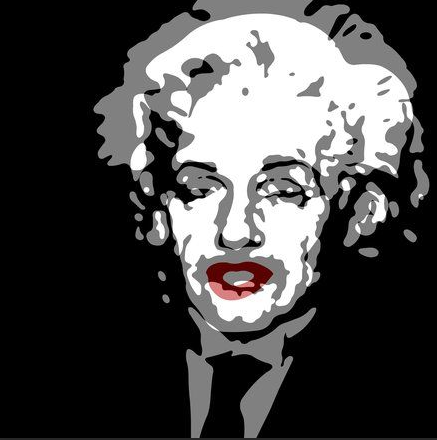
Brains and Beauty (Einstein
and Monroe), Troy Gua
Thomas Alva Edison (1890),
Abraham Archibald Anderson
You don't have to be a religious leader (like MLK Jr.), a politician (like JFK or RFK), an artist (like Jacob or Leroy), a scientist or inventor (like Edison or Einstein), a novelist or songwriter to be a dreamer.


Often, dreams lead to discoveries, breakthroughs, and even Nobel Prize winning contributions to the world. They reflect our personal values, behavior and aspirations to do good in the world.

Pablo Picasso was quoted as saying, "Action is the foundational key to all success."

Vincent Van Gogh may have said, "I dream my painting, and then I paint my dream."

I don't know who said it, but I like this quote: "Every possibility begins with the courage to imagine."

"You see things and you say, 'Why?' but dream things that never were, and I say, 'Why not?'" by George Bernard Shaw.

"Art has the power to transform, to illuminate, to educate, inspire and motivate." So have the courage to dream and share your art with others. Edgar Degas said, "Art is not what you see, but what you make others see."

Sunday, September 4, 2022

Artists Born Under Virgo or Libra

Chrysanthemums (1874-6), Tissot

To start posting for the month of September let's look at artists born under the Zodiac signs of Virgo (Aug 23rd thru Sept 22nd) and Libra (Sept 23rd thru Oct 23rd). Virgo artists are hardworking, intelligent, and adventurous, having traits including rational thinking, problem-solving, and an adventurous spirit. Libras, unlike other introverted, unsociable artists, are social butterflies who are outgoing and charming. Libras also have great taste in art and fashion.

French artist, James Tissot (1836-1902), born (in October) under the sign of Libra, painted Chrysanthemums, shown here as the floral symbol for the sign Virgo. Tissot was a friend and mentor of Edgar Degas.


VIRGOS

Thunderstorm (1948), Grandma Moses

One of the most famous American artists born (September 7th) under Virgo is Grandma Moses (1860-1961). She appears in my January 2021 post entitled, Master Artists -- Inspired Late Bloomers and Resilient, Active Seniors. She turned to painting when arthritis kept her from doing her elaborate needlework, but she kept her 'primitive' style. Teachers may use her work as an inspiration for a lesson about the elements of a landscape for younger children. Older children will need to learn the principles of perspective and proportion, not present in her work, for learning about space.


Constellations (1938), Hans Arp


German-French Sculptor, painter, poet, Jeans Hans Arp (1886-1966) was born September 15th. His Constellations linoleum cut is reminiscent of the biomorphic shapes used by (Capricorn) Henri Matisse. Years ago when I taught my daughter in her 6th-grade classroom, my students traced a Matisse shape and were asked to design a composition around it.


Mecklenburg Autumn (1979), Bearden


American artist Romare Bearden (1911-1988), born September 2nd, is famous for collages using photographs and painted paper in a style derived from Cubism. His work also depicts American black culture like his colleague, Jacob Lawrence. Another great artist for studying the art of collage would be American painter, (Libra) Robert Rauschenberg. I use collage for doing wrapping paper self-portraits, which could also be inspired by portrait artists: Amedeo Modigliani, Gilbert Stuart and Sir Joshua Reynolds.


The Migration Series (1941),
Jacob Lawrence
Felix (inspired by N.C. Wyeth)

In 2017 I visited the Seattle Art Museum and saw the exhibit, Jacob Lawrence: The Migration Series. Born September 7th, 1917, his work chronicled the migration of African Americans from the rural South to the industrious North in the decades following World War I.

Here's a project inspired by N.C. Wyeth that was designed to demonstrate the concept of movement. It would also work for a lesson about Jacob Lawrence. The challenge is cutting out the figures, so this lesson works best with 5th- or 6th-graders.


LIBRAS

Medusa (1597), Caravaggio


My first Libra artist is the controversial Italian painter, Caravaggio (1573-1610), born September 28th. He appeared in my March 2020 post entitled, Artist Frenemies - Friendships, Rivalries, and Competition, about his feud with artist Giovanni. Libras are supposedly non-confrontational although I imagine that Caravaggio exhibited the extremely emotional side of the sign. I've seen his artwork in several museums, but it may be somewhat inappropriate for younger viewers.


The Raft of Medusa (1819), Géricault 

This next artist is French painter and lithographer, Théodore Géricault (1791-1824), born September 26th. His epic masterpiece, The Raft of Medusa (1819), is often compared to Delacroix's Liberty Leading the People (1839). Both are good examples of Romanticism, a movement characterized by intense emotion. A young Delacroix (Taurus) actually posed as one of the dying figures on the raft!


No. 1 (Royal Red and Blue)
(1954), Mark Rothko

Libra Mark Rothko (1903-1970), was an American artist, born September 25th, who was famous for his abstract color field paintings designed to evoke emotion from viewers. While initially studying Architecture in college we did many color studies in order to explore color combinations and the optical effect of placing them adjacent to each other. Another Libra artist whose work I don't claim to understand is Robert Rauschenberg. His three-panel White Painting (1951) is particularly unusual and rather uninspiring!

I focus a lot on art history and researching various artists to add interest to my art lessons. And it's important to find inspiration when creating art! I hope this group of artists inspires you to create your own artwork or delve deeper into learning about these artists and their art movements and styles.


Wednesday, June 23, 2021

Weddings in Famous Paintings

Peasant Wedding (1567), Pieter Bruegel the Elder
June has traditionally been one of the most popular months for weddings, along with September and October. However, the subject is not so commonly captured on canvas. Flemish artist Pieter Bruegel the Elder famously painted his Renaissance peasant scenes in red and gold, celebrating wedding feasts and dances. I once owned a print of Bruegel's Peasant Wedding.

I also enjoy his painting, The Wedding Dance (1566).


The Bridal Pair with The Eiffel Tower
(1939), Marc Chagall


Although Russian-French artist, Marc Chagall, is clearly one of my favorites, some of his wedding paintings are a little too dark for my tastes. I prefer this dreamlike painting where the bride and groom are floating in the air. Though many of Chagall's paintings typically employ religious symbolism, here he uses nursery rhymes, including farm animals like the oversized rooster.


The Wedding (1948), Jacob Lawrence

American painter, Jacob Lawrence uses African-American themes from historic events and contemporary life, though I was only able to find one painting of a wedding scene, courtesy of The Jacob and Gwendolyn Lawrence Foundation, Seattle. It definitely reflects his style that has been dubbed, "dynamic cubism". I appreciate his use of color and patterning but wish his figures were more distinct. For example, I can clearly see cufflinks and the thin red binding of a bible (?) but not the minister's face. It's like he is bowing his head or maybe even facing the altar.


The Wedding of the Bohemian (1925-26), Munch


Edvard Munch also painted his version of a wedding feast. This painting was at the Munch Museum in Oslo where we visited in June 2019, though I honestly don't remember seeing it. He has painted himself into the scene, apparently seated at the far left or possibly in the background. While the feast looks happy enough, the people do not.


The Wedding Party (1905), Rousseau


Henri Rousseau's The Wedding Party is a rather unusual photographic wedding portrait of a white bride surrounded by people dressed in black. The black dog in the foreground seems to upstage the bride, although apparently it is meant to be a trick to draw your eye deep into the composition (a repoussoir). The overlapping of the figures is also strange and makes the bride appear to be floating at the dead center.


For more wedding paintings, please visit Janet Howard-Fatta's blog article, Artists and Wedding Paintings Throughout History. The Art Gorgeous has also published The Best Weddings In Art History. The second link displays Kahlo's portrait of her and husband Diego Rivera, which I referenced in my post entitled, Things That Go Together in Art – Subjects, Portraits, Landscapes/Seascapes, Still Lifes, and Couples.