Showing posts with label Tsutakawa. Show all posts

Thursday, July 21, 2022

More Artist Jeopardy

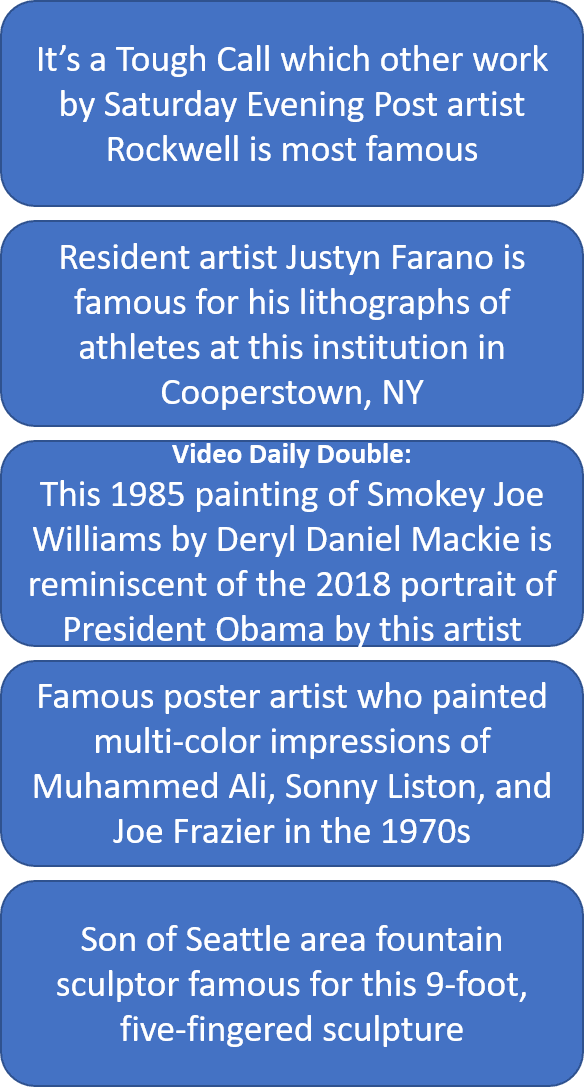
Back in February of 2020, I posted Artist Jeopardy. As a follow-on challenge for both Jeopardy fans and art enthusiasts, here are four more categories to test your knowledge of famous artists. I'll start with my own Jeopardy bio-story.

I’ve been watching Jeopardy since Art Fleming hosted it prior to my high school graduation in 1975. I’ve written several of my own Jeopardy answers over the years. My first game was in 1992 in honor of my parents' 40th wedding anniversary; the answers were all about their married life and Mom won. Fun fact: Mom was a 3-day winner on Concentration (with Host Hugh Downs) when I was in the first grade.

My next game was in the late 1990s with several Art categories that I presented on behalf of the Interurban Center for the Arts in my version of their Projects, Projects class taught to prospective elementary school parent volunteer art docents. Then, in 2005 during my City University Master’s Program, I played Jeopardy Host, Alex Trebek in a version of the game devoted to the subject of Project Management. So, I’ve been part of the game for over 50 years! Maybe I should become a writer for Jeopardy!! Do they even have guest writers?

And the categories are...


WOMEN OF ABSTRACT
EXPRESSIONISM


THE ART OF BASEBALL

For the Video Daily Double


ARTIST'S MUSEUMS

(Name the City)


FATHERS OF ART

MOVEMENTS


Tuesday, October 5, 2021

Art Inside and Outside the Ballpark

Portrait within Seattle Times Pic
The Seattle Mariners


In honor of a great season of Seattle Mariners baseball I am posting about the artwork inside and outside of T-Mobile Park. As game #162 could be the last time we see third-baseman Kyle Seager play baseball as a Mariner, let's take another look at his portrait painted by artist Jeff "Weirdo" Jacobson for the 2018 Mariners Care Auction. I actually pasted the portrait inside 3rd base in a recent photo from the Seattle Times. Taking away 3rd base is hardly consolation for 10 years of Mariners baseball, though hopefully it means something to him and his family.


Edgar (2021), Lou Cella


Outside the park there is the newly installed statue of HOFer Edgar Martinez. It joins the one at the main entrance to T-Mobile Park dedicated to Ken Griffey Jr. Let's also not forget The Mitt, by Gerald Tsutakawa. These and others also appear in my recent post entitled, Edgar Statue, HOFers Murals, and Other Ballpark Art. I took this image from the Seattle Times and cropped it to use on my phone's lock screen. The tarp makes it look like the figure is emerging from a block of stone.


Other Large Art Installations


I also love all of the steel cutout figures of player silhouettes attached to the gates and fences around the outside of the stadium. One of our neighborhood playing fields has been decorated with figures representing multiple sports. My favorite has to be the fences and gates surrounding the city dog park in Palm Springs, CA. Dog faces and figures are actually incorporated into the structure created by sculptor Phill Evans.


Neon scribbles by Cerith Wyn Evans
I appreciate the large installations like the The Tempest that hangs in the main concourse at the Home Plate Gate. The centerpiece of the rotunda includes translucent baseball bats "molded of resin and mounted on brushed aluminum spiraling forms". See the Art-in-the-Park link at the top of this post. I am equally impressed when I find other modern installations like the neon light sculpture hanging in London's Tate Britain entrance.


Entrance to Vigeland Sculpture Park, Oslo

I'm not going to show the nude male figures sculpted in wrought iron on one of the gates in Oslo, Norway's Vigeland Sculpture Park. However, I certainly can show the intricate park entrance. Not a baseball park, but equally impressive iron work and tons of sculptures inside the park!


Brandenburg Gate w/ Quadriga, J.G. Schadow

Speaking of gates, the Brandenburg Gate in Berlin, Germany is also impressive. We luckily got to visit it while on our cruise to seven countries (including Norway) along the Baltic Sea. Atop the structure you can see the sculpture by Johann Gottfried Schadow. Quadriga is a chariot drawn by four horses and driven by Victoria, the Roman goddess of victory. How 'bout that Mariners victory against the A's on 27 September! They actually beat Oakland 12 games in a row.


More Baseball Tributes

Cal Ripken in Wax


While visiting the Baseball HOF in Cooperstown, NY in July 2019 for the induction of Edgar Martinez, we saw lots of great baseball art. Here in the doorway of the Heroes of Baseball Wax Museum is a figure of Cal Ripken. We didn't actually go inside the museum and I am certain there was much more art to be seen outside of the HOF itself and in the surrounding town. Maybe someday there will be a similar tribute to Kyle Seager!


Babe Ruth & Ted Williams, Baseball HOF


My favorite sculpture inside the HOF is the side-by-side life-size basswood figures of Babe Ruth and Ted Williams. The artist, Armand LaMontagene, hit this one out of the park!


Babe & Ted
Closeup of Ted & Babe

Gehrig, Robinson, and Clemente

These three HOF celebrities -- Lou Gehrig, Jackie Robinson, and Roberto Clemente -- were immortalized together inside the hall in 2008 with bronze statues by sculptor, Stanley Bleifeld.

Kyle Seager has been deservedly nominated  for the 2021 Roberto Clemente Award.

Sunday, August 29, 2021

Edgar Statue, HOFers Murals, and Other Ballpark Art

HOFers Mural (2020), 'Weirdo'


Walter Jones, Jack Sikma and Edgar Martinez have been immortalized in a SOHO mural located on 1st Ave South in Seattle, about a block south of T-Mobile Park, and painted by local artist, Jeff Jacobson, a.k.a. 'Weirdo'. On our way to a Mariners baseball game we spotted the spectacular Edgar mural painted on a textured wall covered with small stones. What a surface to paint on! I love the colors and the faint outline of #11 in the middle layer.


Kyle Seager portrait (2018), 'Weirdo'


Weirdo also painted a portrait of 3rd baseman Kyle Seager during Mariners Care Charity Night in June 2018 that sold for a final bid of $2,600.


New Statue at T-Mobile Park (2021)


Then we walked to T-Mobile Park and took plenty of pictures of the new statue of slugger and Baseball HOFer Martinez, sculpted by Chicago-based artist Lou Cella,  and just down the street from his Ken Griffey Jr. statue.


Ken Griffey Jr. Statue (2017)


Dave Niehaus Statue (2011), Lou Cella


Cella is also the artist responsible for the tribute to late sportscaster, Dave Niehaus that sits inside the ballpark. Fans can sit next to Dave for a photo op and take home a great souvenir of their ballpark experience.


The Mitt (1999), Gerry Tsutakawa


On the left field (north) side of T-Mobile Park (once Safeco Field) is The Mitt, a bronze sculpture by Gerry Tsutakawa, son of local fountain artist George Tsutakawa. It's a great example of positive-negative space with its cutout representing the baseball.


The Ascent (1950), George Tsutakawa


While at SAM the morning of the baseball game we spotted two of George Tsutakawa's early paintings. Though known for his sculptures, George Tsutakawa was initially trained as a painter. Here, in these two paintings, he combines Japanese calligraphy with American Modernism. 


The Descent (1950), G. Tsutakawa


I am always pleased to find such gems on my visits to the art museum. The compositions are very much the same, like many abstract works often are, although more representational than most. I like the color scheme and his playful use of line. Diagonal lines create the switchbacks characteristic of mountain trails. The smaller details are reminiscent of embellishments that Joan Miró would have added to his paintings.

Sunday, February 7, 2021

Sculpture & Sumi-e Painting - George Tsutakawa

Seven Flowers (1970), George Tsutakawa


When my daughter was a teenager she played volleyball in a club called Wahine. There, she met the granddaughter of Northwest Sculptor & Painter, George Tsutakawa. While working for NEC in Bellevue, WA, I discovered one of his spectacular bronze fountains, Seven Flowers.

My UW Husky Pumpkin

George Tsutakawa taught at the University of Washington for nearly 30 years (1946-76) and was a trustee of the Seattle Art Museum (SAM). He had four adult children with careers in art, music, and writing, including his son, Gerard (or "Gerry"), whose "The Mitt" sculpture was installed at Safeco Field (now T-Mobile Park) in 1999. See my post from March 2020, entitled Sculpture -- Another dimension of Art. 


Fountain, Maplewood
Golf Course, Tsutakawa


Since then, I've spotted another smaller fountain on the patio of the River Rock Grill overlooking the Maplewood Golf Course in Renton, WA. Every time we've eaten there though, there has never been any water flowing through it. While still beautiful to look at, I am certain that it would be spectacular with the water cascading downward. I wonder if it would provide any mist on a hot Summer day!


Safeco Fountain (1973),
George Tsutakawa


At Seattle's Safeco Plaza sits another taller fountain, known simply as Safeco Fountain. Probably his most famous fountain, sitting outside the Fourth Avenue entrance to the Seattle Public Library, and is known as the Fountain of Wisdom (1958-60). The shapes of these fountains represent flowers and trees, sacred symbols of regeneration.


The Fountain of Wisdom (Left) without water and (Right) with water.


Tsutakawa was once known for his abstract wooden sculptures called 'Obos', which are based on structures made of stacked rocks left one at a time by pilgrims to the Indian Himalayas. Early on, he was influenced by his teachers, Alexander Archipenko and Ambrose McCarthy Patterson, as well as sculptor, Constantin Brancusi. During the 1950s, known as his experimentation period, Tsutakawa was inspired by rock cairns that Tibetan travelers built along mountain passes as offerings to the gods. One such statue was installed in Indianapolis, Indiana in 1971, then removed in 2008. Read about it at WikiVisually.


He also took inspiration from Japanese pagodas and Indian stupas.


George Tsutakawa George died December 18, 1997, of longtime heart problems, leaving a legacy of over 75 fountains inspired by Eastern respect for natural materials and in an abstraction of Western (European) modernism. Besides his interest in sculpture as an art form, he was also a painter and printmaker, using the ancient art of Sumi-e. Tsutakawa and other contemporary artists of today use both monochromatic ink, or ‘Sumi’, in combination with watercolor painting, or ‘e’.


Hurricane Ridge (1981)

Sumi-e by
Darlene Dihel


Sumi paintings use ink-wash in different concentrations to create lines of varying weight/widths much like the East Asian art of calligraphy. Originated by the Chinese, the Japanese began to adopt it as an art form in the 2nd half of the 14th century.


Such paintings may be described as impressions based on their sparse use of line and color to suggest symbolic shapes of clouds, mountains, animals, fish, and other elements of nature. One of my colleagues at the Black Diamond Arts Alliance specializes in Sumi-e painting. I hope to interview more local artists in subsequent 2021 posts.


During February and March, I plan to experiment with watercolor washes embellished by various thicknesses of lines using ink pens I received for my birthday from my friends in Arizona. I am particularly inspired by this photo I took of the sun setting behind our house.




Wednesday, July 1, 2020

Art of the Pacific Northwest Series -- The Art of Port Townsend and the Olympic Peninsula

One of my readers asked that I publish an in-depth series, so I am posting about the Art of the Pacific Northwest. It will include art from cities in Washington, Oregon, Alaska, Idaho, Western Montana, and British Columbia. For example, in my Murals post, I included a somewhat famous building in Portland, OR, where, like Seattle, art is everywhere! Much of the art in the four remaining areas I have never seen in-person either because I didn't stay long enough or it wasn't installed until later. As always, I will try to find a personal connection to the city and its art to make it a more interesting read. 


Let's start with Port Townsend, my all-time favorite Washington vacation getaway spot. It's scenic, historic, recreational, relaxed, and family-friendly.  We enjoy staying at Fort Worden State Park and renting the officers' housing.


Here are two photos that I took and translated into art using the PRISMA App on my phone. The first is of the Olympic Peninsula landmark, Point Wilson Lighthouse (est. 1879) in the style of Piet Mondrian. The second is a view of Puget Sound's Admiralty Inlet from the Officer's Row at Fort Worden State Park, across the parade ground. Notice how the photo app created two focal points for the resulting artwork -- (1) the pink coat of the person climbing the stairs and  (2) the simple white triangle of the sailboat off in the distance.


[from my Art Around Us post in May 2019]
In the past, the starkly furnished houses only displayed black-and-white photographs from the turn of the century when it was used as a military base. Now that they have been renovated, new artwork has appeared. We were pleasantly surprised to see large needlepoint versions of Pinkie by Thomas Lawrence and Sir Thomas Gainsborough's Blue Boy displayed side-by-side in the dining room. My niece and I appreciated them. BTW, prints of these flank the entryway of the Cleavers' home on Leave it to Beaver.


My niece and nephew chose Port Townsend as the backdrop for their weddings, carrying on the family tradition of visiting this treasured place and adding to our collective memories. This photo shows another view of Pt Wilson's lighthouse complete with a moody sky, windswept shore pines, and local groundcover.


There are museums at the fort and in town, some taking donations for entry or with reduced rates with seasonal passports. We've gone to PT for years and hopefully this year I can check out the Jefferson Museum of Art & History (if it's open).

Another tradition is driving or walking to one of the beaches to watch the sunset. You may also visit nearby Fort Flagler on Marrowstone Island and hike to see the old military bunkers there or at Fort Worden, where there's a Marine Science Center down on the dock, adjacent to some of the camping sites.

We also bring colored chalk and draw our own temporary family art on the sidewalks in front of our rental house. Another family tradition!


I spent some time on Father's Day weekend sketching faces and figures with my grand niece. I was inspired by her T-shirt with the face of an alien creature and decided to make one of my own. There was a crazy old nautical spotlight perched atop a closet in one of the rooms we were staying in (The Crow's Nest) at the Palace Hotel. I sketched it into my drawing as some sort of shrinking ray (note the miniaturized horse).


Now for art in and around town...

Also overlooking the inlet, and between Pt Wilson and Pt Hudson, is Chief Chetzemoka Park. Since 1996, the S'Klallam Indian Chief is memorialized in a bronze statue by Dick Brown.


Like the famous "Mitt" sculpture outside Seattle's T-Mobile Park, Gerard Tsutakawa (son of George Tsutakawa) also created the bronze "Salish Sea Circle" (a.k.a. "The Big Nut") for Pope Marine Park.


Downtown, at the bottom of the stairs leading up to Rothschild House State Museum and the Bell Tower, is the Haller Fountain, affectionately known as the Greek sea nymph, Galatea. The statue was once damaged beyond repair, then re-cast in 1992 after a community fundraising effort. She reminds me of Edvard Eriksen's iconic Little Mermaid statue in Copenhagen, Denmark, which also suffered vandalism (See my Baltics post). The steps leading upward remind me of the (Gustav) Vigeland Sculpture Park in Oslo, Norway.


On our recent Father's Day trip to Port Townsend, I visited the studio of acrylic landscape artist, Don Tiller. Here is his version of Galatea. I spent a while in his gallery admiring all of his bright canvases and marveling at the movement and the arrangement of colors. We discussed how he sketches his buildings then paints modified versions into his whimsical compositions. He is not a Plein-air painter. All of his paintings are sealed with the addition of a clear topcoat which gives a consistent finish to the varied layers of acrylics.

I was able to take away a few photographs and purchased some souvenir postcards that included bales of hay, as a nod to my brother who enjoys the subject matter. Tiller's colors are warm oranges and yellows that remind me of Van Gogh's wheat fields. 

As with many photos taken in a gallery setting, one can't help but get the sheen of the light reflecting off of the surface. You get the idea of the finish I was talking about.


I was also able to visit the studio of abstract artist, Milo Redwood. I opened the door to his shop and found him sketching and taking advantage of the natural light between the windows and a red curtain. In the window, you can see the green painting with the word, 'Pisces' painted in red in the top right corner. I wish I had seen it before I wrote my Zodiac post.

Milo was working on some small colored pencil designs on Crescent board that had been covered with two coats of black gesso. I told him that they would make great art projects for my fifth-grade students. He recommended using Prism brand pencils. Like researching the hardness of chalk pastels, you need the right softness so that the color adheres properly to the gesso.

We talked about Picasso, Pollock, and Mark Rothko, who he related stories about when a colleague of his met the artist.


Another impressive piece is Leafwing, a steel sculpture installed in June 2006 along Larry Scott Trail, and created by Russell Jaqua who sadly passed away from ALS (Lou Gehrig's Disease) one week after its dedication.


One of the most recent installations is Matt Babcok's Great Blue statue of a blue heron (with clock) that as of 2015 lives outside the PT Community Center. It bothers me that the clock is at an angle, but I guess it had to be rigidly attached to the canted pipe of the bird's beak.


We stayed in the old Palace Hotel, a city landmark located at the corner of Tyler and Water Streets. The Captain Henry L. Tibbals Building was built in 1889 and housed many businesses over the years. Each room is named after a call girl who worked there when the hotel was a brothel (1925-33), one of many manifestations. It is said to be haunted by at least 10 spirits.


While spending time with family in one of the common area sitting rooms, I enjoyed staring at the uniquely patterned stained glass windows.


Even the third-floor ceiling had large stained glass panels.


So that's Port Townsend in a nutshell! There's much more to see and do. And it's fun to explore and discover hidden treasures. We've been going there for over 30 years and I can still find something I haven't seen.