Thursday, March 19, 2020

Presidential Portraits

As you may know, I am passionate about portraits and the artists who paint them. For this post, allow me to share some of the portraits of the Presidents of the United States. The image of our first president was captured in several paintings by American artist, Gilbert Stuart. President George Washington sat for many portraits, perhaps the most notable of these is the unfinished "The Athenaeum". Originally commissioned by Martha Washington, Stuart refused to part with the portrait and intentionally left it unfinished to use as a reference for other paintings. This particular likeness was used for the image engraved on the one-dollar bill.


A portrait of Teddy Roosevelt was painted by perhaps my favorite portrait artist, Anglo-American John Singer Sargent.


My favorite Sargent painting is known as "Capri Girl" (1878). My daughter and I saw it on display at the Seattle Art Museum and we stood admiring it for several minutes.


The other President Roosevelt, FDR, was captured by two artists in 1945, the year of his death. Douglas Chandor's version, painted in March of 1945, is one of the most unusual portraits because the artist chose to paint his hand gestures.


The portrait by Elizabeth Shoumatoff was started a few days prior to FDR's death (12 April 1945) but never finished.


Several artists created images of President John F. Kennedy, including collages by Robert Rauschenberg.


This JFK portrait by Elaine de Kooning is amazing! Saw her works in 2017on display at Palm Springs Art Museum.


Aaron Shikler's portrait of JFK was painted posthumously.


While visiting the Ronald Reagan Library in 2018, I saw this amazing montage of President Reagan painted by Norman Rockwell.


Simmie Knox's portrait of President Bill Clinton is the first portrait commissioned by an African-American artist. Another beautiful artwork is Kehinde Wiley's portrait of former President Barack Obama.


Slightly out of presidential order is the portrait of President George W. Bush by John Howard Sanden.
I saved Dubya for last because I am in awe of his prolific paintings, which include 66 portraits of veterans. See the book, entitled Portraits of Courage: A Commander in Chief's Tribute to America's Warriors.

Not only was he a great president, but he is a wonderful and prolific artist.


Besides President Bush the Younger, President Ulysses S. Grant was an accomplished landscape painter, Dwight Eisenhauer painted portraits later in life, and even Jimmy Carter dabbled in the visual arts.
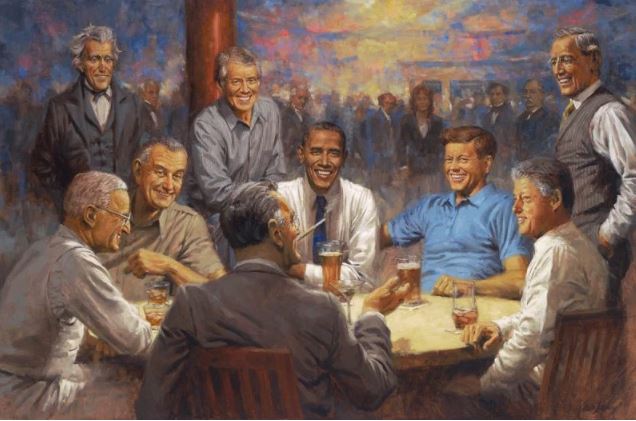


Contemporary American oil painter, Andy Thomas of Carthage, Mo. has painted a couple of fantasy group portraits of presidents from each party hanging out together. In them, he tips his hat to an anonymous future female president.


Tuesday, March 17, 2020

Shamrocks, Bowler Hats, and Irish Artists

Do you know the significance of the shamrock symbol?
St. Patrick used it to explain the Holy Trinity (three) to the Irish while trying to convert them to Christianity. Nowadays it stands for faith, hope, and love. It is often mistaken for the four-leaf clover, although an actual shamrock has only three rather heart-shaped leaves. The British bowler hat or American derby hat was created in 1849 and would have been unavailable to Leonardo da Vinci.


The Girl With a Shamrock Earring is actually wearing a four-leaf clover.


Ben Franklin's family left England for America to escape religious persecution; they were Puritans. Even if he were wearing the bifocals he invented, he still makes a lousy leprechaun!


In modern times, the American derby was worn by Billy the Kid, Butch Cassidy, Charlie Chaplin, Stan Laurel, and British-American actress, Olga Petrova.

Also, don't forget René Magritte's "The Son of Man", who is also wearing a bowler hat (See Movie Art Cameos post).


Indulge me a bit longer as I share some TV and movie characters and actors famous for sporting the bowler hat. Obviously, Mr. Banks from "Mary Poppins" wore a proper British bowler as did Mr. Steed from TV's "The Avengers" and even Stymie from "The Little Rascals".


How about Oddjob from the James Bond movie, "Goldfinger"? Or Liza Minnelli in Cabaret? 
Or the creepy character Alex from "A Clockwork Orange" starring Malcolm McDowell?


Let's talk about some notable Irish artists: Francis Bacon, Dorothy Cross, Conor Harrington, and Sean Scully. Personally, I am not impressed with their works. The works of two of these artists have been described as grotesque (I agree). Three of them are contemporary and have art as recent as 2013. The fourth, Francis Bacon, is a more established 20th-century artist. I liken his works to artists such as Surrealist Salvador Dali and Abstract German Expressionists Max Beckmann and Willem de Kooning. Beckmann and de Kooning, like Bacon, were largely portraitists. I much prefer the former two artists to the latter.


Bacon and Beckmann loved painting figures in triptychs (3 panels). The threes are in keeping with this post's shamrock theme.

I recall teaching about Beckmann years ago when I was an art docent in my daughter's elementary school classroom. The work we used was Beckmann's "Departure" (1932-35).


Here's a self-portrait of Beckmann wearing a bowler hat
(Are you sensing a theme?)


Another German Expressionist that I taught about is Ernst Ludwig Kirchner and his pastel work entitled "Street Scene". My lesson involved the scribble drawing of elongated figures, and I think we made the teacher model for us.


Artist Portrayals in Movies - Twelve of My Favorite Biopics

In this post, I will discuss movies that are biopics of twelve of my favorite artists, many of whom are portrayed by famous actors and a couple of them by lesser-known actors. Unfortunately, most of these movies don't receive favorable ratings.

Perhaps the most recognizable is Kirk Douglas' portrayal of Vincent Van Gogh in "Lust for Life" (one of my favorite movies).

In it, the actor Anthony Quin portrays Van Gogh's friend, Paul Gauguin (not pictured here).


Pablo Picasso has been portrayed by Anthony Hopkins and Antonio Banderas both of whom can be found starring in the movie, "The Mask of Zorro".


Another epic movie, "The Agony and the Ecstacy", stars Charlton Heston as Michelangelo, who is commissioned by Rex Harrison's character (the Pope) to paint the ceiling of the Sistine Chapel. I would watch that movie again!


I've also watched "Pollock", a sad movie starring Ed Harris ("Apollo 13") as Jackson Pollock and Marcia Gay Harden as his wife and fellow artist, Lee Krasner.

Harris' actress wife, Amy Madigan, portrays Pollock's friend and sponsor, Peggy Guggenheim. Although Harden won the academy award for Best Supporting Actress in this film, it pretty much received sour grapes from audiences.


One of the all-time best landscape artists -- J. M. W. Turner -- was portrayed by actor, Timothy Spall. You may remember him as the character Peter Pettigrew in the Harry Potter movies as a rat.

Robert Pattinson of the "Twilight" movies appeared in a film about a young Salvador Dali (didn't see it).


Salma Hayek (recently from the hilarious "The Hitman's Bodyguard") plays Frida Kahlo in her biopic, "Frida".


Some other lesser-known biopics include:

 Andy Garcia's ("The Godfather" and the 'Oceans' films) portrayal of Amedeo Modigliani;
John Malkovich's ("Of Mice and Men", "Con Air", "Dangerous Liaisons") biopic "Klimt"; 
French stage and film actor, Michel Bouquet, as Pierre-Auguste Renoir; and
one-time actor Geir Westby as Edvard Munch.


I've also recently watched the 2003 Scarlett Johansson portrayal of the "Girl with a Pearl Earring", also starring Colin Firth as the artist Johannes Vermeer. Her character, Griet, is supposedly a maid and perhaps the subject of the famous painting which is also known as the 'Mona Lisa of the North'.


Movie Art Cameos


Movie set decoration often involves placing well-known works of art in the background. Sometimes, though recognizable, the artwork may be faked, much like an actor portraying a role. Much of the time, though, the artwork has been borrowed from a collector or a museum. Some films even use an art museum as the setting.


"The Thomas Crown Affair" takes place in New York City and uses the Metropolitan Museum of Art as a backdrop for its romantic art caper. In it, you will see works by Édouard Manet, Claude Monet, Camille Pissarro, Pablo Picasso, and, of course, René Magritte's "The Son of Man".


In "Ferris Bueller's Day Off", the character, Cameron Frye is seen at the Art Institute of Chicago studying "A Sunday Afternoon on the Island of La Grande Jatte", a Pointillist painting by French artist, Georges Seurat. It's always a good idea to visit the museum to view the art in its actual size, both up close and at a distance. Funny that Cam is wearing a Detroit Redwings jersey!


Perhaps my favorite art cameo is the Kandinsky paintings found in the movie "Double Jeopardy". Surely they must be copies as the heroine shoots one of them in the climax scene (spoiler alert!). It's fun to try to recognize the places where movies were filmed, especially if you've been there yourself. It's always a pleasant surprise for me to see visual artworks on the big screen as well.


There's art from Vincent Van Gogh in the movie, "I Am Legend". Included on the site, Paintings in Movies, are Van Gogh's "The Starry Night" and "Road with Cypress and Star", plus other works by Mark Rothko, Henri Rousseau, and Amedeo Modigliani. You can browse for your favorite movie to see what art may have been used. Works by Caravaggio appear in both "Scarface" and "The Great Gatsby". I wonder if they are the real thing! I've seen other movies in which the art hanging in a scene is portraying a familiar work by Henri Matisse. Can you guess the movie?

In my next post, I will discuss movies that are biopics of twelve of my favorite artists, many of whom are portrayed by famous actors and a couple of them by lesser-known actors. Unfortunately, most of these movies don't receive favorable ratings. I personally love to watch Kirk Douglas' portrayal of Vincent Van Gogh in "Lust for Life" (one of my favorite movies). I've also used the video, "Don McLean - Vincent (Van Gogh's paintings)" choreographed to his song, "Starry, Starry Night". Knowing the nostalgic song from the 1970s coupled with the artist's story makes this audio-visual journey even more emotional. Van Gogh started painting at the age of 27 and died at 36, leaving an incredible body of work for the world to enjoy.

Sunday, March 15, 2020

Colorful Landscapes & Outdoor Photographs - Naturalism & Atmosphere

Sunrise at Palm Springs, Photo by Judy Patterson
Whether it is an outdoor photograph, plein air painting, or a made up scene, landscapes typically depict broad views of nature. This style of realism is often referred to as naturalism. They can be representational, impressionistic, or abstract. Probably the biggest challenge for an artist is painting the atmosphere. The 2017 "Seeing Nature: Landscape Masterworks from the Paul G. Allen Family Collection" shown at the Seattle Art Museum was a spectacular display of 39 assorted works celebrating the art of landscape.


Lake Cavanaugh, Mt. Vernon, WA Photo by Karynne Patterson
I found these two paintings (left by Terry Suave and right by Paul Grimm) and thought they were great examples of desert scenes like the one photographed above. The vegetation is similar to the decorative cactus and plantings of Palm Desert.


I like the muted colors of this painting of subtly blooming cactus, entitled "Landscape no 25 (Blooming Cactus Palm Springs)" by artist Daniel Clarke.


For this post, I will share landscape photographs (some by my family) as well as some of my personal favorites. Classic realistic or naturalistic works will include works by Thomas Cole, John Constable, Jean Francois Millet, and J. M. W. Turner.


Wivenhoe Park, Essex (1816), John Constable
Scene from "The Last of the Mohicans," Cora Kneeling at the Feet of Tamenund, Thomas Cole
Viewed this Turner in 2017 at the National Gallery in London.
"The Fighting Temeraire" (1839), Turner
And this VanGogh in 2017 at the Scottish National Gallery in Edinburgh, Scotland.
"Les Oliviers" (1889), Van Gogh

Wheat Field With Cypresses (1889), Van Gogh 
Many of my favorite Impressionists also painted landscapes. Some of my colleagues from the Black Diamond Arts Alliance like to paint outdoors (plein air). Such methods were common to painters such as Van Gogh, although his friend, Gauguin criticized him for it and wondered why he refused to generate his own ideas from his imagination. I argue that his choice of colors came directly from his imagination! Pastel painters, like the Impressionists, paint 'outside the blue box' and often use other than the traditional blue and white sky colors in their paintings.


"Mont Sainte-Victoire Seen from the Bibemus Quarry", Cezanne


On our road trip to California, I was on the lookout for cypress trees. I believe the California versions are pointier than those from Van Gogh's home of Arles, France. Over 20 years ago, I would borrow a small petrified potted version of a cypress tree as a visual aid for students when I would teach about Van Gogh.

Anyway, I will share my favorite landscapes from Paul Cezanne, Camille Pissarro, Alfred Sisley, and of course, Vincent Van Gogh.


These two paintings -- Pissarro's (left) and Millet"s (right) -- are quite different though I naturally gravitate to the brighter, more colorful Pissarro version. However, I have learned to love Millet's peasant painting over the years for its technical beauty. Van Gogh copied many of Millet's works and colorized them much as Pissarro had done.

"Potato Harvest", Pissarro (1893)
"The Gleaners", Millet (1857)


"Effect of Snow at Argenteuil", Sisley (1874)


One of the most difficult landscapes to paint is a snow scene. I recall attempting this in my high school Art Major class and was not very successful. Of course, Sisley mastered it superbly!


While in Palm Springs there were works by Alexander Calder who in addition to making mobiles had quite a large body of abstract expressionist works using black and white and the primary colors. I have long admired Joan Miro, who used a similar color palette. This Calder painting was hanging behind the information desk at the Palm Springs Art Museum. Not sure if it is a landscape although I have seen spiral shapes in other 'wave' paintings.


I find this reddish landscape to be somewhat similar to Frankenthaler's "Carousel" although hers (right) may not actually be a landscape.


.