Friday, January 20, 2023

Album Cover Artwork and Designers

Rock Album Covers


Sgt. Pepper's Lonely Hearts Club Band (1967), Blake


Many albums simply use words and photographs of the musicians on their covers, such as the Beatles' Abby Road from 1969 (their eleventh album). In 2017, on our trip to the UK, we visited the Beatles museum in Liverpool, England. One wall was wallpapered with a life-sized copy of the iconic cover photo with the Fab Four strutting in the crosswalk. Even more iconic is the cover for 1967's Sgt. Pepper's Lonely Hearts Club Band, the Beatles' eighth studio album, designed by British Pop Artist Peter Blake (1932-).

This post will examine cover art from a dozen 20th-century designers.


Face Dances (1981), Blake et.al.

I also love Blake's 1981 design of the "Face Dances" cover of The Who members (by row) -- Pete Townshend, Roger Daltrey, John Entwistle, and Kenney Jones -- whose portraits were painted by sixteen artists: Bill Jacklin, Tom Phillips, Colin Self, Richard Hamilton; Michael Andrews, Allen Jones, David Inshaw, David Hockney; Clive Barker, R. B. Kitaj, Howard Hodgkin, Patrick Caulfield; Peter Blake, Joe Tilson, Patrick Procktor and David Tindle. It was featured in my April 2020 post entitled, Op & Pop Artists - From Allegorical Renaissance to Modern Day Optical and Kinetic Art.


Grand Illusion (1977),
Mouse Miller

Blank Signature (1965),
Magritte


American artist Stanley "Mouse" Miller (1940-) is famous for his 1960s psychedelic rock album cover designs for the Grateful Dead, Journey, and Styx. His "Grand Illusion" Styx album is a pastiche (imitation) of Belgian Surrealist René Magritte's Blank Signature.


Felix-Wyeth

Get Happy!! (1980),
Barney Bubbles

English graphic artist Barney Bubbles (1942-1983) was born Colin Fulcher. He is called the 'founding father' of album covers. His Elvis Costello and the Attractions' "Get Happy!!" cover reminds me of the project my fifth graders did for my N.C. Wyeth movement lesson, using repetition of neon-colored shapes.


Swans Reflecting Elephants
(1937), Salvador Dali

Osibisa (1971), Roger Dean

English artist Roger Dean (1944-) designed the 1971 album for British afro rock band Osibisa. The elephant head butterflies remind me of Swans Reflecting Elephants (1937) by surrealist Dali (1904-89).


Playground Psychotics (1992), Schenkel


I like the color scheme of the Frank Zappa and The Mothers of Invention album, Playground Psychotics, which was released in 1992. Designed by Cal Schenkel (1947-), I appreciate his black-and-white drawings of band members and  Zentangle-like doodles (e.g., spirals). This is what I imagine an album cover would look like!


Powderfinger - Golden Rule (2009), Thorgerson


Storm Thorgerson (1944-2013) designed this simple cover for the seventh and final studio album, Golden Rule, by Australian rock band Powderfinger in 2009. Their 2010 album, Sail the Wildest Stretch, also sports a more vivid version of the bird on its cover. Journey also uses a bird symbol on their albums. I wonder if the Australian band chose its name after Neil Young's 1979 song, Powderfinger.


Jazz Album Covers

Tequilla Mockingbird (1979), Glaser


The 1979 Ramsey Lewis cover "Tequilla Mockingbird" was produced under the direction of Paula Scher and John Berg and illustrated by Milton Glaser (1929-2020). I like its simplicity and movement with its bright rainbow colors against a black background. The jagged lettering of the title deconstructs it into the familiar "To Kill a Mockingbird".


Basie and Williams (1956), Martin


Jazz album covers are typically very graphic and often in a red-black-and-white color scheme. The drawings were cartoon-like and usually included musical instruments. Here are covers by David Stone Martin (1913-1992) and Reid Miles (1927-1993). See the link for more of Martin's covers. I love the watercolor touches on this particular cover.


A Swingin' Affair (1963), Reid Miles


This cover for saxophonist Dexter Gordon was designed by Reid Miles. Although it has a photographic portrait of the musician, I love the composition of red against the black background. You can see more at The Album Cover Art at Blue Note Records.


Artsy Album Covers

New Order - Technique (1989), Saville


These last three covers are much more like paintings than album covers. For New Order's Technique album, Peter Saville (1955-) colorized a cherubic garden ornament complete with psychedelic colors. Apparently, it went well with the vibe of this electronic dance band's music. I imagine the cherub playing an invisible air guitar.


Atomic Playboys (1989), HR Giger


Surrealist artist HR Giger's (1940-2014) Atomic Playboys cover was created for guitarist Steve Stevens' (born Steven Bruce Schneider in 1959) first studio album. Its rather gothic design includes a guitar fret. He was Billy Idol's guitarist and songwriting collaborator, who also played for Michael Jackson, Ric Ocasek, Robert Palmer, and others.


The Bleeders (2008), Vaughan Oliver


British graphic designer Vaughan Oliver (1957-2019) produced this cover for the Bleeders in 2008. It reminds me of the works of abstract expressionists, which have been created by many of my favorite artists. It doesn't look like an album cover, but I really like its contrasting colors and white highlights!


I hope you enjoyed reading this post as much as I have researching it. Please visit the links, especially the other jazz covers. You may also wish to comment naming your favorite album cover!

Tuesday, January 10, 2023

MLK Jr -- Portrait of a Dreamer

MLK Jr. (2017), Glenridge
August of 2023 will mark the 60th anniversary of the 1963 March on Washington for Jobs and Freedom and Martin Luther King Jr's I Have a Dream speech. In February of 2017, a classroom of students from Glenridge Elementary School enlarged a photograph of MLK Jr. and posted it on a bulletin board in one of its hallways. It is a fun way to teach students about value range. My project used a black-and-white poster of Elvis Presley.

MLK Jr. (1962), Karsh

It turns out to be from the famous 1962 portrait by photographer Yousuf Karsh (1908–2002), on display at the National Portrait Gallery, Smithsonian Institution, in Washinton D.C. There is an I Have a Dream (2012) children's book with illustrations by artist Kadir Nelson. My brother has a book by Nelson with paintings of the Negro Leagues, some of which we saw at the Baseball HOF in 2019.

My First Year of Blogging: Teaching Art, Travels, and Observations, from August 2020, also includes MLK. Elvis, JFK, and de Kooning.
JFK (1965), de Kooning

JFK (1960), Rockwell

That same year, President John F. Kennedy was assassinated on November 22nd in Dallas, Texas. I remember it because it was my parents' wedding anniversary and my first-grade teacher cried when the announcement came over the PA system. Five years later, on April 4th, 1968, Martin Luther King Jr. was assassinated in Memphis, Tennessee. Norman Rockwell (1960) and Elaine de Kooning (1965) painted a series of portraits of the 35th President.


The Problem We All Live With (1964), Rockwell


In 1964, Norman Rockwell painted The Problem We All Live With, depicting six-year-old Ruby Bridges being escorted to an all-white elementary school during the New Orleans school desegregation crisis of 1960. Notice the racial slur and the tomato-stained wall.


Aesop's Fables (1970)
Dixie Café, (1948), Lawrence

The Smithsonian is a great place to view historical paintings. Here's one dealing with segregation by Jacob Lawrence. While I enjoy his colorful paintings, his compositional works in black-and-white are particularly striking. I gave a book (right) with such illustrations by Jacob Lawrence to my niece's 3rd-grade teacher.


Stone of Hope (2011), Lei Yixin


In August 2011, the Martin Luther King Jr. Memorial opened to the public in Washington D.C. Chinese sculptor Lei Yixin's inspiration came from a line from MLK's I have a Dream speech -- "Out of the mountain of despair, a stone of hope."


RFK (1972), Leroy Neiman


A month before his death, President Kennedy gave his own version of the I have a Dream speech. It was meant to be a call to action reminiscent of his inaugural address where he said, "...ask what you can do for your country." His brother (and Senator) Robert asked us to "Dream Things That Never Were". RFK's social justice agenda specifically targeted the poor and disadvantaged, while JFK's speech was about his desire for peace in his country, and MLK's speech dreamt of personal freedoms and a world free of discrimination. It's unfortunate that these three dreamers were singled out by fame-seeking assassins.


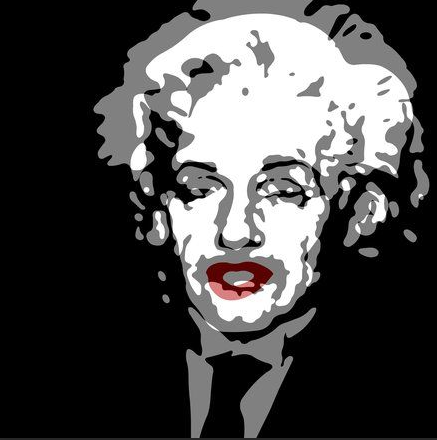
Brains and Beauty (Einstein
and Monroe), Troy Gua
Thomas Alva Edison (1890),
Abraham Archibald Anderson
You don't have to be a religious leader (like MLK Jr.), a politician (like JFK or RFK), an artist (like Jacob or Leroy), a scientist or inventor (like Edison or Einstein), a novelist or songwriter to be a dreamer.


Often, dreams lead to discoveries, breakthroughs, and even Nobel Prize winning contributions to the world. They reflect our personal values, behavior and aspirations to do good in the world.

Pablo Picasso was quoted as saying, "Action is the foundational key to all success."

Vincent Van Gogh may have said, "I dream my painting, and then I paint my dream."

I don't know who said it, but I like this quote: "Every possibility begins with the courage to imagine."

"You see things and you say, 'Why?' but dream things that never were, and I say, 'Why not?'" by George Bernard Shaw.

"Art has the power to transform, to illuminate, to educate, inspire and motivate." So have the courage to dream and share your art with others. Edgar Degas said, "Art is not what you see, but what you make others see."

Saturday, December 24, 2022

The Art of Illustration -- Rockwell, Wyeth, and Others

Daybreak (1922), Maxfield Parrish

This is a continuation of my April 2020 post entitled, Illustration in Children's Literature & the Wyeths. It is inspired by my last post Blue Morning by George Wesley Bellows that is currently on exhibit in the National Gallery of Art in Washington D.C. While investigating similar paintings framed by columns, I found Daybreak (1922) by American Illustrator Maxfield Parrish (1870-1966). 


Baseball Scene of Batter, Catcher and Umpire
(1915), Joseph Christian Leyendecker


Parrish is among the most famous American painters and was once the highest paid illustrator in the country. You've no doubt heard of Norman Rockwell (1894-1978) and maybe J.C. Leyendecker (1874-1951), both known for their covers on The Saturday Evening Post. Both were featured in my December 2020 post, Saint Nicholas and Father Christmas in Art. J.C.'s baseball illustrations may inspire me to write another post about the art of baseball!


Tough Call (1948), Norman Rockwell


Rockwell is probably the most recognizable illustrator of his time. As one of his iconic baseball illustrations depicts, it's a Tough Call as to which artist captured the spirit of baseball better -- Rockwell or Leyendecker. It was fun visiting the Baseball HOF in Cooperstown, NY in 2019 and seeing the art up close and personal. I also like Rockwell's The Dugout (1948) and Leyendecker's Boys Playing Baseball (1915).


Blue Lock the Queen (1916), N.C. Wyeth
A great place to view the works of these artists is the National Museum of American Illustration in Newport, Rhode Island. Here's a link to the N.C. Wyeth exhibit at NMAI. Wyeth (1882-1945) was one of the most famous and successful literary illustrators, helping readers visualize heroic characters in adventure books such as Treasure Island. His first cover for the Saturday Evening Post was published in 1903. I was introduced to his work while I was an art docent in my daughter's elementary school. This illustration accompanied a story published in Collier's magazine.


Mermaid (1910), Howard Pyle


Wyeth's mentor was American painter, Howard Pyle (1853-1911). His Mermaid painting is quite impressive and acclaimed for being the best depiction of a mermaid by an artist. The man being saved by the sea nymph is all blue, as if he became frozen in the frigid water, all expect for his red cap! Its movement reminds me of Wyeth's 'Blue Lock', even down to the red detail on the horse rider's head (bandana). While there is already tension in the mermaid's struggle, the red cap draws my attention even more. Also interesting is Pyle's treatment of the sea foam, reminding me of how Bob Ross teaches us to paint watery seascapes in his Joy of Painting TV series.


Battle at Sea (1947), Fischer


A student of Pyle, German-born American artist, Anton Otto Fischer (1882-1962) was also featured in the Post magazine. His illustrations often depicted maritime or marine war scenes such as Battle at Sea, published in a book about his sailing days. Curiously, there is a red flame in the center of the top third of the composition, much like the red cap in Pyle's Mermaid painting. While Pyle's seascape could be used to show movement, Fischer's would be perfect for teaching about perspective.


Violin Studies, Wistehuff


Revere Wistehuff (1900-1971) was part of the New Rochelle Art Colony in the 1920's, '30s and '40s, along with colleagues Rockwell and Leyendecker. His Violin Studies shows a boy who would rather be playing baseball than practicing his music. The kid reminds me of Buffalo Bob Smith's Howdy Doody character!


Grandma Catches Fly-ball,
Richard Sargent


Finally, we have another baseball illustration entitled, Marmont Hill Grandma Catches Fly-ball by Richard Sargent (1911-1979). It reminds me of Rockwell's The Dugout. It's surprising that she could see the ball with her eyes closed and her handbag hanging in the way. Isn't that Superman's Lois Lane standing next to her?

Thursday, December 8, 2022

Our National Gallery of Art in DC

Majorcan Fisherman (1908), Sargent

John Singer Sargent in Spain

Recently, my daughter attended a professional conference in Washington D.C. and took the opportunity to visit several museums. She shared her photos of famous works on exhibit at the National Gallery of Art. Curiously enough, there were two exhibits of one of our mutual favorite artists, John Singer Sargent, while on one of his seven trips to Spain (1879-1912) to study Velázquez. His painting of a Majorcan Fisherman is particularly captivating and unlike many of his other portraits, usually of women, and typically with a darker color palette. It reminds me of Renoir's Luncheon of the Boating Party (1888) with its canopy and view through to the water in the background. I love the shadows and the sharp contrast of the dominant orange tones with the striking blue of the water.


Newly Discovered Art & Artists

Blue Morning (1909), George Bellows
Another American artist, George Wesley Bellows (1882-1925), painted a similarly framed landscape looking out over water. He is famous for painting urban life in New York City. His Blue Morning scene is reminiscent of Edvard Munch's sad depictions of mine workers returning home in the snow. Here, the column, fence, and shadows frame a silhouetted portrait on a foggy morning. The 'blue' may represent either the color of the water or the sadness of the workers. This is the last of four paintings Bellows made from 1907-1909.


Street of Barns (1914), Feininger


German American painter, caricaturist, and comic strip artist, Lyonel Feininger grew up in New York City. He was a proponent of Expressionism, painting buildings, street scenes, and barns. His figures are elongated much like those painted by fellow German Expressionist, Ernst Ludwig Kirchner. At first blush, I thought this painting was one of the works by Cubist George Braque. I guess I need to practice guessing artists using Artle - the daily art exploration game created by the National Gallery of Art (it's free!).


Still Life (1918), Picasso
Peonies (1901), Picasso
Speaking of Cubists and other Expressionists, The National Gallery of Art was also showing several works by Pablo Picasso. Besides his recognizable Harlequin Musician and The Lovers, also on exhibit were Still Life and Peonies. I hadn't realized that Picasso painted these flowers. Normally, Manet and Monet are the artists whom I associate with them.


Impressionists

Children Playing on the Beach
(1884), Mary Cassatt


Many of the French Impressionists' works are also on display at the National Gallery of Art in Washington D.C. My daughter took photos of the works of Mary Cassatt, Édouard Manet, Henri Matisse, Claude Monet, Camille Pissarro, Georges Seurat, and Pierre Auguste Renoir. I love the innocence of Cassatt's Children Playing on the Beach (1884). Her portraits are some of my favorites -- they are timeless.


The Railway (1873), Manet


Édouard Manet preferred painting portraits, and I'd call him a French Realist. Here in The Railway we see a portrait of a mother and child waiting at the train station. I am distracted by the bars of the iron gate as well as the stitching in the mother's coat. Perhaps the daughter is dressed up to receive her father from the train. Did you notice the puppy cuddling in the woman's lap?


Still Life with Pineapple (1924), Matisse


Fauvist Henri Matisse is responsible for many colorful still lifes, and I especially like this one with a pineapple. We were lucky enough to visit his museum while in Nice, France in 2011. Like contemporary artist, Kehinde Wiley, Matisse backgrounds are always very interesting.


Woman with a Parasol - Madame
Monet and Her Son
(1875), Monet
The Artist's Garden at
Vétheuil
(1881), Monet


Like Manet, Claude Monet used members of his own family as his subjects. We also visited his garden at Giverny in 2011. Quite impressive!


Landscape, Ile-de-France (1873), Pissarro


My daughter knows how much I appreciate the works of Camille Pissarro, His works transcend all of the various Impressionist movements, although he is often referred to as a Neo-Impressionist. His version of Monet's haystacks is equally impressive.


Seurat Retrospective, Georges Seurat


The exhibition also featured a sort of retrospective wall showing the work of French Post-Impressionist and Pointillist, Georges Seurat. Of course, A Sunday Afternoon on the Island of La Grande Jatte (1884-86) is probably his best-known Pointillist works, made famous by the play starring Mandy Patinkin.


A Girl with a Watering Can (1876),
Pierre Auguste Renoir


It's always fun to find familiar artwork at the museum you're visiting. Here's probably the most famous Renoir, A Girl with a Watering Can (1876). I seem to focus on the girl's upper half with the red bow and the blue and white dress, but I never really noticed the watering can. And I consider myself very observant!


More 20th Century Artists

Ground Swell (1939), Edward Hopper
So, luckily my daughter took photos of four more of my favorites, who are more modern and contemporary than those of the French painters you usually spot at art museums. These artists are Edward Hopper, Wassily Kandinsky, Joan Miró, and Lee Krasner (wife of Jackson Pollock).

I love Hopper's clean and confident style. His paintings have no frills, little shading, and calming areas of color that capture a moment and illicit relaxation for the viewer. 


Head of a Catalan Peasant
(1934), Joan Miró
Improvisation 31 (Sea Battle)
(1913), Kandinsky

I love Abstract Expressionism and the playful compositions of Kandinsky and Miró. Whether I am teaching kids or seniors to make colorful Kandinsky concentric circles or cutting out shapes to make Miró balanced compositions, it is always fun to find new masterpieces to share with them as examples for our projects.


Cobalt Night (1962), Krasner

It's surprising how many of Jackson Pollock's work I've seen at various art museums. Like Kandinsky, his compositions are usually numbered and mention the dominant color used in the painting. While vacationing in Palm Springs, I saw the exhibit of the 12 Women of Abstract Expressionism, including some works by Lee Krasner.


I hope you enjoyed this post about some of the 'most important' works currently on display at the National Gallery of Art in D.C. While in St. Petersburg, Russia in June 2019, our tour guide only showed us the 'most important' artwork because of the vast number of pieces at the Hermitage Museum. While I certainly appreciate seeing those, I still enjoy stumbling upon those diamonds in the rough, lesser known or seldom seen works, and even those by artists I've only recently discovered. This is how we learn and grow in our ability to appreciate visual art!