Sunday, June 30, 2019

Baltics (2 of 7) - Stockholm, Sweden


While visiting Stockholm, Sweden, we explored a couple of its 14 islands (50 bridges connect them) and visited the Moderna Museet, housing masterpieces by Picasso, Pollock, Matisse (and others).


“Siphon, Glass, Newspaper, and Violin” (1912, or later)


Apparently, Picasso experimented with mixed media collage at one point in his career as he began to explore Cubism.


"The Wooden Horse: Number 10 A" (1948), Pollock


I was pleasantly surprised to find this piece by Jackson Pollock, an unusual 3-dimensional oil painting using canvas, wood, and masonite.


"Apollo" (1953), Matisse


But the star of the show was this large composition by Henri Matisse using his famous cutout shapes. In 2011, I was lucky enough to visit the Matisse Museum in Nice, France.


To end our day in Stockholm, we took an hour-long boat ride before returning to the ship. In the distance, you can see Gröna Lund Amusement Park, on Djurgården Island.


Baltics (1 of 7) - Copenhagen, Denmark

My family and I just returned from a Baltic cruise through seven countries starting and ending in Copenhagen, Denmark. What a feast for the eyes both on the water and at the ports of call! Whether it was art galleries, all the colorful buildings, graceful sculptures, early sunrises, dramatic cloud formations or white caps on the water, it was an artist's dream vacation. The cruise ship was also beautifully decorated with plenty of fine art everywhere.


This painting (left) with its sunkissed buildings flanking the canal was hanging in the ship's art gallery. The artist really captured the mood of Copenhagen. I don't recall which direction the sun is coming from but if I had to guess I'd say it was at sunset. My photograph (right) is much grayer, but you can still see the reflections of the buildings in the canal. The canal tour was also very informative.

My daughter and I got up quite early the day after our late arrival and walked around along the edge of the canal in search of the Little Mermaid (by Edvard Eriksen). We saw a copy of Michelangelo's David with the artist's name misspelled! Luckily for us, not many others were up at 8 a.m. and the buses full of tourists hadn't yet streamed in to swarm the shores. We were able to stroll through a very large park as well. At its entrance were statues of Greek Gods, Hermes and Poseidon.


We had three days to explore Copenhagen prior to boarding our ship, The Hop-On-Hop-Off buses were an affordable and convenient way to see the city and all the sights to be had.


This unusual tower atop the 17th-century Old Stock Exchange (Borsen) is adorned with four dragons whose tails intertwine to form a spire. It's difficult to see them, but there are three crowns on the very top that symbolize the Scandinavian empire (Denmark, Norway, and Sweden).

Unfortunately, the tower was destroyed in a fire in April of 2024, almost 5 years after our amazing trip. Like the cathedral of Notre Dame, at least we were able to see it while it was still intact. So very sad!


We visited two palaces -- Amalienborg and Rosenborg -- and two art museums -- Statens Museum for Kunst (SMK) and Ny Carlsberg Glyptotek -- each with plenty to see. The SMK link will take you to the painting of Amalienborg Palace Square (1896) by Vilhelm Hammershøi, and my photo (right) shows you what it looks like today.

Among my favorites at SMK were: Rembrandt, Kirchner, Munch, Matisse, Picasso, and Modigliani.

"Landscape from Saint Rémy" (1889)
See Link, Camille Pissarro (1901)
Ny Carlsberg Glyptotek was so impressive that I have to highlight my five favorites. They are Van Gogh (left), Pissarro (right), Monet (below left), Manet (below right), and Degas.
Degas sculptures were also on display, along with Rodin's "The Kiss".

"The Absinthe Drinker" (1858-9)
'Pyramids', Claude Monet (1886)

Monet's 'Pyramids' (1886) was quite impressive in person. 
It was fun to see the collection of works by Manet. 


My daughter pointed out that she could see faint outlines of the 1st dancer's arm behind the column.


At Rosenborg Castle, I saw a kind of painting I've never seen before. It was pleated like a chef's hat and behaved much like the interference pattern of a hologram but instead of producing a 3-dimensional image it contained two different portraits. So glad I didn't miss that! My students will love this!!


Saturday, June 8, 2019

Visual Observation and Illusion


In my lesson where I teach about Positive-Negative Space, I like to use black-and-white pictures that show contrast and at least two different points of view. For example, in the classic vase-with-a-face illusion, some will see the vase as the positive image while others will see two faces. The positive and negative are often different.


It seems like most of these brain puzzles use faces and heads to pull off the illusion. I almost always see faces or animals in cloud formations. I like to hand out individual copies of these illusions so that students may examine them up close. This is especially important for the princess/old man. If you could turn the Mona Lisa upside down, you would swear that she is smiling.


Probably the creepiest illusion is this one with Audrey Hepburn and Marilyn Monroe. To me, the imposters look like Jayne Mansfield and Eileen Heckart (from “Butterflies are Free” and “The Bad Seed”). What makes it more difficult for kids is they only know Marilyn Monroe. The bottom two pictures are great to Teach/Learn real (paper icebergs) vs. implied texture and perspective (3 men walking).


The Cowboy (below left) was the most difficult for me to see. Like the ladies in the very first picture (top right) I saw the old people before I saw the younger person's image.


In a book of Aesop’s Fables retold and illustrated by local Seattle artist, Jacob Lawrence, he does an excellent job of depicting a lion and a monkey to create his illusion and positive-negative space.


Salvador Dali likes to use symbolism in his 'dreamscapes'. Here's one containing two sets of animal trios; can you name them?


Finally, years ago, one of my work colleagues shared a photographic illusion from an issue of National Geographic.
See if you can figure it out!

Friday, June 7, 2019

Palm Springs Art Museum

Every year since my retirement we take a road trip to California and stay in Palm Springs. I like to visit the art museum on free Thursdays. In 2017, there was an exhibit called, "Women of Abstract Expressionism", celebrating the “Divine 12”, often unknown or unrecognized female artists of the 1950s. My favorite was Helen Frankenthaler. The more vivid piece on the top left is reminiscent of the Jackson Pollock work I saw later that year at SFMOMA.


There was a Chihuly free-standing glass sculpture called "End of the Day #2" in the atrium. (Another of the End-of-the-Day chandeliers may be seen suspended in the domed lobby of Tacoma's Union Station.) Above the PSAM chandelier are 100 blown glass vessels, each made by a different artist to precise specifications and containing different objects, making up "Golden Rain" by Michael Petry. His art is inspired by the Greek myth of Danae, who was impregnated by the god Zeus in the form of a golden rain shower. One of the PSAM curators told me that one of the sealed glass droplets had contained gunpowder (of all things) and it had to be opened and confiscated on its way to the museum.


In 2018, there was an exhibit of Andy Warhol at PSAM, including many of his iconic images of Marilyn Monroe, Campbell's Soup Cans, and various other familiar icons collected from old advertising campaigns. When I was a kid, my parents made all three of us boys wear Bermuda shorts with Campbell Soup labels on them for one of our vacations. Apparently, the shorts were more memorable than the vacation!

Warhol made a series of unusual portraits of artist Georgia O'Keeffe and added diamond dust (trust me, it's there). What's neat about my photograph of it is that I accidentally captured his reflection from what was hanging on the opposite wall. Even creepier!

This painting by Thomas Moran, entitled, "Grand Canyon (Mist in the Canyon)" (1915) captures the atmosphere magnificently. When we left California, we stopped on our way back home at several national parks, including Grand Canyon, Bryce Canyon, Antelope Canyon, and Zion. The artist captured the atmosphere well and is reminiscent of many photographs from our trip, only his clouds are much moodier than mine.


This year's PSAM exhibit was called "Unsettled". When you approach the entrance to the exhibit you are greeted by three totem poles yet upon a closer look you are surprised by what they are made of. Do you recognize anything?


Part of their "Lines in the Sand" exhibition is this large Native American basket, but again upon closer examination, it's really a recycling project.


We also visited the Wizarding World of Harry Potter at Universal Studios.


On our road trip South we ran into flooding on I5 from the rainstorm that hit on Valentine's Day. When we visited Joshua Tree Park there was still snow on the ground. We had to cancel our excursion to Yosemite due to snow so instead, we stopped in Ventura, CA, and my daughter and I hiked Santa Cruz Island, part of the Channel Islands just North of Catalina Island.


And we did some side trips to a couple of wineries. Note the whimsical sculptures of a boar and a little girl!


San Francisco Trip & Edvard Munch


While attending one of Tom Petty’s final concerts of his 40th Anniversary Tour my daughter and I visited the San Francisco Museum of Modern Art. There was an exhibit of the work of Edvard Munch, who as it turns out was a very depressing guy. Fortunately, there were also works by several of my favorites: Henri Matisse, Georges Braque, Franz Marc, Piet Mondrian, Jackson Pollock, Salvador Dali, Joan Michell, Edward Hopper, and Robert Rauschenberg.

While traveling from France to Italy in May of 2011 we stopped in Nice and visited the Matisse Museum. Also got to see the Marc Chagall Museum. I remember one of my early and most successful art projects when my daughter was in elementary school involved making a composition that included a shape from a Matisse work. Some of the windows of the museum were painted on the outside of the building.


Although I never taught a lesson about Braque, his work is somewhat similar to that of Picasso. When I teach about Franz Marc, I usually pair him with Wassily Kandinsky.


In my Kindergarten Art Projects post, there is a project on LINE inspired by Mondrian.


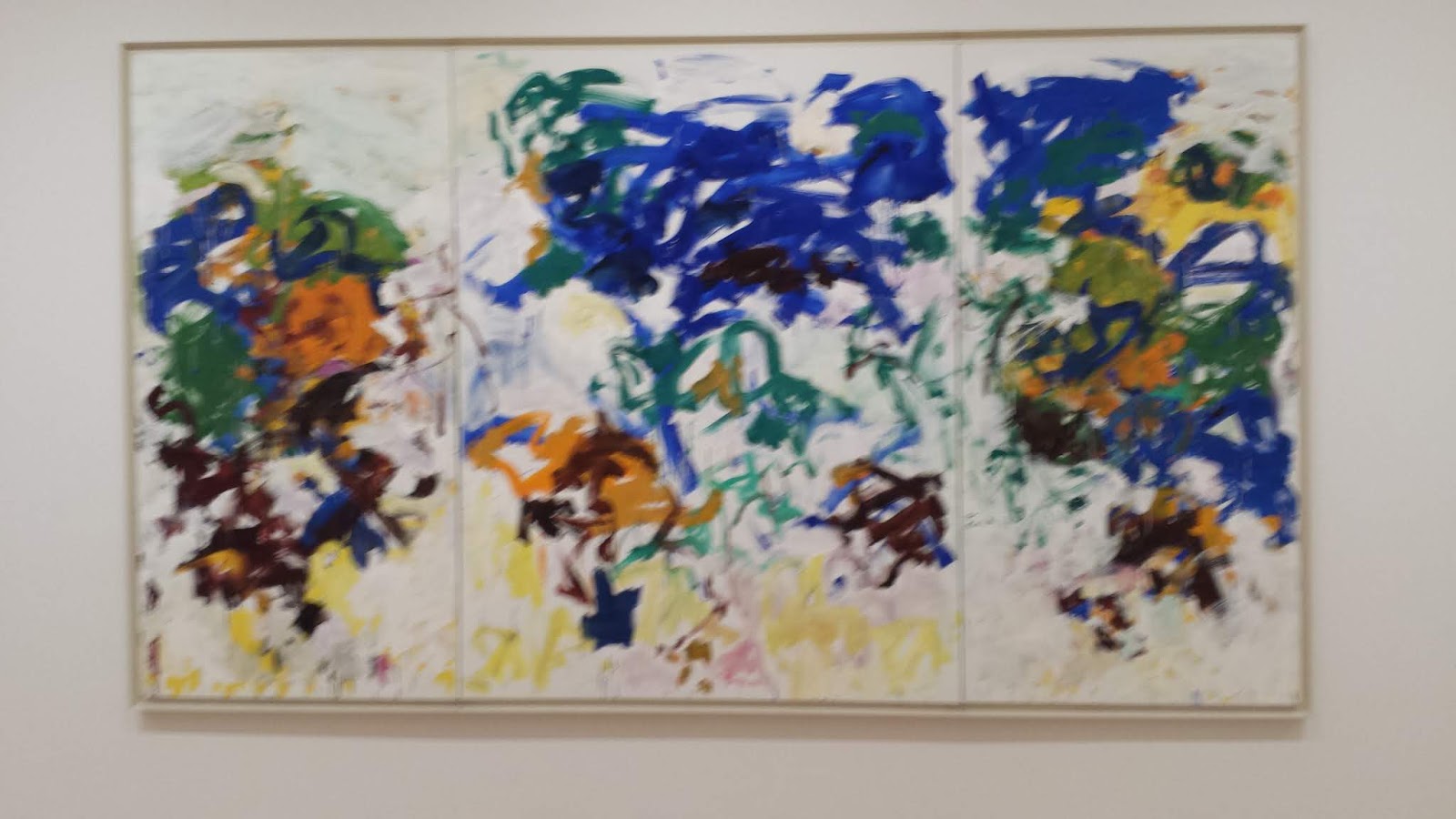
I enjoy seeing works by artists like Jackson Pollock that are not like his typical splatter paintings although he does like to use lots of lines.


I could do an entire post about the 12 female abstract impressionists (like Joan Mitchell) who were on display in the Palm Springs Art Museum when we visited in March 2017.


I'm not sure why but I love seeing the work of Edward Hopper. His "Nighthawks" has been parodied several times including the one with Elvis, James Dean, Marilyn Monroe, and Humprey Bogart.


Rauschenberg is another artist whose mixed media collage is a textural feast for the senses.


Thursday, June 6, 2019

French & Italian Art Museums - May 2011


While visiting France and Italy in 2011 I was able to cross off several of my bucket list items. Our hotel in Paris was within walking distance of the Louvre Museum. We got there early and almost ran through the Porte des Lions entrance to find the Mona Lisa by Leonardo Davinci. It was protected and very small (2′ 6″ x 1′ 9″), and there was glass in front of her, so I couldn’t get a picture without my own reflection in it.


So much to see! Plan to spend several hours there. My daughter and I ran around the museum from room to room and were surprised by some of the works we encountered. Of course, we were using cameras then instead of cell phones.

Did you know that the iconic work (top left) by Dutch artist, Johannes Vermeer is known as the Mona Lisa of the North? I used this graphic in my Vermeer lesson on the element of space, highlighting his painting "The Lacemaker".


My colleague who is the PTA's resident artist at the school where I volunteer taught my 5th-graders how to paint their own Mona Lisa. I enjoyed seeing how they drew her mouth as we all wonder, "Is she smiling?" But I digress. There was of course much more to see, and many of the works were huge floor-to-ceiling masterpieces. 


Except for driving a 5-speed in the roundabout on the Champs- Élysées near the Arc de Triomphe I loved Paris! If you could climb the steps to the top you could see the entire city. Windows in the Louvre also made for spectacular views of the city. Loved the Musée d’Orsay. Lots of art (100) by the Impressionists. We also visited the Palace of Versailles, Normandy, and Giverny, home of Monet’s gardens.


Rome, Italy was mostly about architecture and sculptures, statues, or monuments. It seems like we aren’t taught enough about 3-D sculpture, and therefore suffer from a lack of spatial reasoning.

Florence was my favorite since it is perhaps the international center of art. The Uffizi Gallery was amazing! Its halls were lined with statues and sculptures. At the Galleria dell'Accademia, you will find Michelangelo's David.

This is one of several bridges over the Arno River in Florence now, though not the famous Ponte Vecchio (the one with all the shops) which had been the only bridge until 1218.