Monday, April 20, 2020

Picturesque Antelope Canyon, Arizona - A Photographer's Dream


In 2018, on our way back from California, we visited Antelope Canyon east of Page, Arizona. Guided tours of the rocky caverns containing much-photographed sandstone formations have been conducted exclusively by Navajo tribesmen since 1997. The swirling patterns, textures, and natural lighting effects produce abstract images of yellow, orange, pink and purple. When the guide threw dirt into a stream of light it created an ethereal blueish line.


It is difficult to choose between the number of spectacular photos my family and I were fortunate enough to capture.


On the same trip in 2018, Palm Springs Art Museum was exhibiting the works of Andy Warhol. I was able to capture one of his diamond dust prints, an unusual negative portrait of the artist, Georgia O'Keefe. What makes it even more creepy is the fact that I caught Warhol's reflection from another print on the opposite wall.


Untitled (1940) O'Keefe


Here's one of her landscapes described as 'red and yellow cliffs' taken from the blog of Michael G. Imber containing more landscapes and describing how Ms. O'Keefe lived and camped in the desert to find her inspiration.


The images from Arizona are reminiscent of the abstract flowers painted by Georgia O'Keefe prior to 1920 as well as by her New Mexico landscapes in the 1940s.

"Music Pink and Blue II" (1918)


"Phantom" (2014) by Peter Lik

Peter Lik's black-and-white photo shot in Antelope Canyon in 2014 sold for $6.5M. Personally, I like my "Sasquatch" shot in 2018 at Zion National Park. Maybe you can see my phantom shape next to the tree and above the boulder.


Friday, April 17, 2020

Illustration in Children's Literature & the Wyeths

When my daughter was little, I loved reading books to her, like The Very Hungry Caterpillar, by Eric Carle. His illustration style involved building up shapes from patterned pieces of paper. He inspired one of my kindergarten lesson plans and his patterned paper methodology also inspired my wrapping paper self-portrait project that I do with 5th- and 6th-graders. Henri Matisse also used paper cutouts in his later artwork.


Another of my favorites is the character-filled children's books written and illustrated by Richard Scarry. My daughter enjoyed the dressed up kittens and pigs, but my favorite character was Lowly Worm. Who would have thought such a character would be popular with kids! The Snowy Day, by Ezra Jack Keats, is another innovative storybook in that it uses real characters in real urban settings.


I also need to mention the Berenstain Bears books, by Stan and Jan Berenstain. I think we must have owned every book in the series. The reason that I mention these children's books is that there is a depth of creativity in how Carle texturized his shapes, how Scarry developed his characters (their clothing and surroundings), and how Stan and Jan captured life lessons in a family setting.


I also love the paintings of Andrew Wyeth and own a copy of his autobiography by Thomas Hoving and Wyeth; he was quite a quirky guy! I recall his painting of a roadside plantation house with a dead squirrel in the road. The book shows a study for the painting in which Wyeth uses a smear of actual squirrel's blood. My daughter and I loved that and at the same time, we were creeped out!


It wasn't until my retirement that I discovered Andrew's father, Newell Convers Wyeth. He is my all-time favorite illustrator. He has become a staple in my 5th-grade art lessons and inspires projects that reinforce the art element of movement. N.C. Wyeth learned from and was inspired by artist Howard Pyle. Wyeth is famous for illustrating classic stories such as The Yearling and Treasure Island.


In "Blue Lock, the Queen" (1916) you can really see the movement. This is taken from a story that was published in Colliers Magazine about a spirited wild mare. Also published in Collier's were 400 illustrations by Frederic Remington, whose sculpture I've blogged about.


Here's the motion project inspired by N.C. Wyeth and made by my 5th-grade classroom teacher. That's ex-Mariner pitcher, Felix Hernandez. One of her favorite illustrators is Norman Rockwell, who was prolific with his American portrait covers in the Saturday Evening Post. He is one of several artists who enjoys inserting his own image into his portraits, such as "The Dugout".


"The Dugout" (1948), Rockwell

My brother just told me about Clarence William Anderson
(not to be confused with Pro Wrestler, C.W. Anderson), a writer-illustrator famous for his "Billy and Blaze" book series about horses. He also did covers for the Saturday Evening Post.


Sendak's Wild Things
Drucker's Alfred E. Neuman
The last two illustrators -- Maurice Sendak and Mort Drucker -- are familiar for Where the Wild Things Are (left) and caricatures in MAD Magazine, respectively. I used to draw caricatures of my family, friends, and co-workers,
which were likely inspired by reading those satirical magazines. I never actually read any of Sendak's books, though I've admired his characters over the years.

Drucker's Unlikely Golf Threesome
Mort Drucker died just over a week ago at the age of 91. I dedicate this post to him.
BTW, I read that he was hired at MAD in 1956 when the then Brooklyn Dodgers were playing in the world series. The publisher told him he'd be hired if they won and they did!


Thursday, April 2, 2020

Muralists - Creators of Our Urban Treasures


Obviously, you’ve seen murals on buildings, ceilings, walls, etc. in palaces, museums, or maybe the Vatican’s Sistine Chapel, though sometimes both the artist and the location may surprise you. Next time you're in a large city like Portland, L.A., New York, or Boston, keep a watchful eye for these urban treasures. 


Monet (1920), MOMA NYC
Perhaps the most famous murals were done by Leonardo da Vinci, Michelangelo, and Raphael. But did you know that modern artists such as Claude Monet, Diego Rivera, and John Singer Sargent also painted murals?


Sargent's “Triumph of Religion” mural at the Boston Public Library tells the story of Judeo-Christian religious history. Another good reason to visit the library!

Some works large enough to be murals are in reality very large paintings often displayed side-by-side with adjacent sides touching. Murals done quickly in watercolor on wet plaster are known as frescoes. Most modern-day outdoor urban murals are done in good ole house paint.


Diego Rivera's famous mural, "Dream of a Sunday Afternoon in Alameda Park", was displayed on a wall in the Hotel Prado in Mexico City in 1947. Following the earthquake of 1985, it was moved to the Museo Mural de Diego Rivera.


Here in the Northwest, you may have heard of Portland's Sovereign Hotel where its western and southern facing white walls were transformed into two trompe l'oeil murals by Richard Haas.


The windows running down the center of the walls are real but everything else is painted on to trick your eye.


You need to read the story by the Oregon Historical Society to find out its fate in 2016-17.


Another 'mural' is painted on the outside of the Musée Matisse in Nice, France. When we visited France and Italy in 2011, I was surprised to find that not all of the windows were real. The artist is unknown. Several other buildings in Nice also contain murals on one or more sides. I didn't know this when I visited there.


"Hollywood Jazz: 1945-1972" (1990), Wyatt
Richard Wyatt Jr. is a muralist from L.A. who has also exhibited at the Frye Art Museum in Seattle. His murals in L.A., like this one outside Capital Records, are iconic urban masterpieces.


Wyatt's "City of Dream/River of History" adorns L.A.'s Union Station.


I want to share one more 'mural', today's Google Doodle. It celebrates the life of Dame Jean Macnamara, who contributed to the discovery of the Polio vaccine in 1955. It's a painting of hope by Norman Rockwell. Or is it by Edward Hopper? April Fool! This doodle is actually by artist Thomas Campi of Syndey, Australia.
It was so impressive to me and somewhat of a trompe l'oeil that I had to include it in my blog.

Wednesday, April 1, 2020

Spectacularly Scenic Grand Canyon, Arizona - Natural Wonder

Another place we visited on the tail end of our 2018 road trip is the Grand Canyon. Did you know that two of the twelve yearly deaths there come from falling off the rim? I recall my wife warning some young female tourists about keeping on the safe side of the wall. We stayed overnight in March and woke up to snow in the morning.


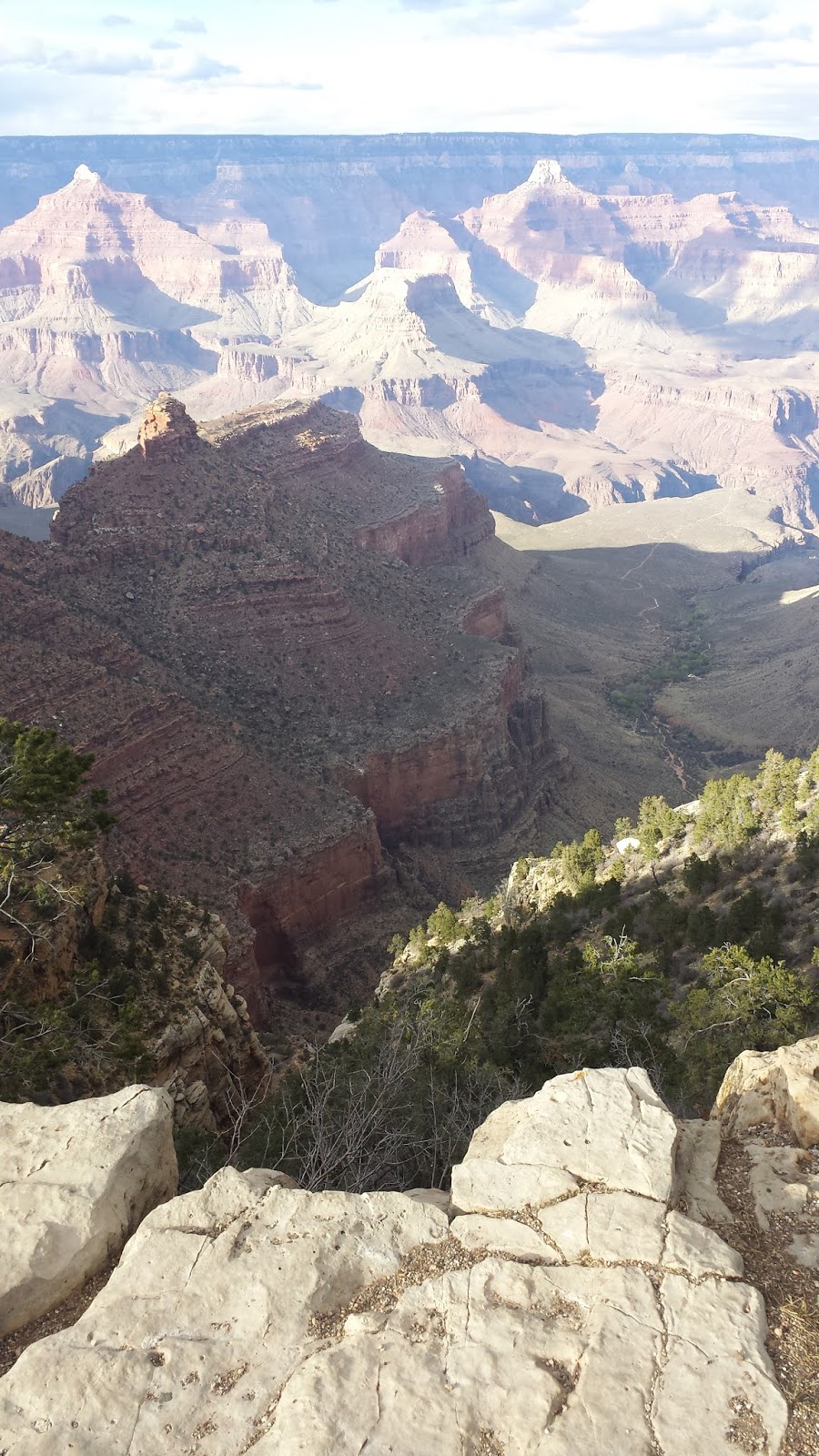
The scenic canyon is the perfect place for plein-air painting, an artist's delight for its atmospheric effects. The photographs shown here were taken by me. I will also share paintings by three of my favorite artists who painted this natural wonder.


Here's an oil painting by Thomas Moran. He emigrated from England to the eastern United States at the age of seven. Most famous for his paintings of Yellowstone (1871-2) and the Grand Canyon (1873), he was invited to participate in geological surveys, along with photographers, as a guest artist of the Santa Fe Railway.


American artist, Arthur Wesley Dow, born 20 years after Moran, also painted the canyon. He's probably most famous as an art educator, who taught Georgia O'Keefe. I love the feel of this painting and appreciate his minimal color palette of beautifully contrasting blues and oranges.


Here's a monochromatic photograph of mine that is a distant, less vivid, yet similar color scheme to Dow's painted version (above).


Oscar E. Berninghaus, born in St. Louis, Missouri in 1874, is also famous for painting southwest landscapes. You can see his brushwork on the cliffs that frame the left side of his painting.


                         I am amazed that the camera on my Samsung iPhone is able to pick up such levels of depth in this photograph. Think of the range of textures one could create in a watercolor painting of this scene.


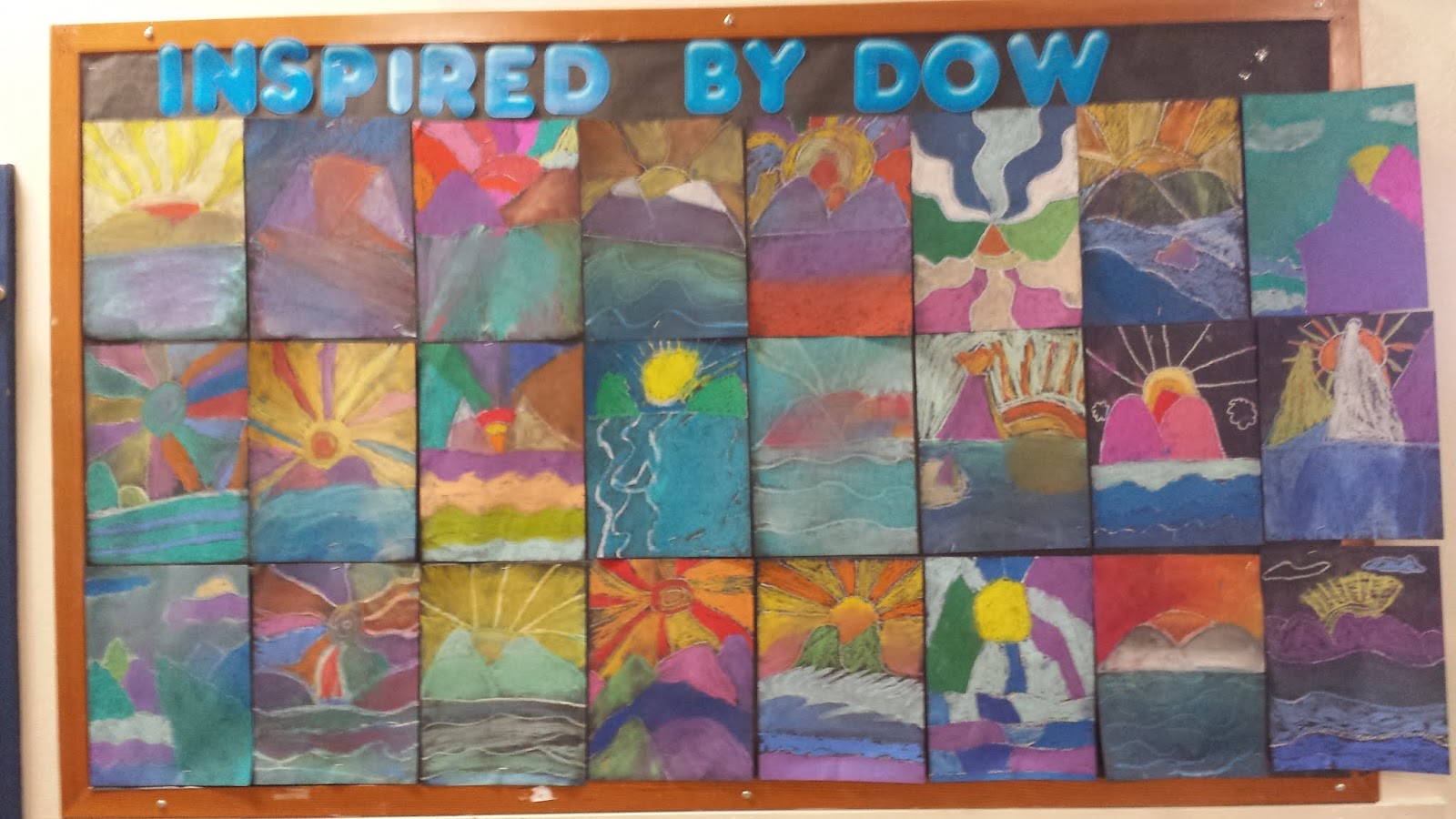
When I taught about Dow to 3rd-graders, we did abstract landscapes using white oil-pastel-outlined areas filled in with chalk pastels. Our landscapes were inspired by Dow's landscapes and they came out with the same soft appeal as Dow's own creations.


Crater Lake, Oregon (1919), Dow

Lake Louise, Alberta Canada (1919), Dow


It amazes me how these two Dow's oil paintings look more like watercolors!


I'm dedicating this post to the Lowell Elementary School 3rd-grade teacher whom I had the distinct pleasure of working with on the above Dow art project. Geriann Holmes Marchio passed away much too soon in November of last year. Her enthusiasm for art and love for teaching and her students was inspiring! I recall how jazzed she would get when her students excitedly responded to my art lessons.

Tuesday, March 31, 2020

Portrait Artists

National Gallery, Scotland
I love a good mystery. For example, who painted the portrait of Ulysses S. Grant on the $50 bill? That question inspired this my 50th blog post. Congratulate me!

I've always loved portraits and there was a time when I would sketch (from memory) caricatures of my family, friends, and co-workers. Many recognizable artists have painted themselves (See my Self-Portraits post), especially Rembrandt who couldn't afford to pay models to sit for him. Now, I'd like to focus on portraits of their subjects.

I've already discussed da Vinci's Madam Lisa Giocondo (Mona Lisa) and Vermeer's Griet (Girl with a Pearl Earring).

National Gallery, London


Besides Rembrandt, my favorite portrait artist has to be John Singer SargentHis figures have an elegance about them, more so than the formality of posed royal subjects (e.g.) by Sir Joshua Reynolds. Many such paintings are more about capturing the folds of a velvet gown or lavish gold thread patterns and textures in the royal garments or capturing moments in history or acclaimed victories.


Sir Joshua Reynolds (1874) by Gilbert Stuart


Van Gogh, Manet, and Matisse also did portraits, but they excelled in other areas, in my opinion. Renoir and Degas painted individuals or groups of people often in graceful compositions. Other artists -- Picasso, Kahlo, Klimt, van Eyck, and even American artist Grant Wood ("American Gothic" farm couple) -- all had their own unique style of portraiture.


Self-Portrait, Gilbert Stuart


I'd like to focus on some of the lesser-known artists responsible for the images of historic figures found on our U.S. currency. It’s difficult to discover which artists were responsible for the art used for such engravings. I knew about Gilbert Stuart, his many (130) portraits of George Washington, and the one unfinished painting from which the dollar bill got the likeness for its engraving.


It appears to be totally possible that he also painted the portrait of
Thomas Jefferson for the two-dollar bill.

Alexander Hamilton (1805), Trumbull


The rest of the currency artists, though seemingly anonymous, still make for interesting reading. Hamilton’s portrait on the $10 bill may have been painted by either Otis Porritt, Caroline L. Ormes Ransom, or most likely, John Trumbull. Another mystery is who painted the portrait of Ulysses S. Grant on the $50 bill. Perhaps a trip to the Smithsonian in Washington D.C. could solve it!

Lincoln Photo (1864), Brady


Portrait artists for Lincoln, Jackson, and Franklin seem to be Mathew Brady, Thomas Sully, and Joseph Duplessis, respectively.


Banknotes around the world are much more colorful than those here in the United States. In addition to portraits of its countrymen or architectural symbols, they also depict their flora and fauna. Scotland's £50 note displays a portrait of Sir Walter Scott on one side and the amazing Falkirk Wheel on the other. The Scottish historian, historical novelist, playwright, and poet is quoted as having said, "Oh what a tangled web we weave, when first we practice to deceive!". Here's another that is hopefully appropriate for today's pandemic: "Look back, and smile on perils past." Unfortunately, like many of the expressions captured in these somber portraits, I won't be smiling. Instead, I'll be breathing a sigh of relief!

Andrew Jackson portrait (1852), Sully
Franklin portrait (1785), Duplessis


These faces became familiar to most Americans through the constant use of their monetary denominations in our day-to-day lives.

Do you have a favorite portrait? What's your favorite work of art? Who is your favorite artist?