Wednesday, March 29, 2023

Praying Hands in Art -- A Dedication

Praying Hands (1508),
Albrecht Dürer


Before I ever asked her out on a date, my wife was working upstairs from my office in a data library behind Dutch doors. When I approached her desk, I immediately noticed a picture containing praying hands, so I asked her if she was a 'religious girl'. Upon further inspection it turned out to be a poster about being left-handed. Some icebreaker! In any case, my question, while puzzling, didn't scare her off.

Hands (and feet) are among the most expressive and challenging features of the body to capture. Let's explore more art dealing with praying.


An Elderly Man in Prayer
(1660), Rembrandt


The second painting shows An Elderly Man in Prayer, painted by Rembrandt. I love the overall texture of the somewhat monochromatic portrait, capturing the old age and beard of the subject. The softness and subtle treatment of light is less like a Rembrandt and more like a Degas.


The Angelus (~1857), Millet


The Angelus by Jean-François Millet shows a peasant couple praying over the grave of their dead child. This painting was studied and copied by Vincent Van Gogh. It may be seen in Paris at the Musée d'Orsay.


The Prayer (1882), Van Gogh


I've used The Prayer by Vincent Van Gogh in my pastels class for the portion where we use a limited color palette. I was inspired by a reproduction that my niece has in her dining room.


Grace (1918), Eric Enstrom


Similarly, Swedish-born American photographer, Eric Enstrom famously captured a photograph of Charles Wilden praying in 1918. It became the Minnesota state photograph in 2002. I love this because my wife was born in the 'North Star State'. You can see the story in the article, The story behind Minnesota’s official state photograph.


Drawing Hands (1948), M.C. Escher


I love the graphical illusions created by M.C. Escher. Although not praying, these hands are interesting and recognizable, and a standout example of his wonderful works. It's a drawing of a drawing.


Three Girls Praying (2015), Mccabe


I found this portrait of Three Girls Praying (2015) by Pamela Mccabe. It is reminiscent of the illustrations of Norman Rockwell. It makes me think of all the people who are praying for my wife as she (and our family) navigates through a tough illness.


While I don't know who painted this beach scene, the subjects remind me of my wife, her sister, and one of her two brothers. I'm dedicating this post to my wife as our family and friends pray for her recovery from a long and serious illness. I hope these images inspire you to pray for someone who needs it. Maybe it will inspire you to use art as a way of dealing with whatever life throws at you.

Friday, March 10, 2023

Recent Artwork -- Acrylics & Watercolors

J.P. at Bat (2023), Patterson


While vacationing in Palm Springs this year I completed two more paintings, one acrylic and one watercolor. The first is a portrait of Mariner shortstop, J.P. Crawford, last season's leadoff hitter for the Seattle-based baseball club. It was so well-received on Facebook that one of our long-time friends wants to buy it for her avid baseball fan husband.

During one of the ALCS playoff games, I captured an image from the TV, then painted it using acrylics. The forearm tattoo was challenging, and I am very pleased with how well the background fans turned out.


Benny and Moana (2023), Patterson
My friend from the Palm Springs City Dog Park commissioned me to do a portrait of his two dogs, Benny and Moana. I had planned to get a large canvas and use acrylics, but instead I decided to use 11"X15" watercolor paper and watercolors. My style has always been to build up layers of paint rather than using washes. I ended up gifting the portrait (unframed) to my fellow dog park patron. Per my research it was going to cost him ~$50 to purchase a matted frame, and I left it up to him to find one that he liked.


Chihuahua (unknown)


In the Airbnb where we stayed there was a large portrait of a dog hanging in one of the bedrooms. The artist chose to use bright, non-traditional colors for this abstracted version of a chihuahua. Someday I will try my hand at alternative color schemes.


Jeju & Bryce (2022), Patterson

I did try woodburning last year in my portrait of Jeju & Bryce. Shading is accomplished by using different sized tips and varying both the pressure and length of time on the wood surface. Hopefully, I didn't ruin the tip by dragging it along the surface. Most of the class chose to do mountain landscapes with black silhouetted evergreen trees. I suppose those scenes made for more useful charcutier boards!


Sketch + Dogs
Lake Sawyer Dogs
(2022), Patterson


You may remember my other portrait of our pets captured in this beautiful Lake Sawyer landscape from last February. I began the portrait in a Zoom class put on last year by PawsWithCause as a training for its volunteers. I was inspired by late TV painter, Bob Ross and his happy little bushes and trees.


Lilly (April 2022), Patterson


In April of last year, I painted a portrait of Lilly, a greyhound mix from a local animal shelter in Kirkland, Washington. My niece loved it enough to purchase it as a donation to PawsWithCause. She planned to display it on her desk at her office. I love the glassiness of her eyes and all the colors of her fur. The muted primary colors of the collar and background also work well in the composition.


Puzzles for PawsWithCause


I used a laminated print of the portrait in a puzzle I made for kids attending one of our farmers markets.


Lakeside Castle (2022), Patterson


Inspired by a landscape by one of the students who attended my September 2022 acrylics class at Franke Tobey Jones' Senior University, here's my very first attempt at using Paint3D on my desktop PC. It was particularly challenging to use a mouse on a PC instead of a stylus on a tablet.


View from Cedar Butte (2022), Patterson


Then, in October of last year, I recreated this painting of the view from Cedar Butte trail using Paint3D. Eventually, I will purchase a tablet and stylus, and try my hand as portraits instead of the less precise use of a mouse.

Friday, February 10, 2023

ART - Controversial and Misunderstood

Point of Origin (1978), John Mason 
For this my 150th post, I want to take a more critical look at what we consider to be ART and why we create it. In my travels I've seen lots of 'art', whether it be famously hung in a museum or spraypainted on city walls. My July 2020 Art of the Pacific Northwest series explored the art of six NW cities, including commissioned works such as sculptures and murals as well as some museum pieces. This geometric steel sculpture currently stands on the lawn outside the Boise (Idaho) Art Museum. Though simple and repetitive, the shapes allow us to frame the surrounding scenery and the metal captures reflected light and shadows.

White Paintings (1951), Rauschenberg
Sometimes 'simple' makes sense but often the observer is left wondering why it is considered 'art'. Though I can understand and appreciate the collages of Robert Rauschenberg, I've never grasped the significance of his multi-paneled White Paintings of the 1950s. I get that it's challenging to paint a consistently unified color field absent of visible brushstrokes, but to repeat it multiple times doesn't seem interesting. And when they're displayed on white walls...nothing's there to see.


Fountain (1917), Duchamp
Just as confusing is Marcel Duchamp's Fountain (1917). He simply flipped a 'readymade' urinal onto its back and wrote a strange nom-de-plume on the side. Apparently, his use of an everyday object later inspired the Pop and Op Art movements. I think it was in Copenhagen at a brewery where I saw urinals made out of beer kegs. Apparently, functional objects are not considered objects d'art.

You may recall Campbell's Soup Cans (1962) by Andy Warhol. When I was a child, my dad took his 3 boys to Bermuda and my mom made us wear shorts with the soup can pattern. Wearable art?!


On our 2017 trip to Palm Springs, the local art museum had a sculpture of a composition of trash bags. I guess you can make art out of anything, though I'm not sure this was recycling. The arranged 'trash bags' were almost cubical and covered in a shiny, wrinkled dark brown medium. Though surprising, it left me wondering how the sculpture was made and trying to find beauty in what my eyes saw as a pile of trash or glistening poop. Maybe it's a box of chocolates!


Roadkill, Andrew Wyeth

When we see a sunset or a mountain landscape, we call it beauty, but when we paint (or photograph) it to share with others it becomes art. Animals also use beauty to get a reaction (from potential mates) much like artists from their observers. Andrew Wyeth used actual blood in a study of a dead squirrel for his painting Roadkill. You wouldn't know that unless you read his autobiography. The strong diagonal line seems to divide the painting in two.


Triptych Bleu I, II, III (1961), Miró
We create art to capture beauty or historical events for communication, memory recall and visualization, leading to education and understanding. Artists do it to make a statement, translate an emotion, or start a movement such as Surrealism or Abstract Expressionism. While I am personally a fan of Joan Miró, his blue works are only slightly more impressive than the Rauschenberg works in white. They become art solely because the artists intended them to be art.

Often artwork is judged or rejected and may be interpreted as controversial. Differences of opinion are expected when viewing works of art. Understanding why you like art or don't is part of the experience. Sometimes seeing it in person makes you appreciate it more, especially when exhibited as the artist intended.


An Allegory of Virtue
(mid-1520s), attributed to
Antonia Allegri


I am also puzzled by art curators who exhibit unfinished paintings, such as The Athenaeum Portrait of George Washington by Gilbert Stuart. I suppose that it preserves the historical portrait as Gilbert's model for the rest of the images of our first President and the likeness of him on the dollar bill. There are many unfinished artworks out there, although I've only seen one of them in person at the Scottish National Gallery. This shows us how some artists work on sections of a painting at a time. I understand if the subject or artist dies before completing a painting, like Gustav Klimt, who left several unfinished works upon his death in 1918 from pneumonia (due to the Spanish flu). 

Check out the Met's article, Unfinished: Thoughts Left Visible, for examples of incomplete works intentionally or unintentionally left unfinished.


Le Bateau (1953),
Henri Matisse


It's particularly telling when museum personnel are unable to determine which end is up, as with Henri Matisse's Le Bateau (1953) which hung for 47 days at the Museum of Modern Art in 1961. It took a museum patron to pose the question as to whether it was upside down. Imagine how many people viewing a work of art would agree that it's actually 'art' and further that it's 'good'.


Fat Car (2001), Erwin Wurm, PSAM
When an artist or artisan produces something 3-D like a car, (to me) it isn't as impressive as sculpting a figure. It's like when the motion picture academy nominates an ailing old musician for playing one. Where's the challenge? Some art installations are meant to impress us by virtue of their size or shock value, but you wouldn't display them in your home. It's fun to visit an art gallery and see the variety of art exhibited there.

Friday, January 20, 2023

Album Cover Artwork and Designers

Rock Album Covers


Sgt. Pepper's Lonely Hearts Club Band (1967), Blake


Many albums simply use words and photographs of the musicians on their covers, such as the Beatles' Abby Road from 1969 (their eleventh album). In 2017, on our trip to the UK, we visited the Beatles museum in Liverpool, England. One wall was wallpapered with a life-sized copy of the iconic cover photo with the Fab Four strutting in the crosswalk. Even more iconic is the cover for 1967's Sgt. Pepper's Lonely Hearts Club Band, the Beatles' eighth studio album, designed by British Pop Artist Peter Blake (1932-).

This post will examine cover art from a dozen 20th-century designers.


Face Dances (1981), Blake et.al.

I also love Blake's 1981 design of the "Face Dances" cover of The Who members (by row) -- Pete Townshend, Roger Daltrey, John Entwistle, and Kenney Jones -- whose portraits were painted by sixteen artists: Bill Jacklin, Tom Phillips, Colin Self, Richard Hamilton; Michael Andrews, Allen Jones, David Inshaw, David Hockney; Clive Barker, R. B. Kitaj, Howard Hodgkin, Patrick Caulfield; Peter Blake, Joe Tilson, Patrick Procktor and David Tindle. It was featured in my April 2020 post entitled, Op & Pop Artists - From Allegorical Renaissance to Modern Day Optical and Kinetic Art.



Grand Illusion (1977),
Mouse Miller

Blank Signature (1965),
Magritte


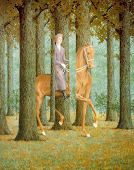
American artist Stanley "Mouse" Miller (1940-) is famous for his 1960s psychedelic rock album cover designs for the Grateful Dead, Journey, and Styx. His "Grand Illusion" Styx album is a pastiche (imitation) of Belgian Surrealist René Magritte's Blank Signature.


Felix-Wyeth

Get Happy!! (1980),
Barney Bubbles

English graphic artist Barney Bubbles (1942-1983) was born Colin Fulcher. He is called the 'founding father' of album covers. His Elvis Costello and the Attractions' "Get Happy!!" cover reminds me of the project my fifth graders did for my N.C. Wyeth movement lesson, using repetition of neon-colored shapes.


Swans Reflecting Elephants
(1937), Salvador Dali

Osibisa (1971), Roger Dean

English artist Roger Dean (1944-) designed the 1971 album for British afro rock band Osibisa. The elephant head butterflies remind me of Swans Reflecting Elephants (1937) by surrealist Dali (1904-89).


Playground Psychotics (1992), Schenkel


I like the color scheme of the Frank Zappa and The Mothers of Invention album, Playground Psychotics, which was released in 1992. Designed by Cal Schenkel (1947-), I appreciate his black-and-white drawings of band members and  Zentangle-like doodles (e.g., spirals). This is what I imagine an album cover would look like!


Powderfinger - Golden Rule (2009), Thorgerson


Storm Thorgerson (1944-2013) designed this simple cover for the seventh and final studio album, Golden Rule, by Australian rock band Powderfinger in 2009. Their 2010 album, Sail the Wildest Stretch, also sports a more vivid version of the bird on its cover. Journey also uses a bird symbol on their albums. I wonder if the Australian band chose its name after Neil Young's 1979 song, Powderfinger.


Jazz Album Covers

Tequilla Mockingbird (1979), Glaser


The 1979 Ramsey Lewis cover "Tequilla Mockingbird" was produced under the direction of Paula Scher and John Berg and illustrated by Milton Glaser (1929-2020). I like its simplicity and movement with its bright rainbow colors against a black background. The jagged lettering of the title deconstructs it into the familiar "To Kill a Mockingbird".


Basie and Williams (1956), Martin


Jazz album covers are typically very graphic and often in a red-black-and-white color scheme. The drawings were cartoon-like and usually included musical instruments. Here are covers by David Stone Martin (1913-1992) and Reid Miles (1927-1993). See the link for more of Martin's covers. I love the watercolor touches on this particular cover.


A Swingin' Affair (1963), Reid Miles


This cover for saxophonist Dexter Gordon was designed by Reid Miles. Although it has a photographic portrait of the musician, I love the composition of red against the black background. You can see more at The Album Cover Art at Blue Note Records.


Artsy Album Covers

New Order - Technique (1989), Saville


These last three covers are much more like paintings than album covers. For New Order's Technique album, Peter Saville (1955-) colorized a cherubic garden ornament complete with psychedelic colors. Apparently, it went well with the vibe of this electronic dance band's music. I imagine the cherub playing an invisible air guitar.


Atomic Playboys (1989), HR Giger


Surrealist artist HR Giger's (1940-2014) Atomic Playboys cover was created for guitarist Steve Stevens' (born Steven Bruce Schneider in 1959) first studio album. Its rather gothic design includes a guitar fret. He was Billy Idol's guitarist and songwriting collaborator, who also played for Michael Jackson, Ric Ocasek, Robert Palmer, and others.


The Bleeders (2008), Vaughan Oliver


British graphic designer Vaughan Oliver (1957-2019) produced this cover for the Bleeders in 2008. It reminds me of the works of abstract expressionists, which have been created by many of my favorite artists. It doesn't look like an album cover, but I really like its contrasting colors and white highlights!


I hope you enjoyed reading this post as much as I have researching it. Please visit the links, especially the other jazz covers. You may also wish to comment naming your favorite album cover!

Tuesday, January 10, 2023

MLK Jr -- Portrait of a Dreamer

MLK Jr. (2017), Glenridge
August of 2023 will mark the 60th anniversary of the 1963 March on Washington for Jobs and Freedom and Martin Luther King Jr's I Have a Dream speech. In February of 2017, a classroom of students from Glenridge Elementary School enlarged a photograph of MLK Jr. and posted it on a bulletin board in one of its hallways. It is a fun way to teach students about value range. My project used a black-and-white poster of Elvis Presley.

MLK Jr. (1962), Karsh

It turns out to be from the famous 1962 portrait by photographer Yousuf Karsh (1908–2002), on display at the National Portrait Gallery, Smithsonian Institution, in Washinton D.C. There is an I Have a Dream (2012) children's book with illustrations by artist Kadir Nelson. My brother has a book by Nelson with paintings of the Negro Leagues, some of which we saw at the Baseball HOF in 2019.

My First Year of Blogging: Teaching Art, Travels, and Observations, from August 2020, also includes MLK. Elvis, JFK, and de Kooning.
JFK (1965), de Kooning

JFK (1960), Rockwell

That same year, President John F. Kennedy was assassinated on November 22nd in Dallas, Texas. I remember it because it was my parents' wedding anniversary and my first-grade teacher cried when the announcement came over the PA system. Five years later, on April 4th, 1968, Martin Luther King Jr. was assassinated in Memphis, Tennessee. Norman Rockwell (1960) and Elaine de Kooning (1965) painted a series of portraits of the 35th President.


The Problem We All Live With (1964), Rockwell


In 1964, Norman Rockwell painted The Problem We All Live With, depicting six-year-old Ruby Bridges being escorted to an all-white elementary school during the New Orleans school desegregation crisis of 1960. Notice the racial slur and the tomato-stained wall.


Aesop's Fables (1970)
Dixie Café, (1948), Lawrence

The Smithsonian is a great place to view historical paintings. Here's one dealing with segregation by Jacob Lawrence. While I enjoy his colorful paintings, his compositional works in black-and-white are particularly striking. I gave a book (right) with such illustrations by Jacob Lawrence to my niece's 3rd-grade teacher.


Stone of Hope (2011), Lei Yixin


In August 2011, the Martin Luther King Jr. Memorial opened to the public in Washington D.C. Chinese sculptor Lei Yixin's inspiration came from a line from MLK's I have a Dream speech -- "Out of the mountain of despair, a stone of hope."


RFK (1972), Leroy Neiman


A month before his death, President Kennedy gave his own version of the I have a Dream speech. It was meant to be a call to action reminiscent of his inaugural address where he said, "...ask what you can do for your country." His brother (and Senator) Robert asked us to "Dream Things That Never Were". RFK's social justice agenda specifically targeted the poor and disadvantaged, while JFK's speech was about his desire for peace in his country, and MLK's speech dreamt of personal freedoms and a world free of discrimination. It's unfortunate that these three dreamers were singled out by fame-seeking assassins.


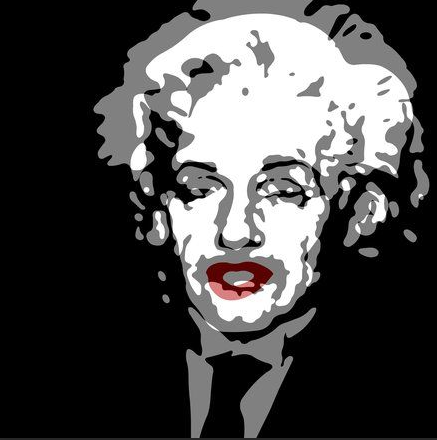
Brains and Beauty (Einstein
and Monroe), Troy Gua
Thomas Alva Edison (1890),
Abraham Archibald Anderson
You don't have to be a religious leader (like MLK Jr.), a politician (like JFK or RFK), an artist (like Jacob or Leroy), a scientist or inventor (like Edison or Einstein), a novelist or songwriter to be a dreamer.


Often, dreams lead to discoveries, breakthroughs, and even Nobel Prize winning contributions to the world. They reflect our personal values, behavior and aspirations to do good in the world.

Pablo Picasso was quoted as saying, "Action is the foundational key to all success."

Vincent Van Gogh may have said, "I dream my painting, and then I paint my dream."

I don't know who said it, but I like this quote: "Every possibility begins with the courage to imagine."

"You see things and you say, 'Why?' but dream things that never were, and I say, 'Why not?'" by George Bernard Shaw.

"Art has the power to transform, to illuminate, to educate, inspire and motivate." So have the courage to dream and share your art with others. Edgar Degas said, "Art is not what you see, but what you make others see."