Tuesday, May 9, 2023

Reflections in Art

Landscapes


Reflections (1983), Bob Ross
I found this great article about Landscape Composition: 16 Reflections. Whether it is Sisley, Turner, or Monet painting the landscape, the result is always more pleasant and serene with the addition of a reflection in water to reveal atmospheric conditions. I particularly enjoyed watching Bob Ross' TV series The Joy of Painting, especially when he'd show us how to paint water and reflections. He pulled down color using a large dry brush, then lightly dragged his brush across to soften the reflections.


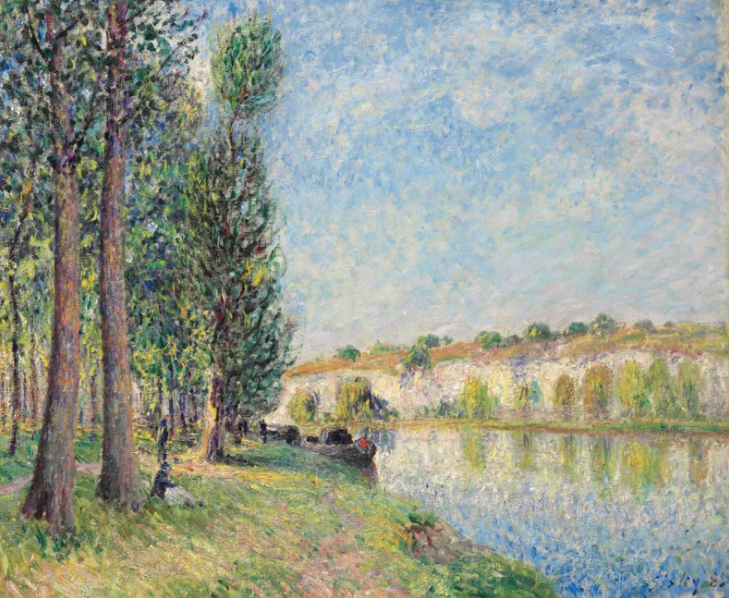
Le Loing à Moret (1885), Sisley


Impressionist painter, Alfred Sisley (1839-1899), was born to British parents in France, where he spent most of his life. His landscapes may have been inspired by the paintings of J. M. W. Turner and John Constable. I much prefer this softer work to some of his other more intricate landscapes.


Boats (1885), Sisley


While this landscape by Sisley may make a wonderful jigsaw puzzle, it makes for a very complex painting. His reflections seem to be concentrated toward the bottom, focusing on the subject boats. The clouds reflect in the water in the middle of the composition. The jetty seems to divide the painting in two.


The Studio Boat (1874), Monet

Some say that Sisley's career was overshadowed by that of Franch Impressionist Claude Monet. Monet's Studio Boat became the subject of four of his paintings. The reflections are well done. Monet has also balanced his composition by offsetting the dark boat hull with the large bank of brown autumn trees and highlighting the studio structure. Many of Monet's other works use dark purple in place of black.


The Grand Canal of Venice (1875), Manet


In Édouard Manet's Blue Venice or The Grand Canal of Venice (1875) the reflections are suggested using impressionistic brushstrokes. Like Monet's work above, Manet has atypically used black for his gondola. Everything else in the painting is bright and textured. 


Le Bateau (1953), Matisse


In 1961, Henri Matisse's Le Bateau ("The Boat") was hung upside-down at New York's Museum of Modern Art for 47 days until a patron pointed it out to a museum guard. In this simple papercut and gouache work, it was apparently difficult to distinguish between the sailboat and its reflection.


Starry Night Over the Rhône (1888), Van Gogh


Before Vincent Van Gogh painted his famous Starry Night with the swirling sky and cypress trees, he captured a moment of calm in Starry Night Over the Rhône (1888). I love the reflected lights of the city. The couple in the foreground seem to be standing in the water due to the repetition of the brushstrokes, colors, and subtle transition from water to shore.


Valley of the Yosemite (1864), Bierstadt

German-born American artist, Albert Bierstadt, painted this landscape of the Yosemite Valley in California along the Merced River in 1864. Everything about this masterpiece is amazing! I love the colors of the sky, the brightness of the sunlight reflecting off the mountains, the sliver of reflected trees in the water, and the silhouettes of the deer grazing in the foreground.


Portraits

Triple Self-Portrait
(1960), Rockwell


Some artists used mirrors in their portraits. One of the most recognizable is Norman Rockwell's self-portrait with him seated in front of a mirror and a large canvas capturing his own image three times. I enjoy seeing what he has pinned to his easel, including his own sketches on one side opposite self-portraits of fellow artists: Durer, Rembrandt, Picasso and Van Gogh. Possibly as a nod to Rembrandt, he has collected a golden helmet as a souvenir of a trip to Paris.


 'Self Portrait', from Behind Gala,
Reflected in Mirror
(1972), Dali
In 1972, Salvador Dali painted a double portrait of the artist and his muse (wife Gala). It reminds me of an interior, painted by Johannes Vermeer, with light streaming in from a window. It may also be a nod to Diego Velázquez's 1656 masterpiece of Las Meninas, where the King and Queen were subtly reflected in a mirror.

Here, we get to see both figures from the front reflected in a mirror and from the back seated. If only we could see what's on his easel! Notice how Gala's chair is downplayed in both color and value so as not to compete with the artist's chair and mirror frame.


A Bar at the Folies-Bergère (1882), Manet
Some say that the man in the upper right of the mirror is Édouard Manet himself in A Bar at the Folies-Bergère (1882). Artists often hide their self-portraits in their paintings. You don't see the back of the man at the bar because he is perhaps (Manet) the viewer of the bar scene. 

The horizontal blueish band may be the stage. The reflection of the bar itself runs behind the barmaid's hips and may be reflecting the two bottles from the lower left corner.


Girl at Mirror (1954), Norman Rockwell


Finally, here's another painting by Norman Rockwell celebrating the innocence of a young girl checking herself out in an attic mirror while reading a glamour magazine. The girl reminds me of actress Margaret O'Brien who starred opposite Judy Garland in the classic Meet Me in St. Louis ten years earlier.

Sunday, April 30, 2023

My Favorite Landscapes with Trees

Landscape with Trees (1881), Van Gogh

Vincent Van Gogh is known for his post-Impressionist works that used bright, bold colors and emotionally expressive brushstrokes. Sometimes we stumble upon paintings that seem less characteristic of a very familiar artist. Here, in Landscape with Trees (1881), Van Gogh captures this autumn scene using a more monochromatic palette than usual. Such uncharacteristic Van Gogh paintings using charcoal and watercolor wash are from 1881-86 while he was in Holland.


Cypresses (1889), Van Gogh


Perhaps more popular are Van Gogh's paintings of cypress, olive, and almond trees. I love his Starry Night and Wheat Field series painted from 1889-90, showing compositions that included pairs of iconic cypress trees. I love the familiar swirling brushstrokes in Cypresses (1889). I featured one of his very last paintings, entitled (olive) Tree Roots (July 1890), in my April 2021 post Artists Who Died Young (like Van Gogh).


Almond Blossom (1890), Van Gogh


Van Gogh often took inspiration from other artists (e.g., Millet), copying their works and making them his own. He studied Japanese art and gifted his Almond Blossom to his brother Theo and sister-in-law Jo on the birth of their son, Vincent Willem. The early Spring flowers symbolized new life. His nephew founded the Van Gogh Museum (The Rijksmuseum) in Amsterdam in 1973, five years prior to his death.


Jean-François Millet's The Gleaners (1857) inspired my Layered Landscapes art project used to teach fifth graders about perspective. In it, students drew three trees ranging in size and emanating from three hills. We chose a color scheme of analogous colors using blended oil pastels.


Two Trees (1907-8), Picasso


Perhaps I could have shown my students Picasso's Two Trees as a way of encouraging their own abilities to draw trees. Though not one of my favorites, it depicts trees using watercolors and in Picasso's Cubist style.


Blue Poles (No. 11),
(1952), Pollock
Four Trees (1891), Monet
In 1891, Claude Monet painted a series of poplar trees. His Four Trees reminds me of Jackson Pollock's Blue Poles due to the repeated shapes resembling Monet's poplars.


Chestnut Trees at Louveciennes
(1870), Pissarro
Chestnut Trees at Louveciennes
(1872), Pissarro
Camille Pissarro painted apple, walnut, and chestnut trees in his impressionistic style. Which one do you like best? I think the one on the right may have inspired one of Dali's later surrealistic works.


Swans Reflecting Elephants (1937), Dali


When teaching about Surrealism and Salvador Dali, I use his Swans Reflecting Elephants (1937) as a warm up challenge for my fifth graders. Of course, I keep the title hidden. I wonder what kind of trees Dali was thinking about when he dreamt up this scene.


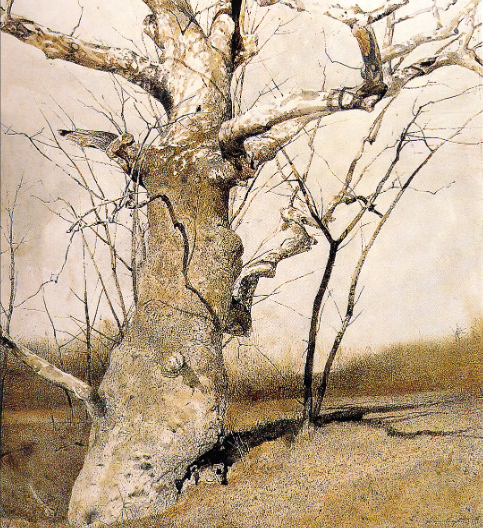
Sycamore (1982), Andrew Wyeth


This barren sycamore tree is recognizably the work of Andrew Wyeth. Wouldn't it be awesome to encounter such a magnificent and quirky tree on a walk through the Pennsylvania countryside of the Brandywine Battlefield?


Cairn in the Snow (1807), Friedrich


I also love 19th century German painter Caspar David Friedrich's (1774-1840) romantic landscape, Cairn in the Snow (1807). The subject is a pile of rocks (cairn) which is also known as a dolmen or a giant's grave (in the snow).


Capri Girl (1878), Sargent


My all-time favorite tree painting is by American portrait painter John Singer Sargent (1856-1925). It's a portrait of a favorite subject, Rosina Ferrara (a.k.a. Capri Girl), leaning on a birch tree. My daughter and I saw it on display at the Seattle Art Museum and couldn't stop looking at it. 

Friday, April 7, 2023

April Flowers in Art -- Daisies & Sweet Peas

Red April (1970), Sam Gilliam

In honor of my wife's birthday, let's pay tribute to April flowers in art. We can all appreciate the lively Spring colors in Red April (1970) by African American color field painter and abstract expressionist, Sam Gilliam (1933-2022). Often compared to Rothko and Pollock, Gilliam experimented with sculptural 3D elements in his paintings by using stretched, draped, and wrapped canvases. Another of my favorite abstract expressionists and color field painters is Helen Frankenthaler. Both Frankenthaler and Gilliam are known as lyrical abstractionists.


Daisies (1919), Matisse


Going back to the early 20th century, French artist and Fauvist, Henri Matisse painted Daisies (1919). Considered to be a double flower, the daisy is our first April flower. Matisse's vaseful of flowers contains Shasta daisies. His later 1939 version, The Daisies, depicts the more traditional wild white and yellow flowers, and there's a nude in the upper left corner, but you are free to access the link.


Girl with a Bouquet of Daisies (1897),
Jules-Cyrille Cavé


Girl with a Bouquet of Daisies (1897) by Jules-Cyrille Cavé (1859-1949) shows a young girl holding a bunch of wild daisies. I'm not sure but the floral wreath on her head may contain sweet peas, which also represent April flowers.


Vase with Daisies and Anemones
(1887), Van Gogh


While Vincent Van Gogh is famous for his paintings of sunflowers and irises, he also painted daisies and anemones. The daisies are in Vincent's favorite color yellow and prominently displayed in a beautiful turquoise vase. The textured background has Van Gogh's characteristic brushstrokes.


Drawing, Sweet Peas (1875),
Henrietta Benson Homer


Daisies are naturally resistant to many plant diseases and pests. Like daisies, sweet pea leaves contain antifungal properties. Here's a drawing of sweet peas by Henrietta Benson Homer (mother to Winslow Homer). I wonder if Mamma Homer ever tried doing embroidery or cross stitch. 

My brother and I used to draw wildflowers using pen-and-ink and watercolors. As a kid, I remember watching Popeye and occasionally seeing him follow around his troublemaker foundling son, Swee' pea. Like other characters (Wimpy, Poopdeck Pappy, and Sea Hag) in E.C. Segar's comic strip Thimble Theater, he only made rare appearances.


Freya (November 2022)


In Norse mythology, the daisy is considered to be the sacred flower of Freya, the goddess of beauty, love, and fertility. My wife's sister has a beautiful dog named Freya. Here's a photo of her that I captured this past Thanksgiving. I love how the beautiful pattern in her fur repeats in the striped fabric of the sofa.

Symbolizing innocence and purity, an old Celtic legend says that God sprinkled daisies over the earth to cheer the parents up, after the death of an infant.

Daisy, from the comic strip Blondie, was the Bumstead's Cocker Spaniel/Poodle/Terrier.


The Madonna of the Carnation
(1478), Leonardo da Vinci


In the 19th century, parents would encourage their children to get up after a fall by saying, “ups-a-daisy”. My Nana would have said, “oopsy daisy” or “whoops-a-daisy”. My wife has received lots of encouragement from family and friends during her recent illness. Her favorite flower is the carnation, which has become a symbol of motherly love. Christians believe that they grew from the Virgin Mary’s tears as she watched Jesus carry the cross.

I hope you've enjoyed this tribute to my wife, April flowers, and the artists and artworks that celebrate them.

Wednesday, March 29, 2023

Praying Hands in Art -- A Dedication

Praying Hands (1508),
Albrecht Dürer


Before I ever asked her out on a date, my wife was working upstairs from my office in a data library behind Dutch doors. When I approached her desk, I immediately noticed a picture containing praying hands, so I asked her if she was a 'religious girl'. Upon further inspection it turned out to be a poster about being left-handed. Some icebreaker! In any case, my question, while puzzling, didn't scare her off.

Hands (and feet) are among the most expressive and challenging features of the body to capture. Let's explore more art dealing with praying.


An Elderly Man in Prayer
(1660), Rembrandt


The second painting shows An Elderly Man in Prayer, painted by Rembrandt. I love the overall texture of the somewhat monochromatic portrait, capturing the old age and beard of the subject. The softness and subtle treatment of light is less like a Rembrandt and more like a Degas.


The Angelus (~1857), Millet


The Angelus by Jean-François Millet shows a peasant couple praying over the grave of their dead child. This painting was studied and copied by Vincent Van Gogh. It may be seen in Paris at the Musée d'Orsay.


The Prayer (1882), Van Gogh


I've used The Prayer by Vincent Van Gogh in my pastels class for the portion where we use a limited color palette. I was inspired by a reproduction that my niece has in her dining room.


Grace (1918), Eric Enstrom


Similarly, Swedish-born American photographer, Eric Enstrom famously captured a photograph of Charles Wilden praying in 1918. It became the Minnesota state photograph in 2002. I love this because my wife was born in the 'North Star State'. You can see the story in the article, The story behind Minnesota’s official state photograph.


Drawing Hands (1948), M.C. Escher


I love the graphical illusions created by M.C. Escher. Although not praying, these hands are interesting and recognizable, and a standout example of his wonderful works. It's a drawing of a drawing.


Three Girls Praying (2015), Mccabe


I found this portrait of Three Girls Praying (2015) by Pamela Mccabe. It is reminiscent of the illustrations of Norman Rockwell. It makes me think of all the people who are praying for my wife as she (and our family) navigates through a tough illness.


While I don't know who painted this beach scene, the subjects remind me of my wife, her sister, and one of her two brothers. I'm dedicating this post to my wife as our family and friends pray for her recovery from a long and serious illness. I hope these images inspire you to pray for someone who needs it. Maybe it will inspire you to use art as a way of dealing with whatever life throws at you.

Friday, March 10, 2023

Recent Artwork -- Acrylics & Watercolors

J.P. at Bat (2023), Patterson


While vacationing in Palm Springs this year I completed two more paintings, one acrylic and one watercolor. The first is a portrait of Mariner shortstop, J.P. Crawford, last season's leadoff hitter for the Seattle-based baseball club. It was so well-received on Facebook that one of our long-time friends wants to buy it for her avid baseball fan husband.

During one of the ALCS playoff games, I captured an image from the TV, then painted it using acrylics. The forearm tattoo was challenging, and I am very pleased with how well the background fans turned out.


Benny and Moana (2023), Patterson
My friend from the Palm Springs City Dog Park commissioned me to do a portrait of his two dogs, Benny and Moana. I had planned to get a large canvas and use acrylics, but instead I decided to use 11"X15" watercolor paper and watercolors. My style has always been to build up layers of paint rather than using washes. I ended up gifting the portrait (unframed) to my fellow dog park patron. Per my research it was going to cost him ~$50 to purchase a matted frame, and I left it up to him to find one that he liked.


Chihuahua (unknown)


In the Airbnb where we stayed there was a large portrait of a dog hanging in one of the bedrooms. The artist chose to use bright, non-traditional colors for this abstracted version of a chihuahua. Someday I will try my hand at alternative color schemes.


Jeju & Bryce (2022), Patterson

I did try woodburning last year in my portrait of Jeju & Bryce. Shading is accomplished by using different sized tips and varying both the pressure and length of time on the wood surface. Hopefully, I didn't ruin the tip by dragging it along the surface. Most of the class chose to do mountain landscapes with black silhouetted evergreen trees. I suppose those scenes made for more useful charcutier boards!


Sketch + Dogs
Lake Sawyer Dogs
(2022), Patterson


You may remember my other portrait of our pets captured in this beautiful Lake Sawyer landscape from last February. I began the portrait in a Zoom class put on last year by PawsWithCause as a training for its volunteers. I was inspired by late TV painter, Bob Ross and his happy little bushes and trees.


Lilly (April 2022), Patterson


In April of last year, I painted a portrait of Lilly, a greyhound mix from a local animal shelter in Kirkland, Washington. My niece loved it enough to purchase it as a donation to PawsWithCause. She planned to display it on her desk at her office. I love the glassiness of her eyes and all the colors of her fur. The muted primary colors of the collar and background also work well in the composition.


Puzzles for PawsWithCause


I used a laminated print of the portrait in a puzzle I made for kids attending one of our farmers markets.


Lakeside Castle (2022), Patterson


Inspired by a landscape by one of the students who attended my September 2022 acrylics class at Franke Tobey Jones' Senior University, here's my very first attempt at using Paint3D on my desktop PC. It was particularly challenging to use a mouse on a PC instead of a stylus on a tablet.


View from Cedar Butte (2022), Patterson


Then, in October of last year, I recreated this painting of the view from Cedar Butte trail using Paint3D. Eventually, I will purchase a tablet and stylus, and try my hand as portraits instead of the less precise use of a mouse.

Friday, February 10, 2023

ART - Controversial and Misunderstood

Point of Origin (1978), John Mason 
For this my 150th post, I want to take a more critical look at what we consider to be ART and why we create it. In my travels I've seen lots of 'art', whether it be famously hung in a museum or spraypainted on city walls. My July 2020 Art of the Pacific Northwest series explored the art of six NW cities, including commissioned works such as sculptures and murals as well as some museum pieces. This geometric steel sculpture currently stands on the lawn outside the Boise (Idaho) Art Museum. Though simple and repetitive, the shapes allow us to frame the surrounding scenery and the metal captures reflected light and shadows.

White Paintings (1951), Rauschenberg
Sometimes 'simple' makes sense but often the observer is left wondering why it is considered 'art'. Though I can understand and appreciate the collages of Robert Rauschenberg, I've never grasped the significance of his multi-paneled White Paintings of the 1950s. I get that it's challenging to paint a consistently unified color field absent of visible brushstrokes, but to repeat it multiple times doesn't seem interesting. And when they're displayed on white walls...nothing's there to see.


Fountain (1917), Duchamp
Just as confusing is Marcel Duchamp's Fountain (1917). He simply flipped a 'readymade' urinal onto its back and wrote a strange nom-de-plume on the side. Apparently, his use of an everyday object later inspired the Pop and Op Art movements. I think it was in Copenhagen at a brewery where I saw urinals made out of beer kegs. Apparently, functional objects are not considered objects d'art.

You may recall Campbell's Soup Cans (1962) by Andy Warhol. When I was a child, my dad took his 3 boys to Bermuda and my mom made us wear shorts with the soup can pattern. Wearable art?!


On our 2017 trip to Palm Springs, the local art museum had a sculpture of a composition of trash bags. I guess you can make art out of anything, though I'm not sure this was recycling. The arranged 'trash bags' were almost cubical and covered in a shiny, wrinkled dark brown medium. Though surprising, it left me wondering how the sculpture was made and trying to find beauty in what my eyes saw as a pile of trash or glistening poop. Maybe it's a box of chocolates!


Roadkill, Andrew Wyeth

When we see a sunset or a mountain landscape, we call it beauty, but when we paint (or photograph) it to share with others it becomes art. Animals also use beauty to get a reaction (from potential mates) much like artists from their observers. Andrew Wyeth used actual blood in a study of a dead squirrel for his painting Roadkill. You wouldn't know that unless you read his autobiography. The strong diagonal line seems to divide the painting in two.


Triptych Bleu I, II, III (1961), Miró
We create art to capture beauty or historical events for communication, memory recall and visualization, leading to education and understanding. Artists do it to make a statement, translate an emotion, or start a movement such as Surrealism or Abstract Expressionism. While I am personally a fan of Joan Miró, his blue works are only slightly more impressive than the Rauschenberg works in white. They become art solely because the artists intended them to be art.

Often artwork is judged or rejected and may be interpreted as controversial. Differences of opinion are expected when viewing works of art. Understanding why you like art or don't is part of the experience. Sometimes seeing it in person makes you appreciate it more, especially when exhibited as the artist intended.


An Allegory of Virtue
(mid-1520s), attributed to
Antonia Allegri


I am also puzzled by art curators who exhibit unfinished paintings, such as The Athenaeum Portrait of George Washington by Gilbert Stuart. I suppose that it preserves the historical portrait as Gilbert's model for the rest of the images of our first President and the likeness of him on the dollar bill. There are many unfinished artworks out there, although I've only seen one of them in person at the Scottish National Gallery. This shows us how some artists work on sections of a painting at a time. I understand if the subject or artist dies before completing a painting, like Gustav Klimt, who left several unfinished works upon his death in 1918 from pneumonia (due to the Spanish flu). 

Check out the Met's article, Unfinished: Thoughts Left Visible, for examples of incomplete works intentionally or unintentionally left unfinished.


Le Bateau (1953),
Henri Matisse


It's particularly telling when museum personnel are unable to determine which end is up, as with Henri Matisse's Le Bateau (1953) which hung for 47 days at the Museum of Modern Art in 1961. It took a museum patron to pose the question as to whether it was upside down. Imagine how many people viewing a work of art would agree that it's actually 'art' and further that it's 'good'.


Fat Car (2001), Erwin Wurm, PSAM
When an artist or artisan produces something 3-D like a car, (to me) it isn't as impressive as sculpting a figure. It's like when the motion picture academy nominates an ailing old musician for playing one. Where's the challenge? Some art installations are meant to impress us by virtue of their size or shock value, but you wouldn't display them in your home. It's fun to visit an art gallery and see the variety of art exhibited there.