Thursday, November 24, 2022

Famous Artists & Paintings -- By Century

The Arnolfini Portrait (1434), van Eyck
15th Century

In this article, I'd like to review famous artists and their paintings, starting with the 15th century, highlighting my favorites. Earlier art primarily focused on religious subjects which, though ornately detailed, was pretty homogenous. Let's start with a work by Jan van Eyck, whose Arnolfini Portrait was included in my Avatars, Doppelgangers, and Lookalikes post. One of the most recognizable paintings of the 15th century, this double portrait also captures the couple's reflection in the convex mirror hung in the background. I saw it in person at the National Gallery of London in 2017. Van Eyck was considered an innovator, some saying that he created oil painting.


"Salvator Mundi" (1500), da Vinci


16th Century


At the beginning of the 16th century, Leonardo da Vinci painted this classic portrait that eventually sold for $450.3M. It was supposed to be on display at the Louvre Abu Dhabi in 2018, but it has yet to be seen in public. See my June 2020 post, entitled Encouraging Artistic Expression, for more details. His other more famous portrait, Mona Lisa, was painted during the same period. I saw her at the Louvre in Paris in 2011. His Madonna Litta was painted toward the end of the 15th century, residing at the Hermitage in St. Petersburg, Russia, where I visited in 2019.


The Hunters in the Snow (1565),
Pieter Bruegel the Elder


Later in the 16th century, Flemish painter Pieter Bruegel the Elder created The Hunters in the Snow. A large print of the landscape hung in my father's office at Price Waterhouse in NYC. It has always been one of my favorites! I love the cool teal color of the sky and frozen river. It's also a wonderful example of the use of perspective to create depth and the illusion of space.


The Saviour of the World
(1608-14), El Greco


17th Century


Moving to the early 17th century, we see El Greco's version of the Christ. The blessing gesture is similar to that of da Vinci's portrait, including the hand on the orb representing the world, although the color scheme is much more modern. I like the use of contrast, especially accentuating the face and the halo effect.
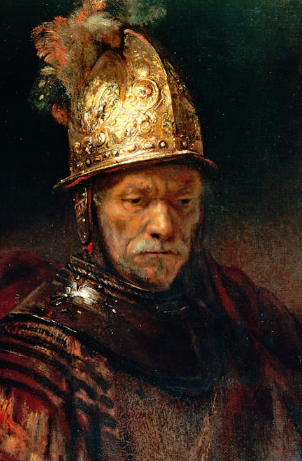


The Man in the Golden Helmet
(1650), Rembrandt


The mid-17th century paintings that I've chosen are three of my all-time favorite portraits. I do seem to gravitate towards portraits. Rembrandt is famous for having painted the most self-portraits though I love The Man in the Golden Helmet. It also inspired my work nickname 'Gelmet' which my co-workers gave me because of my gel hairdo. I often found people staring at the top of my head, much like how museum patrons might focus on the helmet in this painting.


Las Meninas (1656), Velázquez


There's something about this amazing family portrait by Diego Velázquez. To find out more, see my August 2020 post entitled Things That Go Together in Art – Subjects, Portraits, Landscapes/Seascapes, Still Lifes, and Couples. It does appear to have all the detail in the lower half of the painting, but it seems to work!


Girl with a Paearl Earring
(1665), Vermeer


This classic by Johannes Vermeer is known as the 'Mona Lisa of the North' probably because of her mysterious identity. Vermeer often employed blue and yellow in his detailed portraits, usually of women.


The Blue Boy (1770), Gainsborough

18th Century


Thomas Gainsborough and Sir Joshua Reynolds were rivals for the position of Painter to the King. On our trip to the UK in 2017, their paintings were curiously hanging side-by-side in one of the national galleries. Growing up in New Jersey, my next-door neighbor had a red sitting room where a copy of Gainsborough's Blue Boy was hung. One of the houses we rented in Port Townsend's Fort Warden had needlepoint versions of Blue Boy and Pinkie (by Thomas Lawrence) hanging side-by-side. The pair, often seen together, also appears in episodes of Leave it to Beaver just inside the Cleavers' front door entry.


The Age of Innocence (1788), Reynolds


I use portraits from Sir Joshua Reynolds and Gilbert Stuart when I do my wrapping paper self-portraits project with fifth graders. Included in one of the packets provided by Interurban Center for the Arts was his portrait of Lady Caroline (1778). The girl in this painting is unknown but is likely Reynolds' great niece.


Athenaeum Portrait
(1796), Stuart


It's unusual to find unfinished paintings on display in galleries and I've only ever seen one of them. I find it interesting that Gilbert Stuart intentionally kept one of his first portraits of George Washington unfinished to use as a model for later works. Martha Washington admired it, but Stuart refused her and painted another one instead.


Cenotaph to the Memory
of Sir Joshua Reynolds
(1833-6), Constable


19th Century


Another painting I saw at the National Gallery in London is John Constable's homage to Sir Joshua Reynolds. I enjoy seeing artwork in person, especially when it's something I've studied in school or researched for my blog or one of my classes. The stag is meant to represent the wild locale of the monument, which in actuality would have been smaller than a full-sized deer. It's up to the artist to create the focal point and provide it the proper emphasis.


Tiger in a Tropical Storm (1891), Rousseau


Here's another diamond in the rough from the National Gallery in London. It's a landscape by Henri Rousseau that could be perceived as a portrait of a tiger. Crouching tiger but no hidden dragon!


Les Oliviers (1889), Van Gogh
Of course, my all-time favorite artist has to be Vincent Van Gogh. It's difficult for me to choose a favorite. While doing research for this blog I continue to discover new (to me) Van Gogh paintings. For example, I saw this one at the Scottish National Gallery in Edinburgh. Like Van Gogh's Sunflowers, olive trees were another of his favorite subjects to paint.


I love the paintings of the French Impressionists, but there are too many for me to down select for this blog post. I also love the paintings of Henri Matisse and Marc Chagall. I highly recommend visiting their museums in Nice, France.

Capri Girl (1878), Sargent


Let's finish with the 19th century artists/paintings by including John Singer Sargent's portrait of Capri Girl. My daughter and I saw this work while briefly on exhibit at the Seattle Art Museum and we immediately fell in love with it. She appears to be leaning against the branch of a tree and gracefully becomes part of nature. Her bodice and hair blend into the dark background and her skirt disappears into the flowery field. She was a favorite subject of the artist.


Christina's World (1948), Andrew Wyeth
20th Century

My favorite artists of the 20th century are Salvador Dali, Pablo Picasso, Edward Hopper, Jacob Lawrence, Norman Rockwell, and Andrew Wyeth. Since we're primarily showcasing portraits here, and as a transition from Sargent's Capri Girl, I'm including Christina's World by Andrew Wyeth. His wife Betsy modeled for the painting inspired by the Olson (~30-yr-old) girl he saw crawling in the field.


President Obama (2018), Wiley


Kehinde Wiley is probably the best known African American portrait painter of the 21st century, although Simmie Knox was the first to paint the portrait of a President (Bill Clinton). I had the opportunity to see Wiley's paintings on exhibit at the Seattle Art Museum. I also got to see Jacob Lawrence's Migration Series, which was impressive but on a smaller scale than the large decorative works of Wiley. His intricate backgrounds are beautiful! While Lawrence used colorful shapes to build his symbolic compositions, Wiley used colorful patterns to surround and highlight his subjects.


So, who are your favorite artists? Your favorite painting? I find that I often choose to listen to the B-side of a record, straying from the more popular featured song. I also enjoy hearing the more obscure and less played selections (e.g., of Tom Petty songs) just as much as seeing newly discovered works by my favorite visual artists. As with music, you learn to love and appreciate many genres, though you will likely gravitate towards your favorites.

Sunday, November 13, 2022

Mona Lisa -- Mysterious Enigma, Misunderstood Masterpiece?

Mona Lisa (1503-06), da Vinci

While Leonardo da Vinci's Mona Lisa is perhaps the most famous painting of all time, attracting tens of thousands of viewers each day at the Louvre in Paris, it is also one of the most misunderstood artworks. Initially, the 3/4-view portrait of the supposed Italian housewife was copied by artists who admired it for its realism and "subtle gradations of light and shadow" (sfumato) employed by Leonardo. The imaginary background is also admired for its smoky quality, making it both landscape and portrait. Viewers are more taken in by her 'smile'.

Da Vinci produced the small portrait of an ordinary woman whom scholars identify as Lisa Gherardini, wife of the Florentine silk merchant Francesco del Giocondo. She is wearing a veil which is difficult to make out amidst the rest of the dark shades employed in her hair and costume. Other paintings of Florentine women typically show more opulent dress including jewelry and rosy cheeks. The subtlety of expression and apparent lack of eyebrows make her less interesting, though more mysterious, than her contemporaries.

LHOOQ (1919), Duchamp

It wasn't until its theft in 1911 that the painting began to increase in popularity. Even when I visited the Louvre a hundred years later, people crowded around a small window to view it deeply shrouded inside a secured chamber. Get ready for disappointment!

Perhaps it was Marcel Duchamp's kitschy mustached reproduction, mocking her as 'the ideal of feminine beauty', that reinvigorated its post-war popularity. My March 2020 post about Shamrocks, Bowler Hats, and Irish Artists shows Lisa wearing a bowler hat. I guess it's the mystery behind the painting, its theft, and the desire to see the real painting amidst all the reproductions that fuel the attraction. See more in the article, "Why is the Mona Lis so Famous?".

Girl with a Paearl Earring
(1665), Vermeer


Personally, I much prefer Vermeer's Girl with a Pearl Earring, also known as the 'Mona Lisa of the North' or the 'Dutch Mona Lisa'. A young Scarlett Johansson portrayed the subject (Griet) in the 2003 movie. A little publicity for the northern version!


The Cast of Mona Lisa Smile (2003)


Although I've seen several movies depicting Leonardo da Vinci as a character, I've yet to see one about his Mona Lisa. Curiously, there is the 2003 movie entitled, Mona Lisa Smile, which starred Julia Roberts as an educator, along with three other beauties. And a 1986 British crime-drama movie called Mona Lisa about a call girl.


Tomei as Mona Lisa Vito (1992)


In My Cousin Vinny (1992), Marisa Tomei costars as Mona Lisa Vito, the spunky and obstinate fiancée of Joe Pesci. Even the name of the famous portrait subject gets reused, perpetuating the title and its worldwide recognition! Let's not forget the song of the same name recorded by Nat King Cole in March of 1950.


So, would Mona Lisa be as famous without the somewhat anonymous name, enigmatic expression (the smile), theft attempts, or admired painting techniques? Maybe the mystery itself is what attracts us to it!

Monday, October 31, 2022

Pumpkin Carving 2022

My Cheshire Cat (2022), Patterson

More and more I enjoy pealing the skin off a pumpkin to create layers of value for my jack-o-lanterns. The deeper you go, the lighter that area becomes. Completely cutout areas will be bright yellow, while the uncut (skin) areas will have the darkest value. A bonus feature of these shaded pumpkins is that they look good (unlit) in the daylight.

Here's my Cheshire Cat pumpkin. It looks much better with the ears punched through. I also love how leaving the skin around the eyes, nose, and mouth creates an outline, further emphasizing those features.

I carved triangles and diamonds in the lid and on the back side to create chimneys to allow heat to escape. If you carve your lid somewhat symmetrically, then you can rotate the lid to allow for ventilation.


Frankie (2021), Patterson

My favorite pumpkin from last year has to be my Frankenstein head. The lid made for great looking monster hair. By cutting slits in the top edge of the opening the hair was further reflected onto the face, and a larger slit created a gash for a scar. Sometimes the best carvings result from an inspiring pumpkin shape. I didn't need to carve ears, but I did use small scraps and toothpicks to create the electrodes on his non-existing neck.

If you are going to attach ears to your pumpkin, simply cut out an oval shape (or ring) then rotate it and reinsert so that the light can highlight it from both front and back. Notice also how the eyelids are suggested with skin as the outline, while the facial accents are again slits carved all the way through. No shading required!


Every year I search the web for ideas. My Cheshire Cat was inspired by a picture of a pumpkin carving that I found online. The hard drive of my desktop PC before I could get a copy of it on my printer. I also lost MS PowerPoint where I had stored the image. My wife's printer cut off part of the image, so I improvised. I had to figure out how to make the mouth using small triangles on the bottom and larger ones on the top. Everything was carved freehand without using any markers for laying out the lines. For Frankie, I used a photo of a drawing of the monster then made my own inspired design.

Harry (2022), Ken Patterson

I carved a Harry Potter face this year. The example I found has some wonderfully jagged lines and uses peeling for most of the face. The deepest cuts are for his scar (from he who will remain nameless), his eyes, ears, and at his temples. Surprisingly, it only took ~1 hour to complete. I ended up scraping the entire face later but forgot to leave skin for the dark eyebrows. I pushed straightened paperclips through the flesh (from the back) to attach pieces of pumpkin skin above the eyes. Now it looks much more like the young wizard instead of a creepy Chucky doll. It will look even better with glasses made out of wire. The black dots in his eyes are black-headed straight pins. I'm thinking of adding large green sequins for the irises. The entire look is growing on me. It looks better when viewed or photographed from above.


Daytime Harry (2022)


Here's how Harry looks during the daytime and with wire spectacles added. I also added some orange pumpkin sequins (couldn't find green) for irises.


Martha Stewart pumpkin & Mr. Bill

Our pumpkin carving party with the family was a great success. We served pizza and pumpkin pie and take-home caramel apples. We texted photos of our jack-o-lanterns to family members not in attendance and asked them to guess who carved which pumpkin. We also watched the Seahawks beat the NY Giants. Here are two cookie-cutter creations.


Traditional Jack-o-Lanterns


The next two are pretty traditional jack-o-lantern faces. They were carved free hand except for the mouth on the one on the left. He used a cookie cutter shape and repeated it to make the mouth. My sister-in-law got creative and made hair for her pumpkin by carving away the skin and some of the flesh. I like her skeleton nose complete with nostrils.


Symmetric Pumpkin & Chewbacca the Wookie

My sister-in-law's husband decided to carve his second pumpkin by reusing the same cookie cutter for the eyes and mouth. There was lots of hammering going on in order to get the cuts to go most of the way through the flesh. He even inverted the tool to get symmetry in the face. I chose to carve the head of Chewbacca the Wookie from Star Wars, although he could also pass for the Sasquatch.


The Mandalorian (2022), Ken Patterson


We grew two pumpkins this year but didn't carve them. I used another store-bought pumpkin to carve the Mandalorian helmet. It was challenging to carve a black and grey helmet with only little shiny spots on the metal shapes. The deepest cuts were for the eyes and the outside defining the ears and left and right sides of the helmet.


Since my daughter chose not to participate, and her uncle brought a green pumpkin, I carved Grogu ('Baby Yoda') from the Star Wars Disney+ television series The Mandalorian.


Three of the most challenging for me. Mandalorian actually looks best in darkness (below). I love how Baby Yoda looks at twilight (right). Tonight, a 9-yr-old girl told me how much she admired my pumpkins. And she recognized the Wookie! She was definitely a Star Wars fan!!


Here's a photo of my pumpkins all lit up on Halloween night!

Tuesday, October 11, 2022

My Inspirations for Creating Art

From Fox broadcast at Field of Dreams (8/12/21)

Lately, I have been inspired by what I see on social media, TV, commercial ads, and of course movies. I've even captured images from what is being displayed on my TV using my cellphone. It's overwhelming how many photos I've conveniently stored there. I wonder how the old masters would have used the technology and media of today to capture, store, and manipulate images more readily and without spending hours observing, sketching, and drawing what they saw. Of course, they had to rely much more on their own imagination, models, painting outdoors from nature, and the work of other artists for inspiration.

Paint 3D Landscapes
by Jon Patterson


Producing art can be its own inspiration. Practicing and experimenting with techniques and media provides new ideas and develops new skills. I'm constantly reading, consulting my own library of art books, researching topics and artists online, and journaling about future art posts. I find that my art colleagues and my own brother produce much more art than I do, which inspires me to create more art. I've already completed five new works using Paint 3D. And I'm working on an acrylic portrait of one of my favorite baseball players.


Ballet (after Degas)
Ken Patterson


While planning and preparing to teach art to others, I often get inspired to create my own examples for my students or pull images from online sources. For my pastels class, I tried my hand at reproducing a Degas painting as a way of employing many of the techniques I was intending to share with my students.


Bryce and Friends (2021), Ken Patterson

I am also inspired by things in my own life, including of course my pets. I look forward to our annual trip to Palm Springs and our visits to the California dog parks along the way. Here is a pastel version of a photo I took of my dog and two of his new dog park friends. The gravel surface gave me an opportunity to play with color and texture with a nod to impressionism.


Castle Landscape (2022), Ken Patterson


Sometimes my inspiration is a combination of an example I provided for a class, its rendition created by a student, and the challenge to recreate it in Paint 3D. I included it in my latest 'How To' post.


View from Cedar Butte (2022), Ken Patterson

Probably my favorite source of inspiration is nature. While I love doing portraits, I am learning to love painting landscapes, especially from photos. I plan to do more of these using some of my daughter's photos captured during her visits to Italy and adjacent countries. On our recent hike of the Cedar Butte Trail, I photographed the view from the top and painted it using Microsoft Paint 3D. Pretty good, considering I used a mouse on my desktop PC!


Milo Redwood & Studio


The work of other artists has inspired me in many ways. It inspires many of my blog posts. It's been fun for me to interview local artists and learn what inspires them. I often chat up artists when visiting their studios. I'll even engage with museum curators or volunteers to find out more about specific art exhibitions.


Son of Man (1963), René Magritte


Movies can be another source of inspiration and it's fun to watch for famous art being used in the background sets. I've blogged about that too, as far back as March 2020 with my Movie Art Cameos post. "The Thomas Crown Affair" uses the Metropolitan Museum of Art as a backdrop for its romantic art caper. In it, you will see works by Édouard Manet, Claude Monet, Camille Pissarro, Pablo Picasso, and, of course, René Magritte's "The Son of Man".

The photography can also be pretty impressive. Many of my brother's paintings were done using professional photographic compositions created by my sister-in-law.


So, what inspires you? Living with intentional observation, reading, journaling, sketching, drawing, taking photographs, taking art classes, visiting museums, and experiencing nature will enrich your life and may make you a better artist. If nothing else, it will allow you to appreciate life and share it with others.

Sunday, September 25, 2022

Painting Using MS Paint 3D -- How To

Gaylord, Michigan (2022), Jon Patterson

For a while now, I've been posting my brother's artwork that he masterfully accomplishes using Microsoft Paint 3D. It usually requires a tablet and stylus to adequately control the brush strokes using the tools. Unfortunately, the devices available to me are either PCs or Android tablets, so I will need to eventually purchase a MS Surface. Here's the latest painting by my brother. It was inspired by a Fall 2007 photograph my sister-in-law took in the northern part of the lower peninsula of Michigan. It's his third oil brush painting.


He did use the marker tool for very fine lines like the fencing in the background as the oil brush tool's smallest stroke width was too wide. He also used the watercolor brush to blend colors here and there. You'll find that it takes lots of practice to do blending with this tool.


So let's explore the modern world of digital painting! We'll start with a simpler portrait of a cat named Hopper using a photo from South County Cats that we use for PawsWithCause, the non-profit where I volunteer my time in retirement. When we sketch a shelter animal on a canvas for someone else to paint, we typically use Paint 3D to eliminate the background, isolating the animal itself. You may also use Photoshop to accomplish the same thing. This will allow you to lay down any shade you want (using the paint bucket tool) and then add details over it (sort of like underpainting).


My brother used Photoshop to make a transparent background with the cat at 40% opacity, and a second file has the cat at 100% opacity. Sometimes it's easier to color over if the subject is not so bold as 100% opacity. Hopefully at 40% opacity you can still make out the details, but you may also reference the original photo of your subject for the colors, shapes, and shading.


You'll have to overlay color to get a blended effect. But if you use the degree opacity -- which you can set for 7 of the 10 drawing tools -- you can sort of achieve a blended effect. Also, try different shades of a similar color to get the effect you want; i.e., make the overlay color have a hint of the "under" color by sliding along the rainbow color bar. I like the way the shag carpet came out in my background. Don't worry about getting every little detail purr-fect. You are allowed to edit. Since this is my first attempt, I tried nearly every type of brush (even the spray can) available with the tool.


Original Photo of a Painting

Although I am still limping by with a mouse, I decided to jump right into a more complicated landscape. I chose one with lots of color and appropriately Autumn leaves. It was a photo of a painting that I supplied for inspiration during my recent Acrylic Landscapes class at Franke Tobey Jones' Senior University in Tacoma, WA. I decided to do my painting free-hand from this photo.


Acrylic on Canvas


And here's an interpretation done in acrylic on an 8"X10" canvas by one of my students. Note how she chose to make the castle the focus of her painting. She listened to my tips and tricks, used a modified color scheme, edited out the mountain, and created her own composition.


Let's get started with my Paint 3D version and set the size of our canvas. For an 11x14", set the height at 2200 pixels and the width at 2800 pixels. For an 8x10", set the height at 1920 pixels and the width at 2400 pixels. For a square design, it may be ~2500 x 2500 pixels. The higher the pixel number, the higher the resolution (and the bigger the file size). Since you set this in Paint 3D, for a Paint 3D PROJECT (and not an image you are importing), the numbers apply to the whole project (if that makes sense).


The first painting step is to lay down the zones of color in the background, using broad (20-50 pixel setting) brush strokes, to serve as our underpainting. My brother recommended using primarily the oil brush tool for this painting.


Mine is a bit more detailed because I wanted to leave a space for the clouds and castle shape. The trees will eventually show through to the background, so I extended the dark gray shape to the right. It may be important to write down the RGB color codes you choose in the event you want to return to them later (e.g. for the pond reflection). Of course, you can rely on your eyes for choosing colors.


Most of the rest of the painting can be done with the oil brush set for narrower strokes (25 pixels or less). Experiment! Remember you can always hit the “Undo” button if you don’t like it! The “Undo” button can erase a seemingly unlimited number of previous strokes. While I was using a mouse, I noticed that I had to lift it up regularly, so that I didn't Undo large areas. This is especially true when scribbling in the clouds!


I used the marker tool to begin playing with the trees. Since I don't have to wait for paint to dry, I am able to freely move around and add overlapping details. I did some of it with the watercolor brush and even tried the spray can tool on the shadowy grass in the foreground (in later steps).


This picture has lots of colors in it, so I chose multiple shades of yellow, orange, green, etc. And remember, when you’re in “yellow” mode, you can slide that rainbow color bar toward orange if you want it more orange, or toward green if you want it more green. This is pretty much the final state of this painting. I like how my colors are brighter than the original. I probably could have made the grassy area in the foreground more vivid, but I was mainly playing with the tools.


Here's the final painting. Notice how the sky has been softened using a combination of watercolor strokes and the spray can tool. The horizon line has also been blended. I added in grass using the marker tool to give a bit more detail to the foreground. For my next challenge, I may try painting a dog.


Here's a kitschy painting of my 1-yr-old Shih Tzu masquerading as a Star Wars Wookie, Chewbacca. I call it Chewbailey.


Here she is dressed as an organ grinder's monkey. Her paws are raised above her head as if she's putting on the fez.


After hiking the Cedar Butte Trail in North Bend, I was inspired to capture the view from the top using my PC mouse in Paint 3D. Similar to the above landscape, I laid down bands of color for the sky using the oil brush. Then I worked on the purple mountain and the lower valley. After softening/blending the sky, I used the watercolor brush and spray can to create a sort of haze. I finished by drawing in the trees using a combination of the marker and other tools.